
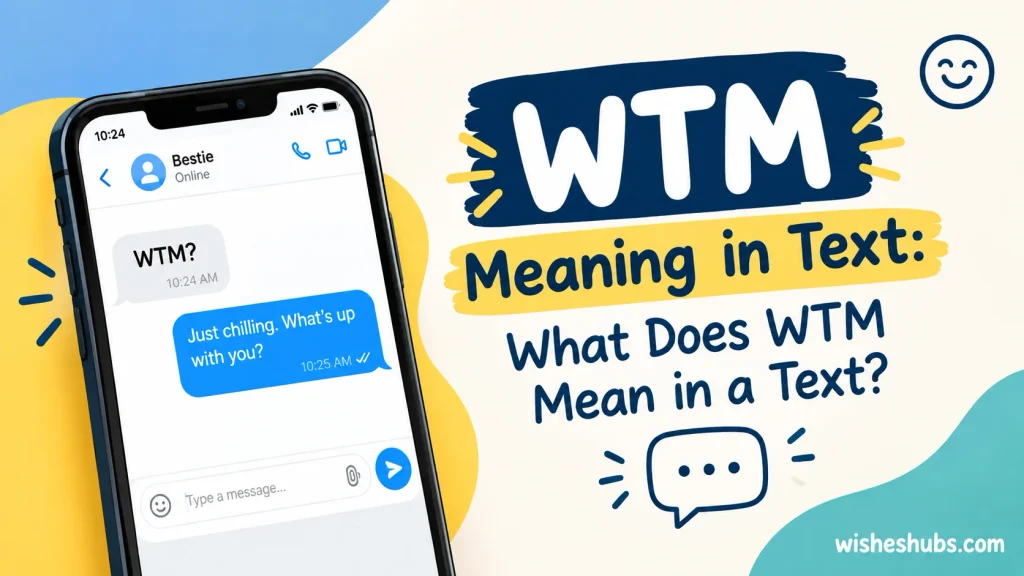
Have you ever received a text saying “WTM?” and wondered what the sender actually meant? This short abbreviation appears frequently in casual conversations, group chats, and social media messages. If you’re unfamiliar with texting slang, those three letters can feel surprisingly cryptic.
In most casual conversations, WTM means “What’s the Move?” People use it when they want to know the plan, ask what’s happening next, or figure out what everyone wants to do. It can fit anything from a spontaneous night out to a simple question about weekend plans.
The phrase sounds more natural when you understand the idea behind “the move.” Here, “move” doesn’t usually mean physically moving somewhere. Instead, it refers to the next plan, activity, decision, or action. Think of it as asking, “What’s the plan?”
Context still matters, though. Text abbreviations can carry different meanings in different settings. The surrounding conversation, relationship between the people, and topic being discussed can help you understand exactly what the sender intends.
Quick Answer: What Does WTM Mean in Text?
WTM usually means “What’s the Move?” in text messages.
People use WTM to ask about plans or the next thing to do. It commonly appears when friends are deciding where to go, what to do, or whether they should hang out.
For example:
Friend: “WTM tonight?”
You: “Let’s grab food and catch a movie.”
In this example, WTM essentially means “What are we doing tonight?”
The abbreviation is casual, conversational, and common in texting and social-media communication. It isn’t generally suitable for formal emails, professional messages, or academic writing.
What Does WTM Stand For in Texting?
WTM stands for “What’s the Move?”
The phrase asks someone about the current plan or intended next step. It’s especially useful when plans haven’t been finalized yet.
For instance:
“I’m free after 8. WTM?”
The sender isn’t asking where you should physically move. They’re asking what you want to do.
You might answer:
- “Let’s get dinner.”
- “Want to hit the gym?”
- “We could stay in and watch a movie.”
- “Not sure yet. What are you thinking?”
The beauty of WTM lies in its flexibility. A single three-letter abbreviation can open the door to an entire conversation about plans.
Is WTM a Texting Acronym or Slang?
WTM functions as an informal texting abbreviation. It belongs to the broader collection of shortened expressions people use in digital conversations.
Texting naturally favors brevity. Instead of typing:
“What’s the move for tonight?”
Someone can simply write:
“WTM tonight?”
That saves time while keeping the meaning clear to people who know the expression.
However, WTM isn’t appropriate everywhere. A message to a close friend can handle plenty of slang. A formal workplace email usually can’t.
What Does “What’s the Move?” Mean?
The expression “What’s the move?” is a casual way to ask about a plan or decision.
Depending on the situation, it can mean:
- What are we doing?
- What are the plans?
- Where are we going?
- What should we do next?
- What’s happening tonight?
- What’s the next step?
The exact meaning comes from context.
Imagine your friends are standing outside a restaurant after dinner. Someone asks:
“WTM?”
They might mean, “Where are we going next?”
Now imagine you’re chatting on Friday afternoon:
“WTM this weekend?”
That probably means, “What are the plans this weekend?”
So, WTM works like a conversational shortcut. The phrase doesn’t provide the plan. It asks someone to provide it.
How Is WTM Used in Text Messages?
WTM can appear in several everyday situations. Its meaning stays broadly consistent while the specific plan changes.
Asking About Weekend Plans
Friday arrives and nobody has made plans yet. One friend might text:
“WTM Saturday?”
They’re asking what everyone wants to do.
A natural response could be:
“Let’s go downtown and get dinner.”
Here, WTM works as a quick invitation to start planning.
Making Last-Minute Plans
WTM also fits spontaneous conversations.
Suppose you suddenly become free after work:
“I’m off early today. WTM?”
The sender wants to know whether something fun might happen.
The response could be as simple as:
“Bowling?”
That one-word answer works because both people understand the conversational context.
Asking About a Group’s Plans
WTM can work especially well in group chats.
For example:
“Everyone’s free tonight. WTM?”
The sender wants the group to settle on an activity.
Someone might respond:
“Dinner first, then maybe a movie.”
The abbreviation helps move the conversation from “Are you free?” toward “What should we actually do?”
Starting a Casual Conversation
Sometimes WTM isn’t attached to a specific event.
A friend might simply send:
“WTM?”
That can be an informal way to start talking about hanging out.
If you’re interested, you might answer:
“Nothing planned. You?”
The conversation can then develop naturally.
Asking What Happens Next
WTM can also refer to the next action.
For example:
“We finished the project. WTM now?”
In this case, the sender is asking about the next step.
This usage is still casual. In professional settings, a clearer phrase such as “What should we do next?” would usually work better.
WTM Meaning in Different Contexts
The surrounding conversation gives WTM its practical meaning.
| Context | What WTM Usually Means | Example |
| Friends | What’s the plan? | “WTM tonight?” |
| Weekend | What are we doing? | “WTM this weekend?” |
| Group chat | What’s everyone planning? | “WTM guys?” |
| Hanging out | What should we do? | “I’m free. WTM?” |
| After an event | What’s next? | “Game’s over. WTM?” |
| Dating | What are we doing together? | “WTM Friday?” |
The important point is that WTM generally revolves around plans or action.
It differs slightly from abbreviations that simply ask about someone’s current status.
WTM Meaning on Snapchat, Instagram, TikTok, and Social Media
You may encounter WTM in social-media DMs, group chats, and casual online conversations.
The platform doesn’t usually change the basic meaning. Someone writing WTM on Snapchat is generally using the same phrase as someone texting it through another messaging service.
For example:
“WTM later?”
This could mean:
“What are we doing later?”
Likewise:
“WTM tonight 👀”
could suggest that the sender wants to know whether there’s a plan for the evening.
Emojis can influence the tone, but they don’t change the core definition. The 👀 emoji, for example, can make a message feel more playful or curious.
Examples of WTM in Text Messages
Seeing WTM in realistic conversations makes the meaning much easier to understand.
Example: Making Weekend Plans
Alex: “You free Saturday?”
Jordan: “Yeah, I am.”
Alex: “WTM?”
Jordan: “Let’s get brunch and walk around downtown.”
Here, WTM means “What’s the Move?” or simply “What are we doing?”
Example: Planning a Night Out
Sam: “Everyone’s done with work.”
Chris: “WTM tonight?”
Sam: “Dinner at 8?”
The abbreviation helps the group shift from availability to actual plans.
Example: Group Chat
Mia: “Who’s free tonight?”
Noah: “I’m free.”
Emma: “Same.”
Noah: “WTM?”
Noah wants someone to suggest the activity.
Example: After an Event
Taylor: “Concert just ended.”
Jordan: “WTM now?”
Taylor: “Food?”
Here, WTM means “What should we do next?”
Example: Casual Invitation
Chris: “I’m bored.”
Jamie: “Same 😂”
Chris: “WTM?”
The sender may be suggesting that they make plans together.
How to Reply When Someone Texts “WTM”
Your response should match the situation. If you already have an idea, give a clear suggestion. If you don’t, ask the other person what they’re thinking.
If You Already Have a Plan
You can answer directly:
“Let’s grab dinner around 7.”
If You Want Them to Suggest Something
Try:
“Not sure yet. What are you thinking?”
This keeps the conversation open.
If You’re Free
You could say:
“I’m free tonight. What do you wanna do?”
That signals interest without locking you into a specific plan.
If You Don’t Want to Make Plans
A friendly response can keep things comfortable:
“I’m probably staying in tonight. Rain check?”
You don’t need to invent an elaborate excuse. A straightforward answer usually works best.
If You Don’t Understand WTM
If the context doesn’t make sense, simply ask:
“What do you mean by WTM?”
That’s better than guessing. Slang can be slippery when the surrounding conversation doesn’t provide enough clues.
Is WTM Casual or Formal?
WTM is casual.
It works naturally between friends, acquaintances, and people who already communicate informally.
Good places to use WTM
- Text messages
- Snapchat conversations
- Instagram DMs
- Group chats
- Casual social-media conversations
- Informal conversations with friends
Places to avoid WTM
- Formal business emails
- Job applications
- Academic assignments
- Official documents
- Professional client communication
- Formal workplace announcements
For example, texting a friend:
“WTM after work?”
sounds completely normal.
Writing to a client:
“WTM regarding tomorrow’s meeting?”
would sound unnecessarily informal and unclear.
A better professional version would be:
“What are the plans for tomorrow’s meeting?”
Also Read This: KM Meaning in Text: What Does KM Mean in a Text?
Does WTM Have Other Meanings?
Abbreviations can have multiple meanings outside a specific conversation. WTM can appear in other contexts with different expansions, particularly outside casual texting.
However, when someone uses WTM while discussing plans, hanging out, or social activities, “What’s the Move?” is the most relevant interpretation.
Context should always settle the question.
If a friend says:
“WTM Friday?”
the intended meaning is fairly clear.
If WTM appears inside a technical document or specialized discussion, don’t automatically assume it means “What’s the Move?” The subject matter may point toward another definition.
WTM vs. Similar Texting Expressions
WTM can look similar to other short texting abbreviations. Their meanings overlap occasionally, but they aren’t interchangeable.
| Texting Term | Meaning | Main Purpose |
| WTM | What’s the Move? | Asking about plans |
| WYD | What You Doing? | Asking what someone is doing |
| WYA | Where You At? | Asking someone’s location |
| WYO | What You On? | Asking what someone is up to |
| LMK | Let Me Know | Requesting information or an update |
| HBU | How About You? | Returning a question |
Consider the difference:
“WYD?”
Usually asks what you’re doing right now.
“WYA?”
Usually asks where you are.
“WTM?”
Usually asks what the plan is.
That distinction may seem tiny. In real conversations, it can make a big difference.
Is WTM the Same as “What Are We Doing?”
WTM and “What are we doing?” can mean nearly the same thing in casual conversations.
For example:
“WTM tonight?”
could easily be rewritten as:
“What are we doing tonight?”
The difference mainly comes down to tone and phrasing.
“What are we doing tonight?” sounds straightforward.
“What’s the move tonight?” sounds more casual and slang-oriented.
Neither phrase necessarily carries a different plan. They’re simply different ways to ask about it.
Is WTM Flirty?
WTM isn’t inherently flirty.
The abbreviation itself doesn’t communicate romantic interest. Friends can use it with each other just as easily as dating partners can.
For example:
“WTM after the game?”
Two friends might send this without any romantic meaning.
On the other hand:
“WTM Friday? Just you and me 😉”
could have a flirtier tone because of the surrounding wording and context.
The important distinction is simple:
WTM describes the plan. The conversation determines the vibe.
Don’t read romantic intent into the abbreviation alone.
Is WTM Rude?
Usually, WTM isn’t rude.
It’s simply short and informal. Texting often removes greetings and extra words that people would naturally include in spoken conversation.
Still, tone can change depending on the situation.
Compare:
“WTM?”
with:
“WTM tonight? 😄”
The second message feels warmer because the sender adds context and a friendly emoji.
A one-word or three-letter message can sometimes feel abrupt. That doesn’t necessarily mean the sender is annoyed. They may simply be texting quickly.
WTM Meaning: Capital Letters vs. Lowercase
You may see the abbreviation written several ways:
- WTM
- wtm
- Wtm
These usually mean the same thing.
Capitalization typically reflects personal typing habits rather than a different definition.
For example:
“WTM tonight?”
and
“wtm tonight?”
both communicate “What’s the move tonight?”
Punctuation can slightly affect the perceived tone, but capitalization normally doesn’t change the meaning.
Common Mistakes When Using WTM
Although WTM looks simple, a few mistakes can create confusion.
Assuming WTM Always Means the Same Thing
Context matters with abbreviations.
If the conversation doesn’t involve plans, check the surrounding messages before deciding what WTM means.
Using WTM in Formal Communication
Text slang can look unprofessional when the audience expects formal language.
Use the full phrase when communicating with clients, teachers, employers, or unfamiliar professional contacts.
Confusing WTM With WYD
WYD asks what someone is doing.
WTM usually asks what the plan is.
Someone can answer “WYD?” with:
“Watching TV.”
A response to “WTM?” might instead be:
“Dinner at 7, then bowling.”
Assuming WTM Is Flirty
The phrase doesn’t automatically signal attraction.
Look at the entire conversation rather than three letters.
Giving an Unclear Response
If someone asks WTM because they want to make plans, responding with “idk” doesn’t move the conversation forward.
A better answer might be:
“I’m open. Want to grab dinner?”
That gives the conversation somewhere to go.
When Should You Use WTM?
WTM works best when the conversation feels relaxed and informal.
You can use it when:
- You want to know tonight’s plans.
- Friends are deciding where to go.
- A group hasn’t chosen an activity.
- You want to make spontaneous plans.
- You want to know what happens next.
- You’re chatting casually with someone familiar.
For example:
“WTM after class?”
That’s a natural way to ask whether there’s a plan afterward.
Another example:
“WTM this weekend?”
This invites the other person to discuss weekend activities.
When Should You Avoid Using WTM?
Sometimes clarity matters more than brevity.
Avoid WTM when you’re communicating in situations where the recipient may not understand texting slang.
Instead, write:
- “What are the plans?”
- “What are we doing tonight?”
- “Where should we go?”
- “What should we do next?”
These alternatives take only a few extra words. They also eliminate unnecessary ambiguity.
A useful rule is simple: use WTM with people who already understand your conversational style.
WTM Meaning in Text: Quick Reference
| Question | Answer |
| What does WTM mean in text? | What’s the Move? |
| What does WTM stand for? | What’s the Move? |
| What does WTM usually ask? | It asks about plans or the next activity. |
| Is WTM casual? | Yes. |
| Is WTM formal? | No. |
| Is WTM flirty? | Not by itself. |
| Can WTM mean something else? | Yes, depending on context. |
| Where is WTM commonly used? | Texts, DMs, and group chats. |
| What is a simple reply to WTM? | Suggest a plan or ask what the sender has in mind. |
| Is WTM the same as WYD? | No. WYD asks what someone is doing while WTM usually asks about plans. |
Real-World Case Studies of WTM Usage
Case Study: The Weekend Group Chat
Imagine four friends trying to make Saturday plans.
One person writes:
“WTM Saturday?”
Nobody has decided anything yet. Another friend suggests brunch while someone else proposes a movie.
Here, WTM acts as a conversation starter for planning. It doesn’t identify a particular activity. Instead, it invites everyone to contribute.
Case Study: The Spontaneous Hangout
Someone finishes work earlier than expected and texts:
“Got off early. WTM?”
The sender isn’t asking where the other person currently is. They’re asking whether they should make plans.
That small distinction separates WTM from WYA, which asks about someone’s location.
Case Study: The Dating Conversation
A person texts:
“WTM Friday?”
That could simply mean “What are we doing Friday?”
If the conversation already involves romantic plans, WTM may carry a slightly more personal tone. Still, the abbreviation itself remains neutral.
This is why context matters more than assumptions.
FAQs About WTM Meaning in Text
What does WTM mean in a conversation?
WTM usually means “What’s the Move?” In a conversation, it typically asks about the plan, activity, or next thing you should do.
Why do people say “What’s the move?”
People say “What’s the move?” when they want to know what everyone plans to do. It sounds more casual and relaxed than simply asking, “What are the plans?”
What does WTM mean when someone texts it alone?
When someone sends only “WTM?”, they’re usually asking what the plan is. The right interpretation depends on the conversation happening before that message.
Can WTM mean “where should we go?”
Yes. In conversations about going out, WTM can effectively mean “Where should we go?” or “What should we do?” The broader meaning remains “What’s the Move?”
What does WTM mean after someone asks if you’re free?
If someone asks whether you’re free and then sends “WTM?”, they’re likely trying to turn that availability into an actual plan. They may want you to suggest an activity or destination.
Can you use WTM when making plans with friends?
Absolutely. WTM is especially natural in casual conversations with friends. You can use it when planning dinner, a night out, a weekend activity, or a spontaneous hangout.
Does adding a question mark change WTM’s meaning?
No. “WTM” and “WTM?” generally carry the same basic meaning. The question mark simply makes the request for information clearer.
What should you say instead of WTM?
If you want clearer wording, you can say “What are the plans?”, “What are we doing?”, or “What should we do next?” These alternatives work better in formal conversations.
Is WTM appropriate for professional messages?
Generally, no. WTM is informal texting slang, so professional communication should use clearer wording such as “What are the plans for today?” or “What should we do next?”
How can you tell what WTM means from context?
Look at the messages around it. If the conversation involves going out, meeting up, weekend plans, or deciding what to do, WTM almost certainly refers to “What’s the Move?”
Conclusion:
Understanding WTM meaning in text makes casual conversations much easier to follow.
WTM usually stands for “What’s the Move?” and people use it to ask about plans, activities, or the next step. It’s common in texts, group chats, and social-media DMs. While the phrase feels casual and sometimes playful, its exact tone depends on the conversation and relationship between the people involved.

Anna Brown is a passionate writer at WishesHubs, sharing heartfelt wishes, quotes, and messages for every special moment.
1 thought on “WTM Meaning in Text: What Does WTM Mean in a Text?”