
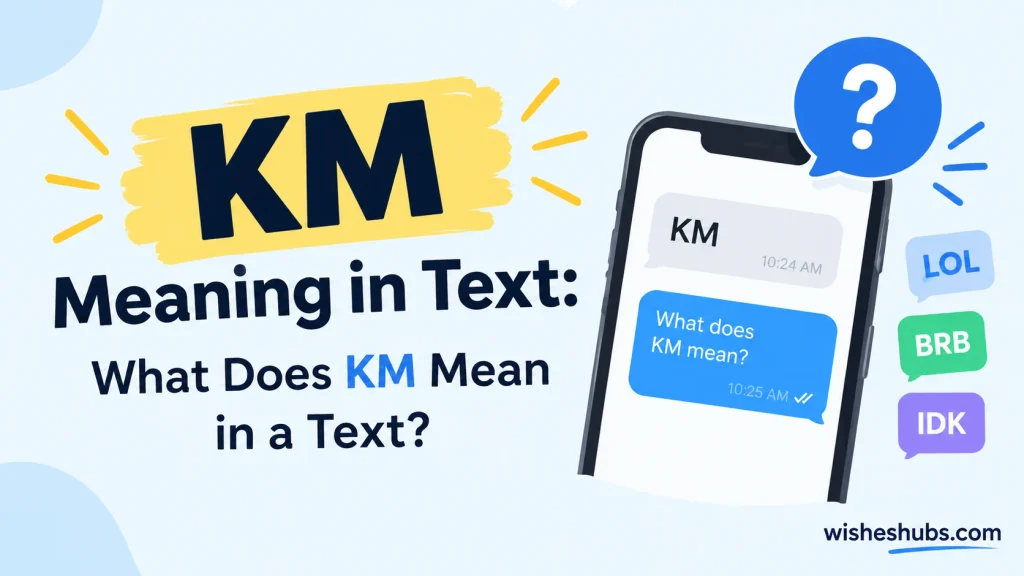
Seeing “KM” in a text message can leave you scratching your head, especially when the sender gives you no extra context. Two simple letters can carry very different meanings depending on the conversation. A romantic chat, a frustrating situation, and a travel discussion can each give “KM” a completely different interpretation.
The most important thing to remember is that KM doesn’t have one universal texting meaning. In some casual conversations, people may use it as shorthand for phrases such as “Kiss Me” or “Kill Me.” In everyday messages about travel, running, or distance, km usually means kilometer or kilometers.
That difference makes context incredibly important. If someone says, “The trail is 5 km away,” there’s little mystery. However, if someone simply sends “KM,” you’ll need to consider the conversation, tone, relationship, and surrounding words before deciding what they mean.
Whether you spotted KM on a texting app, social media, or an online chat, understanding the possible meanings can help you avoid an awkward misunderstanding. Here’s what KM meaning in text can actually mean and how to figure out the right interpretation.
Quick Answer: What Does KM Mean in Text?
KM can mean different things in texting, depending on context. In informal chats, people may use KM to mean “Kiss Me” or “Kill Me.” In conversations involving travel, running, driving, or distance, km normally means kilometer or kilometers.
Here are the main possibilities:
| KM Meaning | Typical Context | Example |
| Kiss Me | Romantic or playful conversation | “Come closer, KM 😘” |
| Kill Me | Frustration, embarrassment, or dramatic humor | “I sent it to the wrong person. KM.” |
| Kilometer(s) | Distance, travel, running, or directions | “The store is 3 km away.” |
The conversation itself is the best clue. Don’t automatically assume that every “KM” means “Kiss Me” or “Kill Me.”
What Does KM Mean in Texting?
When someone types KM in a casual conversation, the meaning depends heavily on what they were discussing. Unlike widely recognized abbreviations such as “LOL” or “BRB,” KM doesn’t have one universally accepted slang definition.
One important distinction matters here. “km” is an established abbreviation for kilometer, while interpretations such as “Kiss Me” and “Kill Me” rely more heavily on informal usage and context.
For example, imagine someone texts:
“How far is your house from the station?”
You reply:
“About 2 km.”
In this case, KM clearly refers to kilometers.
Now imagine a playful romantic conversation where someone says:
“I wish you were here right now.”
A follow-up message saying “KM” could potentially mean “Kiss Me.” The surrounding conversation gives the abbreviation its meaning.
That’s why reading the entire exchange is usually more reliable than decoding two letters in isolation.
KM as “Kiss Me”
In a romantic, affectionate, or flirtatious conversation, KM may be used as shorthand for “Kiss Me.” This interpretation fits situations where two people are already talking about affection, dating, physical closeness, or romance.
For example:
Person A: “I can’t stop thinking about you.”
Person B: “Then come here. KM ❤️”
Here, the romantic context makes “Kiss Me” a plausible interpretation.
However, don’t treat KM = Kiss Me as a guaranteed rule. Texting slang varies between friend groups, platforms, and individuals. Some people would simply write “kiss me” rather than abbreviate it.
You should therefore look for supporting clues such as:
- Romantic conversation
- Flirty comments
- Affectionate emojis
- References to kissing or physical closeness
- A dating or relationship context
- Playful language between two people
If none of those clues appear, another meaning may fit better.
KM as “Kill Me”
Another possible informal interpretation is “Kill Me.” People sometimes use this phrase dramatically when they’re embarrassed, frustrated, overwhelmed, or reacting to an awkward situation.
It usually isn’t meant literally in ordinary casual conversation. Instead, the expression can function like saying “I’m so embarrassed” or “This is awful.”
For example:
“I called my teacher ‘Mom’ in front of everyone. KM.”
The sender isn’t normally making a literal request. They’re using exaggerated language to express embarrassment.
You might also see it after a frustrating mistake:
“I studied the wrong chapter for three hours. KM.”
Again, the surrounding message makes the intended tone clearer.
Context matters especially here. If a message involving “KM” sounds genuinely concerning rather than humorous or figurative, don’t assume it’s slang. Take the person’s words seriously and check on them.
KM as “Kilometer” or “Kilometers”
The most straightforward meaning of km is kilometer, a metric unit used to measure distance.
One kilometer equals 1,000 meters. In the United States, people commonly encounter kilometers when discussing international travel, running events, maps, or scientific information. The unit is also standard in most countries around the world.
Examples include:
- “The hotel is 2 km from the airport.”
- “I ran 5 km this morning.”
- “The next exit is 10 km away.”
- “It’s about 3 km from downtown.”
In these situations, km isn’t really texting slang at all. It’s simply a shortened unit of measurement.
A useful detail is that the standard symbol is written km, with lowercase letters. Unlike some casual abbreviations, “km” doesn’t need a period in standard scientific and technical usage.
KM Meaning Depends on Context
The biggest mistake people make with short abbreviations is assuming they have only one meaning.
KM is a perfect example.
Consider these two messages:
“I ran 10 km today.”
and:
“KM ❤️”
The letters look identical, yet the likely meanings are completely different.
Your first clue should always be the subject of the conversation. If you’re discussing exercise, “km” almost certainly refers to kilometers. If you’re flirting with someone, an informal romantic interpretation becomes more plausible.
Here are some useful context clues:
Romantic Conversation
If the conversation involves dating, affection, or flirting, “Kiss Me” could make sense.
Embarrassing Situation
If someone has just described an awkward mistake, “Kill Me” may be intended as dramatic slang.
Travel Discussion
If you’re talking about roads, airports, hotels, or destinations, km almost certainly means kilometers.
Running or Fitness
A message like “I finished 5 km” clearly refers to kilometers.
Directions
Messages involving distances usually use km in its standard measurement sense.
How to Tell What Someone Means by KM
When someone sends a short abbreviation without explanation, don’t panic. A few simple clues can usually narrow it down.
Look at the Message Before It
The previous message often provides the strongest clue.
Suppose someone writes:
“How far is the beach from your hotel?”
Then you receive:
“About 4 km.”
The meaning is obvious because the conversation concerns distance.
Now consider:
“I wish you were here.”
followed by:
“KM.”
The romantic context creates a very different interpretation.
Check the Topic of the Conversation
The topic can eliminate several possible meanings immediately.
| Conversation Topic | Most Plausible Meaning |
| Running | Kilometer(s) |
| Road trip | Kilometer(s) |
| Travel | Kilometer(s) |
| Maps or directions | Kilometer(s) |
| Romantic chat | Possibly “Kiss Me” |
| Embarrassing story | Possibly “Kill Me” |
| Casual conversation without context | Ambiguous |
This simple approach prevents you from forcing a slang definition into a conversation where it doesn’t belong.
Notice the Tone
Tone can completely change how a short message feels.
“KM 😂” after an embarrassing story may suggest exaggerated frustration.
“KM ❤️” in a romantic conversation could suggest affection.
Meanwhile, “5 km” doesn’t need any slang interpretation.
Text messages lack facial expressions and vocal tone. As a result, people often use emojis, punctuation, and surrounding words to add emotional clues.
Look for Emojis and Other Words
Emojis can provide useful hints, although they aren’t definitive proof.
For example:
- ❤️ 😘 🥰 → may support a romantic interpretation
- 😂 😭 🤦 → may support a humorous or frustrated interpretation
- 🏃 📍 🚗 → may point toward distance or travel
Don’t rely on one emoji alone. Look at the entire message.
Ask If You’re Still Unsure
Sometimes the best solution is also the simplest.
You can ask:
- “What do you mean by KM?”
- “KM as in kilometers?”
- “Wait, what does KM mean here?”
- “Do you mean ‘kiss me’?”
A quick question beats a completely wrong assumption.
Also Read This: Uhm Meaning in Text: What Does “Uhm” Mean in a Text?
KM Meaning in Different Texting Situations
The following examples show how dramatically context can change KM meaning in text.
| Situation | Likely Interpretation | Why |
| “The airport is 8 km away.” | Kilometer(s) | The message discusses distance |
| “I ran 7 km before breakfast.” | Kilometer(s) | Running uses distance measurements |
| “Come over here. KM ❤️” | Possibly Kiss Me | Romantic context supports it |
| “I forgot everyone’s names. KM 😂” | Possibly Kill Me | The sender expresses embarrassment |
| “KM” by itself | Unclear | There isn’t enough context |
The last example deserves attention.
A standalone “KM” is genuinely ambiguous. Without additional information, nobody can reliably determine what the sender intended.
Examples of KM in Text Messages
Realistic examples make these distinctions easier to understand.
Romantic Example
Alex: “I miss you already.”
Sam: “Then stop texting and come see me.”
Alex: “Okay. KM ❤️”
In this exchange, “Kiss Me” fits the romantic tone. Still, it remains an informal interpretation rather than a universal texting rule.
Frustration Example
Jamie: “I just realized I sent the screenshot to the person we were talking about.”
Taylor: “KM 😂”
Here, “Kill Me” works as exaggerated humor about an embarrassing mistake.
Distance Example
Alex: “How far is the restaurant?”
Sam: “It’s only 2 km from here.”
There is no slang puzzle here. KM means kilometers.
Fitness Example
“Finished my first 10 km run today!”
In this case, km refers to kilometers. The fitness context makes the meaning clear.
KM vs. Similar Texting Abbreviations
Short internet expressions can look deceptively similar. A single extra letter may completely change the meaning.
KM vs. KMS
KMS is different from KM and can carry a much more serious meaning in online slang. It is sometimes used as an abbreviation for a phrase involving self-harm or suicide.
Because of that, KM and KMS should never be treated as interchangeable abbreviations.
If someone uses KMS in a way that appears serious rather than joking, take the message seriously. A person’s safety matters more than decoding slang.
KM vs. K
The letter K commonly appears in texts as shorthand for “okay.”
For example:
“I’ll meet you at 7.”
“K.”
That doesn’t mean the same thing as KM.
The difference is tiny on screen, yet the meanings are unrelated.
KM vs. “Kiss Me” Variations
Someone who wants to say “Kiss Me” might simply write those words in full. Others may use informal shorthand.
This is an important point because texting abbreviations aren’t governed by one universal dictionary. People invent shortcuts, adapt them, and sometimes use them only within a particular friend group.
Is KM a Common Texting Abbreviation?
That depends on which meaning you’re asking about.
“km” as kilometer is well established and widely recognized. It appears in maps, transportation information, fitness tracking, travel conversations, and everyday distance measurements.
Informal meanings such as “Kiss Me” or “Kill Me” are more context-dependent. They aren’t as universally recognized as major texting abbreviations such as LOL, IDK, or BTW.
This distinction matters when you’re interpreting a message.
If someone says:
“The trail is 6 km long.”
There’s a clear conventional meaning.
If someone sends:
“KM”
with no context, several interpretations remain possible.
So, rather than memorizing one definition, think of KM as a context-sensitive abbreviation.
Is KM Rude or Offensive in Texting?
KM isn’t automatically rude or offensive. Its tone depends on what the sender means.
When it represents “Kiss Me,” it can sound affectionate, playful, or flirtatious.
When someone uses “Kill Me” figuratively, it may sound dramatic, frustrated, or humorous.
When “km” means kilometer, it carries no offensive meaning at all.
The relationship between the people also matters. A phrase that feels playful between close friends may sound strange coming from a stranger.
For that reason, consider these factors before reacting:
- Who sent the message?
- What were you discussing?
- Was the conversation romantic?
- Did something embarrassing happen?
- Did the sender mention distance?
- What emojis or punctuation did they use?
- Does the interpretation fit the sentence naturally?
How to Reply When Someone Texts “KM”
Your response should match the likely meaning.
If They Mean “Kiss Me”
If you’re comfortable with the romantic tone, you could respond playfully:
“Only if you ask nicely.”
Or:
“Come here then ❤️”
If They Mean “Kill Me”
If the sender is joking about an embarrassing situation, you could respond:
“You’re going to survive 😂”
Or:
“That is painfully awkward.”
If the message appears serious rather than humorous, don’t respond with a joke. Check whether the person is safe.
If They Mean “Kilometers”
Keep your reply straightforward:
“Yep, about 3 km.”
Or:
“It’s less than 1 km from the station.”
If You Don’t Know What They Mean
There’s nothing wrong with asking.
Try:
“Wait, what does KM mean here?”
That’s especially useful when the message could reasonably have several meanings.
Common Mistakes When Interpreting KM
A little context can prevent a surprisingly awkward conversation.
Assuming KM Always Means “Kiss Me”
A romantic interpretation may fit some conversations. It doesn’t fit every message.
Ignoring the Topic
If someone is discussing running, km almost certainly means kilometers. Turning it into slang would make little sense.
Treating Every Abbreviation as Universal
Internet language changes quickly. A shortcut that one group understands may confuse another group completely.
Taking “Kill Me” Literally Without Context
People sometimes use “kill me” as exaggerated humor after an embarrassing moment. However, context still matters. Don’t dismiss genuine signs of distress as slang.
Ignoring Capitalization
Capitalization can provide a small clue, although it isn’t a reliable rule. km usually appears as the standard symbol for kilometer. KM may appear when someone types in uppercase or uses an informal abbreviation.
The surrounding words remain far more useful than capitalization alone.
A Simple Way to Decode KM
When you’re unsure about KM meaning in text, use this quick process:
Read → Identify the topic → Check the tone → Look for clues → Ask if necessary
For example:
Message: “The gym is 4 km from my house.”
Topic: Location and distance.
Likely meaning: Kilometer.
Another example:
Message: “I can’t believe I did that. KM 😭”
Topic: Embarrassment.
Possible meaning: Kill Me.
And:
Message: “I wish you were here. KM ❤️”
Topic: Romance.
Possible meaning: Kiss Me.
This approach works because it focuses on meaning in context rather than abbreviation alone.
FAQs:
Can KM have more than one meaning in texting?
Yes. KM can have several meanings, depending on the conversation. It may refer to “Kiss Me,” “Kill Me,” or “kilometer(s).” The topic and wording around KM usually reveal the intended meaning.
Why do people use KM instead of writing the full phrase?
People often shorten words to save time and keep messages casual. However, not everyone uses the same abbreviations. That’s why KM can sometimes create confusion between different conversations.
Does KM mean the same thing on social media and in text messages?
Not always. Social media slang can vary between communities and platforms. Someone may use KM as informal shorthand in a chat while another person uses “km” strictly as a distance measurement.
What does lowercase km usually mean?
Lowercase km most commonly refers to kilometer or kilometers. You’ll often see it in messages about driving, running, travel, maps, and distances.
What does uppercase KM usually mean?
Uppercase KM can represent an informal phrase such as “Kiss Me” or “Kill Me.” However, capitalization alone doesn’t determine the meaning. The surrounding conversation provides a much stronger clue.
Can KM be used jokingly in a text?
Yes. If someone uses KM to represent “Kill Me,” they may be expressing embarrassment or frustration in an exaggerated way. For example, someone might write “KM 😂” after making an awkward mistake.
Is KM a good abbreviation to use in a formal message?
Usually, no. If you’re writing a professional email, school assignment, or formal message, write the intended phrase clearly. Use “km” as a measurement when appropriate, but avoid ambiguous texting slang.
Can a single KM message be difficult to understand?
Absolutely. A standalone “KM” provides very little context, so you can’t reliably determine the intended meaning from those letters alone. The previous messages often provide the missing clue.
What clues help identify KM in a conversation?
Pay attention to the topic, tone, previous messages, emojis, and relationship between the people chatting. Distance-related discussions point toward kilometers, while romantic conversations may support “Kiss Me.”
Should you ask someone what KM means?
Yes, especially when the meaning could change the tone of your response. A quick question such as “What do you mean by KM?” can clear up the confusion immediately.
Conclusion:
KM Meaning in Text can vary from a romantic “Kiss Me” to a dramatic “Kill Me” or the straightforward measurement “kilometer.” Context remains the key to understanding it correctly.
Check the conversation topic, tone, and surrounding words before jumping to a conclusion. Once you spot those clues, decoding KM becomes much easier and helps you avoid confusing or awkward replies.

“Explore unique wishes, greetings, and celebration ideas with Emma Brooke at Wisheshubs.com – your go-to place for inspiring messages!”

1 thought on “KM Meaning in Text: What Does KM Mean in a Text?”