
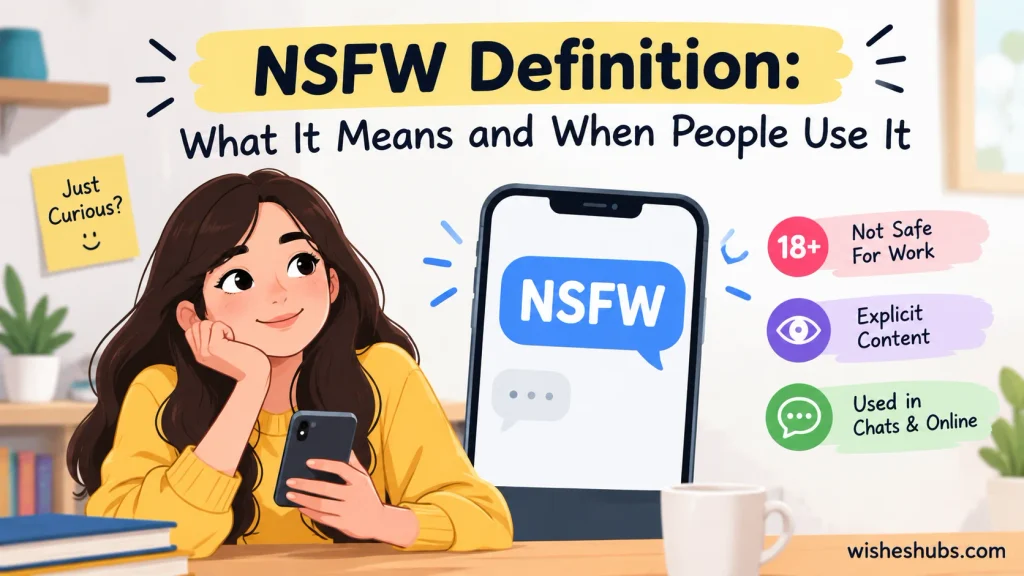
Seeing NSFW on a post, message, image, or website can make you pause before clicking. The abbreviation appears everywhere online, yet its meaning can shift slightly with context. Understanding the NSFW definition helps you know what a warning actually signals and why someone added it.
In simple terms, NSFW means “Not Safe For Work.” People use the label to warn you that content might be inappropriate, embarrassing, disturbing, or unsuitable for viewing around coworkers, customers, classmates, or the public. The warning doesn’t always mean sexual content.
Depending on the platform, NSFW may refer to nudity, sexual material, graphic violence, disturbing imagery, strong language, or other sensitive content. The label gives you a moment to decide whether you’re in the right setting to view it. Think of it as a digital heads-up before you open the door.
Quick Answer: What Does NSFW Mean?
NSFW stands for “Not Safe For Work.” It’s an informal internet warning that tells you content may not be appropriate to view in a workplace or other public setting.
The term most commonly describes sexual, nude, graphic, violent, or otherwise sensitive material. However, there’s no universal checklist that makes something NSFW. Different websites, communities, and users can apply the label differently.
For example, someone might message you, “NSFW link—don’t open this at work.” They’re telling you that the link could contain content you’d rather not have visible on your screen in a professional environment.
Importantly, NSFW isn’t a legal classification. It also doesn’t automatically mean the content violates a website’s rules. It’s primarily a warning about suitability and viewing context.
What Does NSFW Stand For?
The abbreviation breaks down into four simple words:
- N — Not
- S — Safe
- F — For
- W — Work
Together, they form “Not Safe For Work.”
The phrase developed as internet users needed a quick way to flag material that could cause problems if opened around other people. Before modern content-warning systems became widespread, users often relied on short labels such as NSFW to alert others.
Why Is It Called “Not Safe For Work”?
The word work reflects the original concern behind the warning.
Imagine you’re sitting at your desk with your screen visible to coworkers. You click a link expecting a funny meme. Instead, an explicit image suddenly appears. That’s exactly the kind of situation an NSFW warning tries to prevent.
The same principle now applies beyond offices.
You might be:
- Sitting in a classroom
- Using a computer at a library
- Browsing on public transportation
- Giving a presentation
- Using a shared family device
- Sitting beside coworkers
- Attending a professional meeting
In all these situations, content that seems acceptable in private could become awkward or inappropriate when displayed publicly.
NSFW is essentially a digital “look before you click” warning.
What Does NSFW Mean Online?
Online, NSFW functions as a content warning.
Someone may place the label in a post title, message, filename, link description, image tag, or community category. The goal is simple: give viewers advance notice.
NSFW can appear on:
- Social media posts
- Discussion forums
- Reddit communities
- Messaging apps
- Websites
- Blogs
- Online communities
- Email messages
- Group chats
- Image-sharing platforms
The meaning isn’t always identical across these spaces.
For example, one community might use NSFW primarily for sexual material. Another might use it for graphic violence or disturbing photographs. That’s why the surrounding context matters.
NSFW Doesn’t Automatically Mean “Forbidden”
One important distinction often gets overlooked.
NSFW describes suitability. It doesn’t automatically describe legality or platform permission.
A piece of content can carry an NSFW warning while still being permitted under a particular website’s rules. Conversely, content can violate platform policies even if nobody labels it NSFW.
The warning and the platform’s moderation rules serve different purposes.
What Kind of Content Is Considered NSFW?
There isn’t one universal definition of NSFW content. Still, certain categories appear frequently.
Sexual or Explicit Content
Sexual material is one of the most common reasons for an NSFW label.
This can include sexually explicit imagery, pornography, nudity, or strongly sexual material. People often use NSFW to prevent such content from appearing unexpectedly in professional environments.
A warning doesn’t necessarily describe exactly what’s contained in the material. It simply signals that you should exercise caution before opening it.
Graphic Violence or Gore
NSFW can also describe graphic or disturbing violence.
For example, a photograph showing severe injuries or an extremely disturbing accident scene may receive an NSFW warning. The concern isn’t sexual content. Instead, the material could be deeply uncomfortable or inappropriate for public viewing.
Some platforms use more specific labels for this category.
Offensive or Disturbing Material
Certain communities also use NSFW for material that contains highly offensive, shocking, or disturbing themes.
The exact threshold varies.
A mildly crude joke probably won’t receive the same warning as highly disturbing imagery. Community expectations play a major role in how users apply the term.
Other Potentially Inappropriate Material
In some contexts, NSFW can cover:
- Extremely strong profanity
- Disturbing photographs
- Sexual jokes
- Graphic imagery
- Mature themes
- Highly suggestive content
The key factor is often where someone might view it, rather than the content alone.
NSFW vs. Explicit Content: What’s the Difference?
NSFW and explicit don’t mean exactly the same thing.
“Explicit” describes the nature or level of detail in content. “NSFW” warns you about whether viewing that content could be inappropriate in a particular environment.
| Term | Meaning | Primary Purpose |
| NSFW | Not Safe For Work | Warns about potentially inappropriate viewing |
| Explicit | Clearly graphic or detailed | Describes the content itself |
| SFW | Safe For Work | Indicates generally workplace-friendly content |
| NSFL | Not Safe For Life | Signals extremely disturbing material |
For example, a sexually suggestive joke could be considered NSFW without being explicitly graphic.
Likewise, an extremely violent image could be NSFW even though it has nothing sexual about it.
That’s the crucial difference.
NSFW Meaning in Text Messages and Chats
When someone sends NSFW in a text, they’re usually warning you about what comes next.
Consider these examples:
- “NSFW pic.”
- “That link is NSFW.”
- “Warning, this video is NSFW.”
- “Don’t open this at work. It’s NSFW.”
- “Can you mark that NSFW before sending it?”
In each example, NSFW works as a shorthand warning.
What Does NSFW Mean in a Text?
The NSFW meaning in text remains “Not Safe For Work.”
However, the tone can change depending on the relationship between the people chatting.
A close friend might use NSFW casually before sending something risqué. A coworker might use it more cautiously when describing a potentially sensitive webpage. A moderator might use it as part of a formal content-labeling system.
So, don’t interpret the abbreviation in isolation. Read the surrounding message and consider who sent it.
NSFW Meaning on Social Media
Social media platforms use content warnings to help users make informed choices before viewing potentially sensitive material.
You might encounter NSFW in:
- Post descriptions
- Hashtags
- Community rules
- Image captions
- Video descriptions
- Profile notices
- Content labels
However, platform policies differ.
Some services provide built-in sensitive-content settings. Others rely more heavily on user-generated labels or moderation systems. A platform’s rules can also change over time.
That means an NSFW tag shouldn’t be treated as a universal technical standard.
Why Social Media Users Add NSFW Warnings
A warning can help users:
- Avoid unexpectedly seeing sensitive material.
- Decide whether they’re comfortable viewing it.
- Prevent an awkward situation in public.
- Respect community expectations.
- Keep potentially mature content away from professional settings.
A thoughtful warning takes only a few seconds. It can save someone from an uncomfortable surprise.
NSFW Meaning on Reddit, Forums, and Online Communities
Reddit and other online communities commonly use NSFW as a content label.
Community members may apply warnings to posts containing adult material, nudity, graphic imagery, or other sensitive subjects.
The important point is that community standards vary.
One forum might consider a certain image ordinary discussion material. Another might require an NSFW tag for the same content.
Moderators can also establish additional rules around sensitive posts. Therefore, checking a community’s guidelines remains useful when you’re unsure.
NSFW Tags and Community Context
Think of an NSFW tag like a road sign.
A sign doesn’t change the road. It simply tells you what you’re approaching.
Likewise, an NSFW label doesn’t necessarily change the content. It gives you information before you encounter it.
Also Read This: WTM Meaning in Text: What Does WTM Mean in a Text?
When Should You Use the NSFW Label?
Adding an NSFW warning makes sense when content could reasonably create an uncomfortable situation if someone viewed it publicly.
Before Sharing Potentially Inappropriate Content
If you’re sending something sensitive to a friend or group, consider adding a short warning.
For example:
“NSFW — contains mature imagery.”
That gives recipients useful context without forcing them to open the material first.
In Professional Spaces
Professional environments deserve extra caution.
Workplace messaging systems, company email, team channels, and shared documents aren’t appropriate places for every type of content. Even when something isn’t prohibited, consider whether people actually need to see it.
A warning isn’t permission.
That’s an important distinction.
If workplace policy prohibits certain material, adding “NSFW” doesn’t make sharing it acceptable.
In Public or Shared Environments
Public spaces create another reason to use content warnings.
Someone may open a link while sitting beside strangers. A graphic or explicit image appearing unexpectedly can create an awkward situation within seconds.
A simple NSFW label gives the person a choice.
NSFW and Workplace Etiquette
The workplace connection sits at the heart of the NSFW definition.
Professional environments usually require people to consider more than their own preferences. Coworkers may have different boundaries, responsibilities, and expectations.
Before sharing questionable material through workplace systems, consider:
- Who will receive it?
- Why does it need to be shared?
- Could someone see it unexpectedly?
- Does company policy permit it?
- Could it create discomfort or conflict?
If the answer to those questions raises concerns, don’t assume an NSFW warning solves the problem.
Workplace policies always take priority over informal internet labels.
Is NSFW the Same as Adult Content?
No.
Adult content and NSFW content overlap significantly, but they aren’t identical categories.
Adult content generally refers to material intended for mature audiences. NSFW refers more broadly to material that may be unsuitable to view in professional or public settings.
For instance:
- Explicit sexual content can be NSFW.
- A graphic accident photograph can be NSFW.
- A disturbing image can be NSFW.
- A mature joke could sometimes be considered NSFW.
This broader meaning explains why defining NSFW simply as “porn” misses an important part of the term.
What Does SFW Mean?
SFW means “Safe For Work.”
It’s essentially the opposite of NSFW.
People use SFW to indicate that content should generally be suitable for professional or public environments.
For example:
“Here’s the SFW version of the image.”
That statement suggests the material has been edited or selected to avoid content that could cause an awkward situation at work.
You’ll often see SFW and NSFW used together when websites provide different versions of the same material.
What Does NSFL Mean?
NSFL stands for “Not Safe For Life.”
It’s a stronger and more alarming internet warning than NSFW.
People generally use NSFL to signal extremely disturbing, graphic, or potentially traumatizing material. The phrase intentionally goes beyond the workplace-focused idea behind NSFW.
NSFL isn’t a formal universal classification either. Usage can vary across online communities.
Still, when you see the label, treat it as a serious warning rather than casual internet slang.
How to Respond When Someone Sends NSFW Content
You don’t have to open every link someone sends.
When a message includes an NSFW warning, consider these steps:
- Read the warning first.
- Check where you are.
- Consider who’s nearby.
- Ask the sender what type of content it contains if needed.
- Open it only if you’re comfortable doing so.
- Don’t forward sensitive material without considering the recipient.
This approach works especially well in group chats.
If you’re unsure what the warning covers, a simple question such as “What kind of NSFW?” can prevent an unpleasant surprise.
Common Misunderstandings About NSFW
“NSFW Always Means Porn”
This is one of the most common misconceptions.
NSFW can refer to sexual content, but it isn’t limited to sexual material. Graphic violence, disturbing imagery, and other mature content may also receive the label.
“NSFW Means Illegal”
It doesn’t.
NSFW is an informal content warning. It isn’t a legal category.
Whether something is legal depends on applicable laws and the actual nature of the material. An NSFW label doesn’t establish legality.
“An NSFW Label Makes Sharing Content Okay”
It doesn’t.
A warning tells people what they might encounter. It doesn’t automatically make distribution appropriate.
Workplace rules, platform policies, consent, privacy, and other considerations still matter.
“NSFW Has the Same Meaning Everywhere”
Not necessarily.
The broad definition remains “Not Safe For Work,” but individual communities can apply the term differently.
One site’s moderators may use NSFW narrowly. Another community might apply it to a wider range of mature or disturbing material.
Examples of NSFW in Everyday Internet Conversations
| Example | Meaning |
| “NSFW link ahead.” | The link may contain inappropriate material |
| “That photo is NSFW.” | The photo may be unsuitable for public or professional viewing |
| “Mark it NSFW before posting.” | Add a warning before publishing the content |
| “Is this NSFW?” | Someone wants to know whether the material could be inappropriate |
| “This page has an NSFW warning.” | The page alerts visitors about potentially sensitive material |
| “Don’t open that at work. It’s NSFW.” | The sender strongly recommends viewing it privately |
These examples show why context matters. NSFW is usually a warning, not a detailed description.
NSFW Etiquette: What You Should Know
Good internet etiquette starts with respecting other people’s ability to choose what they see.
When sharing potentially sensitive content:
- Use an NSFW warning when appropriate.
- Give enough context to explain the general concern.
- Don’t surprise people with explicit or disturbing material.
- Respect workplace and school policies.
- Consider whether the recipient actually wants the content.
- Don’t assume a private group chat makes everything appropriate.
- Avoid forwarding sensitive content without considering privacy and consent.
- Follow the specific rules of the platform or community.
A warning should help people make a choice. It shouldn’t become an excuse for careless sharing.
A Simple NSFW Decision Guide
When you’re unsure whether something needs an NSFW label, use this quick checklist:
Could the content…
- Contain nudity or sexual material?
- Show graphic violence?
- Include disturbing imagery?
- Create a serious problem if displayed at work?
- Make a reasonable viewer uncomfortable in a public setting?
- Conflict with the rules of the community where you’re posting?
If several answers are yes, adding an NSFW warning is usually a sensible precaution.
The exact decision still depends on the platform and audience.
Key Facts About the NSFW Definition
Here are the essential points to remember:
- NSFW means “Not Safe For Work.”
- It’s primarily an informal content warning.
- Sexual content is a common use of the term.
- NSFW can also describe violent, graphic, disturbing, or mature material.
- It isn’t a universal legal classification.
- An NSFW warning doesn’t automatically mean content violates platform rules.
- SFW generally means “Safe For Work.”
- NSFL generally means “Not Safe For Life.”
- Context matters when interpreting an NSFW label.
- A warning doesn’t override workplace rules or platform policies.
FAQs About NSFW
What is the NSFW definition in simple words?
NSFW means “Not Safe For Work.” It warns you that a photo, video, message, link, or post may contain content that isn’t appropriate to view in a workplace or public setting.
What does NSFW mean when someone sends it in a text?
When someone writes NSFW in a text, they’re warning you that the content they’re sharing may be inappropriate or sensitive. It gives you a chance to decide whether you’re somewhere suitable to view it.
Does NSFW always refer to sexual content?
No. NSFW doesn’t always mean sexual content. It can also describe graphic violence, disturbing images, strong mature themes, or other material that could make viewing it publicly uncomfortable.
Why do people put NSFW warnings on posts?
People use NSFW warnings to give viewers advance notice about sensitive content. The warning lets you decide whether you want to view the material before it appears on your screen.
Can something be NSFW without being inappropriate for everyone?
Yes. NSFW depends partly on context. Content that seems harmless in a private setting might be unsuitable during a work meeting, in a classroom, or around customers and coworkers.
Is NSFW an official content rating?
Generally, no. NSFW is an informal internet label rather than a universal rating system. Websites and online communities can create their own rules for what they consider NSFW.
What’s the difference between NSFW and explicit?
Explicit describes the nature or level of detail in content. NSFW warns that content may be unsuitable to view in certain environments. Explicit content can be NSFW, but the terms aren’t interchangeable.
What does SFW mean compared with NSFW?
SFW means “Safe For Work.” It’s commonly used for content that should generally be suitable for professional or public viewing. NSFW serves as the opposite warning.
Is NSFW the same as adult content?
Not exactly. Adult content can be NSFW, but NSFW has a wider meaning. Graphic violence, disturbing imagery, and other mature material can also receive an NSFW warning.
What should you do when you see an NSFW warning?
Take the warning seriously and consider your surroundings before opening the content. If you’re at work, school, or somewhere public, waiting until you’re in a private setting may be the better choice.
Conclusion:
The NSFW definition is simple: NSFW means “Not Safe For Work.” It acts as a quick warning that content may be unsuitable for professional or public settings.
While sexual material commonly receives an NSFW label, the term can also cover graphic violence, disturbing imagery, or other mature content. Understanding the context helps you decide when to open, share, or avoid flagged content.

Emily Harris shares simple, heartfelt wishes, quotes, and messages to help you celebrate every special moment beautifully.






1 thought on “NSFW Definition: What It Means and When People Use It”