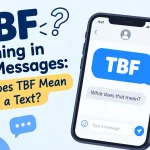
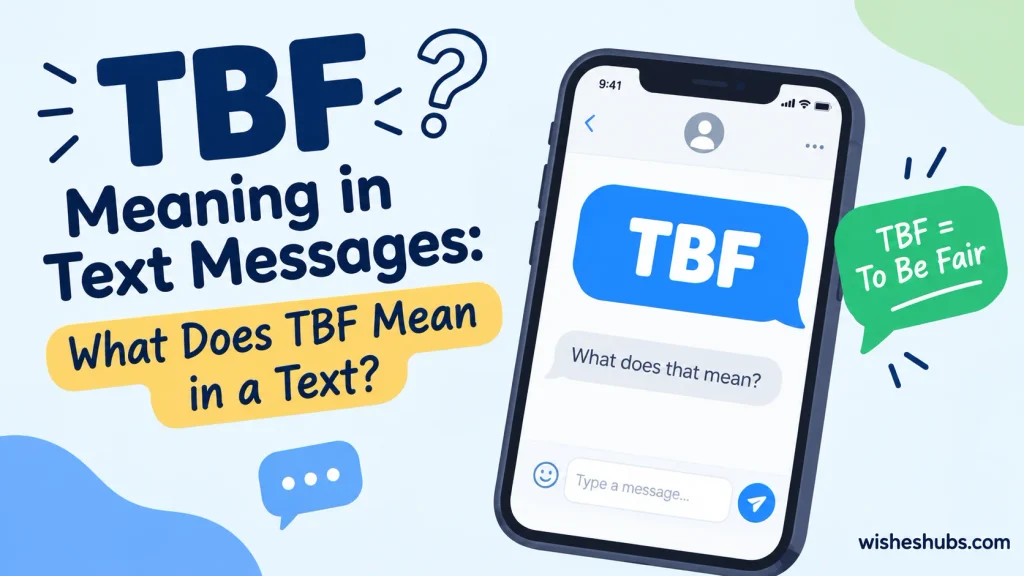
Ever received “TBF” in a message and wondered what it means? Understanding TBF Meaning in Text Messages helps you follow casual conversations, online discussions, and everyday digital communication without missing the point.
In this article, you’ll discover how TBF means “to be fair” and how context shapes its meaning. You’ll also explore English usage, grammar, tone, and common examples. Whether you’re reading a casual text or writing a response, these details make the abbreviation easier to understand and use naturally.
Beyond basic texting, TBF can appear during business communication, meetings, scheduling discussions, project management, and online conversations. However, its suitability changes with the setting. You’ll learn when TBF fits casual writing, when formal writing works better, and how consistency improves clear digital communication.
Quick Answer
TBF means “to be fair” in text messages and most casual online conversations.
People commonly use TBF to:
- Acknowledge another person’s point
- Add balance to an opinion
- Recognize an overlooked fact
- Soften criticism
- Defend someone or something
- Show that a situation has more than one side
Example:
“The restaurant was expensive. TBF, the portions were huge.”
Here, TBF means “to be fair.” The sender admits that the restaurant cost more while pointing out why the price might have been reasonable.
TBF is generally an informal abbreviation, so it fits texts, DMs, social media, and group chats better than formal writing.
What Does TBF Mean in Text Messages?
The most common TBF meaning in text messages is “to be fair.”
The phrase introduces a point that adds balance to what someone has just said. Think of it as putting another weight on the other side of a scale.
For example:
“Jake was late again. TBF, he had car trouble.”
The first sentence criticizes Jake for being late. The second sentence adds information that changes how you might view the situation.
TBF doesn’t necessarily mean the sender completely disagrees with the original statement. Instead, it often means, “There’s another side worth considering.”
You may see TBF at the beginning of a sentence:
“TBF, that’s not really her fault.”
It can also appear later in a message:
“The game was frustrating, TBF it was still fun.”
The punctuation varies in casual texting. Some people use a comma after TBF while others don’t.
What Does “To Be Fair” Mean?
“To be fair” is a conversational phrase people use before recognizing something reasonable, true, or relevant.
Imagine two friends arguing about a movie.
One says:
“That movie was terrible.”
The other replies:
“TBF, the acting was pretty good.”
The second person isn’t necessarily saying the movie was great. They’re pointing out one positive detail that deserves consideration.
That’s the central idea behind TBF.
TBF Can Show Fairness
A person may use TBF when they don’t want to present a one-sided opinion.
For example:
“I didn’t like the teacher’s presentation. TBF, she had only one day to prepare.”
The writer still doesn’t like the presentation. However, they recognize a circumstance that affected it.
TBF Can Introduce a Concession
A concession means acknowledging that another point has some validity.
For example:
“I think Mike overreacted. TBF, I would’ve been annoyed too.”
The writer maintains their original opinion while admitting that Mike had a reason to feel annoyed.
That’s why TBF often appears in disagreements.
How Is TBF Used in Texting?
TBF has several closely related uses. The exact purpose depends on what follows the abbreviation.
TBF to Add Balance to a Statement
One of the most common uses involves balancing criticism with a positive or reasonable observation.
“The hotel room was tiny. TBF, it was really clean.”
The sender isn’t pretending the room was spacious. They’re simply adding another relevant fact.
This style makes TBF useful when a conversation becomes too one-sided.
TBF to Acknowledge Someone’s Point
TBF can also mean “you have a point.”
“TBF, you’re right about the timing.”
Here, the sender acknowledges that another person made a valid argument.
The abbreviation doesn’t automatically mean full agreement. It simply signals that the sender recognizes something reasonable.
TBF to Correct an Oversimplified Opinion
Sometimes people make quick judgments without knowing the whole situation.
TBF gives the writer a way to add context.
“She didn’t answer anyone all day. TBF, she was working a double shift.”
That extra information doesn’t erase the original fact. It provides a fuller picture.
TBF to Soften Criticism
TBF can make criticism feel less harsh when used naturally.
Compare these:
“He completely messed up the project.”
With:
“He messed up the project. TBF, he wasn’t given much time.”
The second version still contains criticism. However, it acknowledges circumstances that matter.
TBF Meaning in Text With Examples
Context makes this abbreviation much easier to understand.
| Text Message | What TBF Means | Likely Tone |
| “TBF, she did warn us.” | To be fair, she did warn us. | Reasonable |
| “TBF, that wasn’t his fault.” | To be fair, that wasn’t his fault. | Understanding |
| “The food was expensive. TBF, it was really good.” | To be fair, the quality was good. | Balanced |
| “TBF, I would’ve done the same.” | To be fair, I understand that choice. | Understanding |
| “He messed up. TBF, he apologized.” | To be fair, he took responsibility. | Balanced |
| “TBF, you’re making a good point.” | To be fair, your argument has merit. | Agreeable |
| “I hated the first episode. TBF, the second was better.” | To be fair, later content improved. | Reflective |
The recurring idea is balance.
When you see TBF, ask yourself: What point is the sender adding to make the situation more balanced?
That question usually reveals the intended meaning immediately.
TBF Meaning in Different Conversations
The abbreviation can feel slightly different depending on where you encounter it.
TBF in Friendly Texts
Friends often use TBF casually when discussing people, plans, movies, food, games, or everyday problems.
For example:
“Tom forgot the tickets. TBF, he thought Sarah had them.”
This use feels natural because friends often give each other additional context during casual conversations.
TBF in Arguments
TBF becomes especially useful during disagreements.
Suppose one friend says:
“You never listen to me.”
The other might respond:
“TBF, you didn’t tell me the whole story.”
Here, TBF introduces a counterpoint. Depending on the surrounding messages, it could sound calm, defensive, or argumentative.
The abbreviation itself doesn’t determine the tone.
TBF in Group Chats
Group chats move quickly. People often use abbreviations to respond without writing full phrases.
A conversation might look like this:
Alex: “We should’ve left earlier.”
Sam: “TBF, nobody was ready at 7.”
Alex: “Okay, that’s fair.”
Here, TBF helps Sam acknowledge the situation while defending the group’s decision.
TBF on Social Media
You may also encounter TBF in comments, replies, and discussions.
For example:
“People complain about the price, but TBF, the event includes three performances.”
Social media users often use the abbreviation when responding to a strong opinion without completely rejecting it.
Is TBF Formal or Informal?
TBF is informal.
It’s appropriate for quick digital communication where abbreviations are normal.
Good places to use TBF
- Text messages
- Instagram DMs
- Facebook Messenger
- Group chats
- Casual Discord conversations
- Gaming chats
- Informal social media replies
Better alternatives for formal writing
In professional or academic writing, spell out the phrase:
- To be fair
- In fairness
- It is worth noting
- On the other hand
- However
For example, instead of writing:
“TBF, the deadline was short.”
A professional email could say:
“To be fair, the deadline was relatively short.”
The meaning remains the same. The register simply changes.
What Does TBF Mean From a Guy?
When a guy sends TBF, it normally means “to be fair.” There isn’t a separate male-specific definition.
For example:
“TBF, I should’ve told you earlier.”
This means:
“To be fair, I should’ve told you earlier.”
The message may show that he’s acknowledging his own mistake.
However, the abbreviation alone doesn’t reveal romantic interest, attraction, or hidden intent. You need to consider the full conversation.
Another example:
“TBF, you had a reason to be upset.”
Here, the sender recognizes the other person’s perspective.
The important clue isn’t the sender’s gender. It’s what comes before and after TBF.
What Does TBF Mean From a Girl?
The same basic rule applies when a girl uses TBF.
TBF still generally means “to be fair.”
For example:
“TBF, he did apologize.”
She may be pointing out that someone deserves some credit despite earlier criticism.
Or she might say:
“TBF, I would’ve reacted the same way.”
That message acknowledges another person’s behavior without necessarily expressing complete approval.
Gender doesn’t change the standard texting definition.
Read More: NFS Meaning in Texting and Social Media: What Does NFS Mean?
Is TBF a Good or Bad Thing to Say?
TBF is generally neutral.
The tone depends heavily on context.
Someone can use it sincerely:
“TBF, you were right.”
Someone can use it defensively:
“TBF, you didn’t give me enough time.”
Someone can use it sarcastically:
“TBF, you only ignored me for three days.”
The third example sounds sarcastic because the surrounding statement creates that tone.
Therefore, don’t treat TBF as automatically positive or negative.
What Can Change the Tone?
Several clues matter:
- The words immediately after TBF
- The previous messages
- Punctuation
- Emojis
- The relationship between the people
- Whether the conversation involves an argument
- Whether the statement contradicts something previously said
Context is king here.
Can TBF Sound Sarcastic?
Yes. TBF can appear in sarcastic messages, although the abbreviation itself isn’t inherently sarcastic.
Consider this:
“TBF, you only changed your mind five times today.”
The exaggerated wording suggests sarcasm.
Now compare it with:
“TBF, you had already explained your concerns.”
This sounds much more sincere.
The difference comes from the surrounding language rather than the abbreviation.
If you’re unsure about someone’s tone, look at the entire exchange instead of interpreting TBF in isolation.
TBF vs. TBH: What’s the Difference?
TBF and TBH look similar, but they serve different purposes.
| Abbreviation | Full Meaning | Main Purpose |
| TBF | To be fair | Adds balance or acknowledges another side |
| TBH | To be honest | Introduces an honest opinion or statement |
For example:
TBF: “TBF, she did have a good reason.”
This adds a fair point.
TBH: “TBH, I don’t like the new design.”
This introduces a personal opinion.
A simple way to remember the distinction is:
TBF balances. TBH reveals.
TBF vs. IMO and IMHO
Other internet abbreviations can also appear in opinion-based conversations.
TBF
To be fair
“TBF, both teams played well.”
It adds balance.
IMO
In my opinion
“IMO, the first version was better.”
It introduces a personal view.
IMHO
In my humble opinion
“IMHO, the older design looked cleaner.”
It also introduces a personal opinion.
| Term | Meaning | What It Does |
| TBF | To be fair | Recognizes another side |
| IMO | In my opinion | States a personal view |
| IMHO | In my humble opinion | States a personal view with a modest framing |
These abbreviations can appear together in the same conversation.
For example:
“IMO, the movie was too long. TBF, the final act was excellent.”
The first sentence gives an opinion. The second adds balance.
Does TBF Have Other Meanings?
TBF can represent other phrases in specialized contexts. However, “to be fair” is the common conversational meaning when you’re discussing ordinary texting and online chat.
Context matters because abbreviations aren’t always universal.
For example, an abbreviation used within a workplace, organization, hobby, or technical community might have a specialized definition. That doesn’t make the specialized expansion the intended meaning in a casual text.
If someone sends:
“TBF, you’re right.”
The natural interpretation is “to be fair.”
When interpreting abbreviations, always consider the surrounding words rather than relying on a list of every possible expansion.
How to Reply When Someone Texts “TBF”
Your response depends on what the sender is trying to say.
If You Agree
You can keep your reply simple:
- “Yeah, that’s true.”
- “Fair point.”
- “I can’t argue with that.”
- “That’s a good point.”
- “You’re right about that.”
If You Disagree
You can acknowledge their point without changing your position.
For example:
“I get what you mean, but I still see it differently.”
Or:
“That’s fair. I just think there were other factors too.”
This keeps the conversation constructive.
If They’re Defending Someone
A useful response might be:
“That’s fair. I hadn’t considered that.”
This works particularly well when the sender has introduced information you didn’t know.
Common Mistakes When Understanding TBF
A few misunderstandings pop up repeatedly.
Assuming TBF Always Means Agreement
It doesn’t.
Someone can use TBF while maintaining their original opinion.
“TBF, the service was good, but the price was ridiculous.”
The writer acknowledges good service while still criticizing the price.
Assuming TBF Always Means Sarcasm
It doesn’t.
TBF can sound completely sincere.
Treating TBF as a Romantic Signal
The abbreviation doesn’t inherently communicate attraction or romantic interest.
A message’s meaning comes from its broader context.
Confusing TBF With TBH
These abbreviations have different functions.
TBF = to be fair.
TBH = to be honest.
Ignoring the Rest of the Message
The three letters aren’t enough to determine tone.
Always read the complete sentence and surrounding conversation.
Why Do People Use TBF Instead of “To Be Fair”?
Texting rewards brevity. TBF delivers the same basic phrase in only three letters.
That’s useful when conversations move quickly.
Instead of:
“To be fair, you did tell me about this yesterday.”
Someone can write:
“TBF, you did tell me yesterday.”
The shorter version takes less effort while keeping the meaning clear.
TBF also works as a conversational signal. Once readers recognize it, they immediately understand that the sender is about to add another perspective.
It’s almost like a verbal traffic sign: Hold on. There’s more to consider.
TBF in a Sentence: Easy Patterns to Understand
Learning the common sentence patterns makes TBF easier to recognize.
“TBF, + Statement”
This is probably the most familiar structure.
“TBF, he tried his best.”
Meaning:
“To be fair, he tried his best.”
“Statement. TBF, + Additional Point”
This structure often appears when someone wants to balance criticism.
“The apartment is small. TBF, it’s in a great location.”
The second sentence adds context.
“TBF + Statement”
Some people skip punctuation in quick chats.
“TBF I would’ve done the same.”
The meaning remains unchanged.
Texting doesn’t always follow formal punctuation rules. That’s especially common in fast-moving conversations.
A Realistic TBF Conversation Example
Consider this short exchange:
Mia: “I can’t believe Daniel forgot the meeting again.”
Chris: “TBF, nobody reminded him about the time change.”
Mia: “That’s true. I forgot about that.”
Here, Chris isn’t necessarily saying Daniel did nothing wrong. Instead, he adds an important fact.
That is the heart of TBF meaning in text messages.
What Happened in the Conversation?
- Mia made a criticism.
- Chris introduced another relevant fact.
- TBF signaled that he wanted to make the judgment more balanced.
- Mia reconsidered her initial reaction.
This pattern appears frequently in everyday conversations.
TBF Meaning at a Glance
| Question | Answer |
| What does TBF mean? | To be fair |
| What does TBF stand for in texting? | To be fair |
| Is TBF informal? | Yes |
| Is TBF common online? | Yes, especially in casual conversations |
| Does TBF always mean agreement? | No |
| Can TBF be sarcastic? | Yes, depending on context |
| Does gender change its meaning? | No |
| What does TBF usually do? | Adds balance or acknowledges another side |
| TBF vs. TBH? | TBF adds fairness; TBH introduces honesty |
| Should you use TBF in formal writing? | Usually spell out “to be fair” instead |
FAQs:
What does TBF mean in texting?
TBF usually means “to be fair.” People use it to acknowledge another perspective, add context, or balance an opinion.
What does TBF stand for in a text?
TBF stands for “to be fair.” It’s a common informal abbreviation used in texts and online conversations.
What does TBF mean from a guy?
When a guy uses TBF, it generally means “to be fair.” The abbreviation doesn’t have a special meaning based on gender.
What does TBF mean from a girl?
A girl using TBF generally means “to be fair.” Her gender doesn’t change the standard definition.
Is TBF rude?
TBF isn’t inherently rude. It can sound polite, neutral, defensive, or sarcastic depending on the surrounding conversation.
Can TBF be sarcastic?
Yes. Someone can use TBF sarcastically when the rest of the message creates an ironic or exaggerated tone.
Does TBF mean agreement?
Not necessarily. TBF often means the sender acknowledges a valid point without completely agreeing with the overall argument.
What is the difference between TBF and TBH?
TBF means “to be fair,” while TBH means “to be honest.” TBF adds balance to a discussion. TBH usually introduces an honest opinion or statement.
How do you respond to TBF in a text?
You can say “Fair point,” “That’s true,” or “I hadn’t thought of that.” If you disagree, acknowledge the point before explaining your view.
Is TBF used only in texting?
No. You’ll also see TBF in social media comments, DMs, group chats, gaming conversations, forums, and other informal online communication.
Conclusion:
Understanding TBF Meaning in Text Messages makes casual digital conversations much easier to follow. TBF usually means “to be fair” and helps add balance, acknowledge another viewpoint, or soften a statement. Its meaning stays consistent across most texting situations, although tone can change with context. Use TBF naturally in informal chats, while clearer wording works better in formal writing and professional communication.

“Explore Mark Hill at Wisheshubs.com – your go-to place for best wishes, greetings, and celebrations. Easy, fun, and ready to share!”