
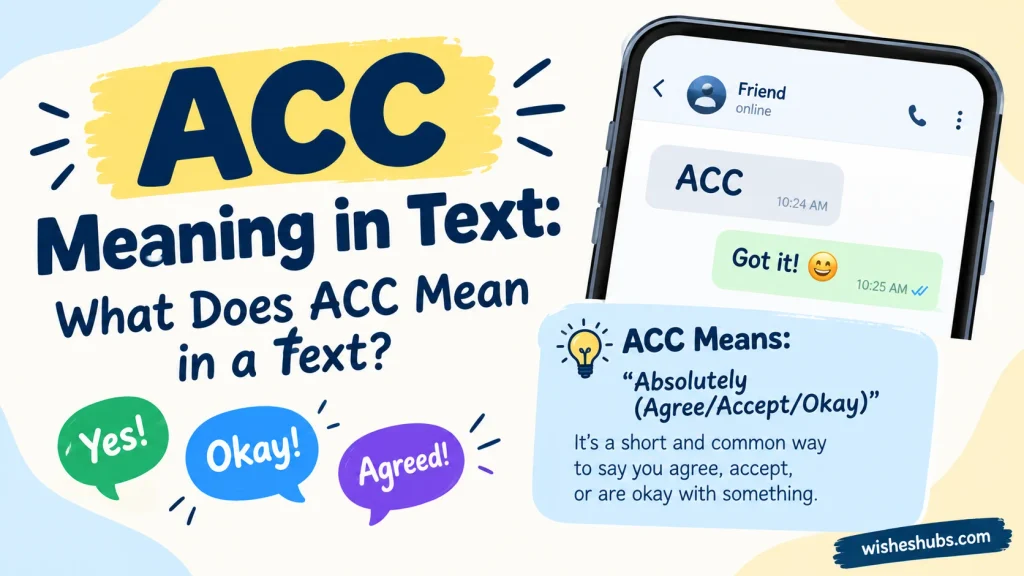
Seeing ACC in a text message can leave you scratching your head for a second. Unlike popular shortcuts such as LOL or BTW, ACC doesn’t always carry one universally understood meaning. In casual texting, it can mean “actually,” especially when someone wants to correct, clarify, or emphasize something. However, the surrounding conversation can change its meaning.
If a friend texts, “ACC, I already told you,” they’re most likely using ACC as a shortened form of actually. In another conversation, however, ACC could refer to an account, an organization, or something specific to that person’s community. That’s why reading the entire message matters before deciding what the abbreviation means.
Texting language constantly evolves. People shorten words to type faster, fit casual communication styles, or create shorthand within a particular group. ACC follows that broader pattern, although it isn’t as standardized as many widely recognized texting abbreviations.
Understanding the context makes the mystery much easier to solve. The words before and after ACC, the topic being discussed, and the relationship between the people texting can all provide useful clues. Here’s what ACC can mean and how to interpret it correctly.
Quick Answer: What Does ACC Mean in Text?
ACC can mean “actually” in casual texting. People may use it when correcting information, adding clarification, or emphasizing what they really mean.
For example:
“ACC, I don’t live there anymore.”
Here, ACC means “actually.”
Another example:
“I thought you hated coffee.”
“ACC, I love coffee.”
Again, the sender is essentially saying, “Actually, I love coffee.”
However, ACC doesn’t have one fixed meaning in every text message. In an account-related conversation, it can be shorthand for “account.” It can also represent an organization’s name or another context-specific term.
The safest rule is simple: don’t interpret ACC in isolation. Look at the complete message and conversation first.
What Does ACC Mean in Texting?
When ACC appears in casual text conversations, one possible interpretation is “actually.” The abbreviation can work as a compact way to introduce a correction, clarification, or contrasting fact.
Think of it as a quick verbal turn.
Someone says one thing. The sender responds with ACC to introduce what they believe is the more accurate version.
For example:
“You said Sarah was coming tonight.”
“ACC, she’s coming tomorrow.”
The sender isn’t simply adding another random detail. They’re correcting the previous statement.
ACC can also add emphasis without necessarily correcting someone.
“ACC I really liked that movie.”
In that sentence, “actually” signals that the speaker’s opinion may differ from what the other person expected.
ACC Meaning as “Actually”
The “actually” interpretation makes the most sense when ACC introduces information that changes, corrects, or qualifies something previously discussed.
Common patterns include:
- ACC, that’s not what happened.
- ACC I already finished it.
- ACC, she’s my cousin.
- ACC I don’t mind waiting.
- ACC, I think you’re right.
Notice something important: the abbreviation doesn’t create a new meaning by itself. The sentence around it supplies the meaning.
That’s why dictionary-style definitions alone aren’t enough when you’re decoding texting slang.
ACC Meaning in a Casual Text
In a conversation between friends, ACC may function as informal shorthand for “actually.”
Texting encourages this kind of compression. People routinely shorten expressions, remove punctuation, and rely on context because messages don’t need to sound like formal writing.
For example:
“Are you still mad at him?”
“ACC no. We talked about it.”
The sender could have written:
“Actually, no. We talked about it.”
The meaning remains essentially the same.
ACC When Correcting Someone
One of the clearest uses of “actually” involves correcting a previous statement.
Imagine this exchange:
Alex: “The store closes at 9.”
Jordan: “ACC, it closes at 10.”
Here, ACC signals that Jordan believes the previous information was incorrect.
It can also correct the sender’s own earlier assumption:
“I thought the appointment was Friday. ACC, it’s Thursday.”
In this case, the sender uses “actually” to update the information.
ACC When Clarifying a Point
ACC may also introduce a clarification without directly telling someone they’re wrong.
For example:
“I don’t really know her. ACC, we’ve met a few times.”
The word “actually” changes the nuance. The speaker is refining what they just said.
That distinction matters because “actually” doesn’t always mean “you’re wrong.” It can simply introduce a more precise version of the speaker’s thought.
Other ACC Meanings You May See
Context can completely change the meaning of ACC.
Although “actually” can fit casual texting, ACC also appears as an abbreviation for words and names outside texting slang.
ACC as “Account”
In some digital or administrative contexts, ACC can stand for “account.”
For example:
“Log into your ACC and check the payment.”
Here, interpreting ACC as “actually” would make no sense.
The topic provides the clue. If the conversation involves passwords, banking, social-media profiles, billing, subscriptions, or user profiles, account may be the intended meaning.
However, “ACC” isn’t a universal abbreviation for account across every platform. A company’s internal shorthand may differ from another service’s terminology.
ACC as an Organization or Name
ACC can also appear as an acronym for organizations, institutions, conferences, athletic associations, and other named entities.
For instance, ACC is widely associated with the Atlantic Coast Conference, a major collegiate athletic conference in the United States.
So a message such as:
“Did you watch the ACC game?”
could have nothing to do with texting slang.
The subject of the conversation matters enormously. If two people are discussing college sports, interpreting ACC as “actually” would be a poor fit.
ACC Meaning in Different Texting Contexts
The same three letters can produce completely different interpretations depending on the conversation.
| Context | Possible ACC Meaning | Example |
| Casual conversation | Actually | “ACC, I already knew that.” |
| Correction | Actually | “ACC, that’s not what I said.” |
| Account-related discussion | Account | “Check your ACC balance.” |
| College sports | Atlantic Coast Conference | “The ACC schedule is out.” |
| Organization-specific chat | Organization or internal acronym | Depends on the group |
This is a useful reminder: abbreviations don’t live in a vacuum.
ACC in a Text From a Friend
If a friend suddenly writes:
“ACC I wasn’t mad at you.”
“Actually” is a reasonable interpretation because the sentence naturally accommodates it.
The same applies to:
“ACC I wanted to go.”
“ACC, I forgot to tell you.”
“ACC, you’re right.”
In each case, “actually” fits naturally.
ACC in Social Media Messages
On social platforms, people often communicate with shorthand. ACC may therefore appear in DMs, comments, or private conversations.
However, social-media context doesn’t automatically make ACC mean “actually.”
Look at the surrounding words.
For example:
“ACC I thought you knew.”
That strongly supports “actually.”
Meanwhile:
“I can’t access my ACC.”
could point toward account, depending on the platform and conversation.
ACC in Group Chats
Group chats can develop their own shorthand.
One friend group might regularly use ACC to mean “actually.” Another group might use it for an entirely different phrase. In some communities, an acronym may become familiar because everyone already understands its meaning.
If you’ve just joined a group chat, don’t assume every abbreviation follows standard texting conventions.
Group-specific language can behave like a mini-dialect.
ACC in Work Messages
Professional communication requires more caution.
If a coworker writes:
“ACC, the client approved the change.”
the intended meaning may be “actually,” although the abbreviation could momentarily slow the reader down.
For important workplace messages, writing “actually” instead of ACC usually creates less ambiguity.
Clear communication beats shaving a few characters off a sentence.
How to Know What ACC Means in a Text
You don’t need a secret texting dictionary to decode ACC. A few contextual clues usually help.
Look at the Entire Sentence
Start with the simplest test.
Replace ACC with “actually.”
Does the sentence still make sense?
“ACC, I forgot about the meeting.”
Yes.
Now try:
“Send the payment to my ACC.”
“Actually” clearly doesn’t fit.
That quick substitution test can solve many abbreviation puzzles.
Consider the Conversation Topic
The subject often provides the strongest clue.
If you’re discussing:
- Personal opinions → “actually” may fit
- Corrections → “actually” may fit
- Banking → “account” may fit
- Online profiles → “account” may fit
- College sports → Atlantic Coast Conference may fit
- A particular organization → its official acronym may fit
Consider Who Sent It
People develop personal texting habits.
One person might use ACC frequently. Another might never use it. If the sender has used ACC several times, compare the previous messages.
Past usage within the same conversation can be a valuable clue.
Ask If the Meaning Remains Unclear
There’s no prize for guessing incorrectly.
If ACC doesn’t make sense, ask:
“What do you mean by ACC here?”
That’s especially useful when the message could reasonably have several interpretations.
Also Read This: GMT Meaning in Texting: What Does GMT Mean in a Text?
Examples of ACC in Text Messages
Realistic examples make the difference between recognizing an abbreviation and actually understanding it.
Example: Correcting Information
Sam: “You said the store closes at 8.”
Mia: “ACC, it closes at 9.”
Meaning: Actually.
Mia uses ACC to correct the previous information.
Example: Correcting an Assumption
Sam: “I thought you didn’t like sushi.”
Mia: “ACC, I love sushi.”
Meaning: Actually.
Here, ACC introduces information that contradicts Sam’s assumption.
Example: Adding Clarification
Sam: “So you don’t know her?”
Mia: “ACC, we’ve met twice.”
Meaning: Actually.
Mia adds a more accurate detail to her earlier position.
Example: Expressing Agreement
“ACC, I think you’re right about that.”
Meaning: Actually.
The sender uses the term to emphasize or qualify their agreement.
Example: Account Context
“I changed the password for my ACC.”
Possible meaning: Account.
The surrounding subject makes “account” much more plausible than “actually.”
ACC vs. Similar Text Abbreviations
ACC can overlap with the conversational role of other abbreviations, particularly when someone wants to add a thought or qualify a statement.
| Abbreviation | Meaning | Typical Function |
| ACC | Actually / context-dependent | Correction or clarification |
| TBH | To Be Honest | Honest opinion or admission |
| IMO | In My Opinion | Personal viewpoint |
| BTW | By The Way | Introduces another point |
| FYI | For Your Information | Shares information |
| IDK | I Don’t Know | Expresses uncertainty |
The distinction is worth noticing.
TBH generally introduces honesty or personal opinion. IMO identifies an opinion. BTW changes the direction of the conversation. ACC, when used as “actually,” often modifies or corrects something already stated.
For example:
“TBH, I don’t like it.”
This means the speaker is emphasizing honesty.
“IMO, it’s overpriced.”
This clearly marks a personal opinion.
“ACC, it’s cheaper online.”
This introduces a correction or clarification.
Is ACC a Common Texting Abbreviation?
ACC is not as universally established as abbreviations such as LOL, BRB, IDK, or BTW.
That’s an important distinction.
Many texting shortcuts have highly recognizable meanings across different English-speaking communities. ACC can be more context-sensitive. Some people may understand it immediately as “actually,” while others may interpret it as something completely different.
This variation explains why searches for ACC meaning in text can produce conflicting answers.
Rather than treating one definition as universally correct, consider three questions:
- What is the conversation about?
- Does “actually” fit naturally?
- Does the sender use ACC consistently?
Those clues are usually more reliable than an isolated acronym list.
Is ACC Appropriate to Use in Text Messages?
For casual conversations, abbreviations can make messages feel quick and relaxed.
ACC may work when you’re texting:
- Friends
- Family members
- Close acquaintances
- Informal group chats
- People who already understand your shorthand
However, professional or formal communication calls for greater clarity.
Avoid unexplained abbreviations when writing:
- Job applications
- Formal business emails
- Academic assignments
- Customer-service messages
- Legal or financial communication
Instead of:
“ACC, the figures are different.”
write:
“Actually, the figures are different.”
The second version leaves less room for interpretation.
How to Reply When Someone Texts “ACC”
Your response depends on what ACC appears to mean.
When ACC Means “Actually”
Suppose someone writes:
“ACC, I already sent it.”
Natural responses include:
- “Oh, okay.”
- “Got it.”
- “My mistake.”
- “Thanks for clarifying.”
There’s no special response required simply because someone used an abbreviation.
When You Aren’t Sure
If the meaning isn’t obvious, ask directly:
“Do you mean actually?”
Or:
“What does ACC mean here?”
A short clarification can prevent an unnecessarily confusing conversation.
Common Misunderstandings About ACC
Several assumptions can make ACC harder to understand.
ACC Doesn’t Always Mean “Actually”
This is the biggest point.
While “actually” can make sense in casual texting, context determines the intended meaning.
Capitalization Doesn’t Guarantee the Meaning
Someone might type:
- ACC
- acc
- Acc
Capitalization alone doesn’t establish what the abbreviation means.
Not Every Acronym Is Universal
Texting slang changes quickly. Different age groups, communities, workplaces, fandoms, and friend groups can develop different shorthand.
Acronyms therefore need context.
“Actually” Doesn’t Always Signal an Argument
When someone writes:
“ACC, I agree with you.”
they aren’t necessarily correcting you. The word can simply introduce a clarification or emphasis.
Tone comes from the complete message.
A Simple ACC Meaning Checklist
When you encounter ACC in a message, run through this quick checklist:
- Read the entire sentence.
- Try replacing ACC with “actually.”
- Check whether the conversation involves an account.
- Consider whether ACC refers to a specific organization.
- Look at the sender’s previous messages.
- Pay attention to the conversation topic.
- Ask for clarification if the meaning remains uncertain.
This method is much more reliable than memorizing one definition.
ACC Meaning in Text: Key Takeaways
The meaning of ACC depends heavily on context.
The most useful points to remember are:
- ACC can mean “actually” in casual texting.
- It can introduce a correction, clarification, or emphasis.
- ACC can also mean “account” in certain contexts.
- ACC may represent an organization or proper name, such as the Atlantic Coast Conference.
- Capitalization doesn’t determine the meaning.
- ACC isn’t as universally standardized as LOL or BTW.
- The surrounding words usually provide the strongest clue.
- When the meaning isn’t clear, asking the sender is the safest option.
FAQs:
Is ACC a texting abbreviation for actually?
Yes, ACC can be used as a short form of “actually” in casual text conversations. It often appears when someone wants to correct a detail, clarify their previous statement, or add emphasis.
Why do people use ACC instead of actually?
People may use ACC to save typing time or keep a conversation informal. Like other texting abbreviations, it can make messages shorter and quicker. However, not everyone uses ACC this way.
Can ACC have different meanings in texting?
Yes. ACC can have multiple meanings depending on context. In casual conversation, it may mean “actually.” In account-related discussions, it could refer to “account.” Other meanings can apply when the conversation involves a specific organization or subject.
Does ACC mean the same thing as “actually”?
When a sender uses ACC as texting shorthand, it carries the same basic meaning as “actually.” The difference is mainly the abbreviated form. Context still determines whether “actually” is the intended interpretation.
Can ACC be used at the beginning of a text?
Yes. ACC can appear at the beginning of a message when someone introduces a correction or clarification.
Example:
“ACC, I meant Tuesday.”
Here, ACC means “actually.”
Can ACC sound rude in a text?
ACC isn’t automatically rude. However, the message surrounding it can affect how the reader perceives the tone. A blunt correction such as “ACC, you’re wrong” may sound confrontational, while “ACC, I think the date is different” sounds more neutral.
Should you use ACC in a formal message?
It’s usually better to write “actually” in formal communication. Spelling out the word makes your meaning immediately clear and avoids forcing the reader to decode an abbreviation.
Does punctuation change the meaning of ACC?
Punctuation doesn’t normally determine what ACC means. A sender might write “ACC, that’s correct” or “ACC that’s correct.” The surrounding words and conversation provide more useful clues.
What should you do if you don’t understand ACC?
If the message doesn’t provide enough context, simply ask the sender. You could say, “What do you mean by ACC here?” A quick clarification prevents unnecessary confusion.
Is ACC as common as LOL or BTW?
No. ACC isn’t generally as recognizable or standardized as widely used abbreviations such as LOL, BTW, or IDK. Its meaning can vary more between conversations and communities, which makes context especially important.
Conclusion:
The meaning of ACC in text depends on the conversation surrounding it. In casual messages, ACC can mean “actually” when someone wants to correct, clarify, or emphasize a point. In other situations, it may mean “account” or refer to a specific organization or subject. When you’re unsure, check the context first. If the meaning still isn’t obvious, asking the sender is the simplest solution.

“Explore Mark Hill at Wisheshubs.com – your go-to place for best wishes, greetings, and celebrations. Easy, fun, and ready to share!”





1 thought on “ACC Meaning in Text: What Does ACC Mean in a Text?”