
Have you ever seen “text to text” in a conversation and wondered what the person actually meant? The phrase can be confusing because text has more than one meaning. It can refer to a written work, a passage, or a text message.
In most cases, text to text meaning depends on the context. In education and reading, it usually describes a connection or comparison between two written texts. For example, you might compare two books that explore the same theme.
However, a casual conversation can use “text to text” differently. Someone might use it while talking about communicating through text messages. That distinction matters because the phrase isn’t a standard texting abbreviation with one fixed definition.
Understanding the surrounding sentence usually solves the mystery. Once you know whether the conversation involves schoolwork, literature, documents, or messaging, the intended meaning becomes much easier to identify.
Quick Answer
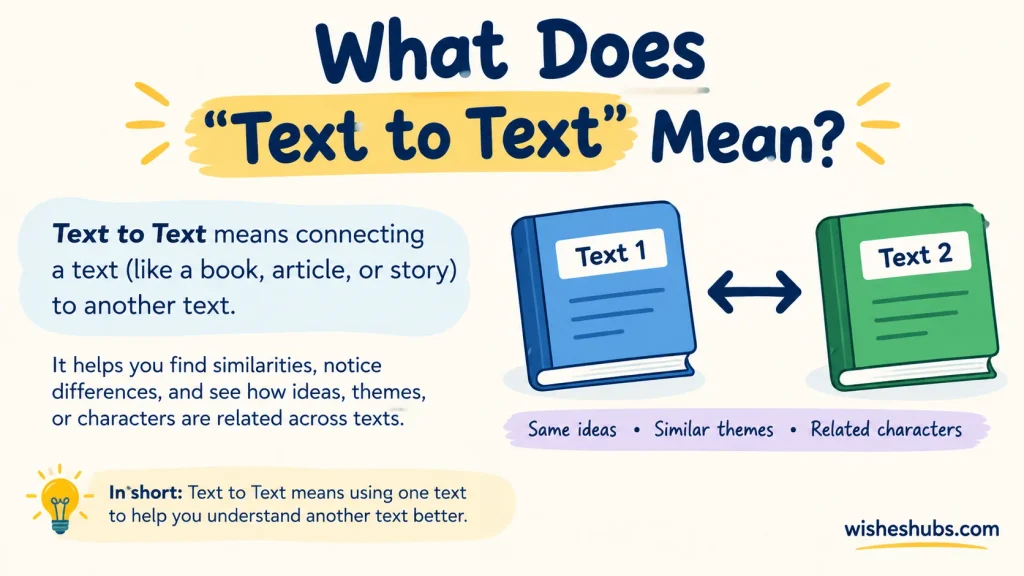
Text to text usually means connecting, comparing, or relating one written text to another. The phrase commonly appears in reading, literature, education, and writing.
For example:
“The teacher asked us to make a text-to-text connection between the two stories.”
Here, the student needs to find something meaningful that connects the stories. That connection could involve their themes, characters, events, conflicts, messages, or ideas.
The phrase can have a different meaning in casual messaging. If someone says they discussed something “text to text,” they may simply mean they communicated through text messages.
So, there isn’t one secret slang definition. Context determines the intended meaning.
What Does Text to Text Mean?
The simplest text to text meaning is a relationship between two pieces of written material.
A “text” doesn’t necessarily mean a phone message. In reading and writing, a text can be almost any written work. It could be a novel, article, poem, essay, news report, speech, or even a short passage.
When you connect one text to another, you look for meaningful similarities or differences.
For example, imagine that you read two stories about people overcoming difficult circumstances. One story might involve a young athlete while the other follows a student dealing with family problems.
The characters are different. The settings are different. Yet both stories could share a theme of resilience.
That shared idea creates a text-to-text connection.
The Basic Idea Behind Text to Text
Think of two written works as two puzzle pieces.
They don’t have to look identical. Instead, you look for the part where they fit together.
A text-to-text connection might involve:
- Similar themes
- Different perspectives
- Similar characters
- Contrasting characters
- Related events
- Shared conflicts
- Similar messages
- Common symbols
- Different approaches to the same subject
- Similar arguments or evidence
The connection should have a meaningful reason behind it. Simply saying that two stories are both books isn’t a useful text-to-text connection.
Text to Text Meaning in Reading
The term text-to-text connection has an important place in reading comprehension.
Readers often understand a new text more deeply when they connect it with something they’ve already read. This process helps them recognize patterns, compare ideas, and evaluate different perspectives.
For example, suppose you read one article explaining the causes of climate change. Later, you read another article discussing its effects.
You can connect the two texts because the first focuses on causes while the second focuses on consequences.
That connection helps you build a broader understanding of the subject.
What Is a Text-to-Text Connection?
A text-to-text connection occurs when you relate one written work to another based on a meaningful feature.
You might ask:
- Does this text discuss an idea I’ve seen before?
- Does another story have a similar character?
- Do these authors present opposing opinions?
- Do these books share the same theme?
- Does one article provide information that supports or challenges another?
- Do the texts describe similar events from different perspectives?
These questions turn reading into an active process rather than simply moving your eyes across a page.
Text to Text Meaning in Literature
Literature provides countless opportunities for text-to-text comparisons.
Two novels might feature completely different characters while exploring the same central theme. Likewise, two poems might use different imagery to discuss similar emotions.
For instance, one story could explore freedom through a character escaping an oppressive situation. Another might explore freedom through a teenager choosing their own future.
The plots differ, yet both texts examine the same underlying idea.
Common Literary Connections
When comparing literary texts, readers often examine:
| Element | What You Can Compare |
| Theme | The central idea explored by both works |
| Characters | Their personalities, choices, or development |
| Conflict | Problems faced by characters |
| Setting | Where and when the stories take place |
| Plot | Similar or contrasting events |
| Point of view | How each author presents the story |
| Symbolism | Objects or images representing larger ideas |
| Tone | The emotional attitude of the writing |
| Message | What readers can learn from each work |
A strong comparison doesn’t stop at identifying similarities. Differences can be just as valuable.
For example, two stories might explore courage. One author could portray courage as taking physical risks while another could present it as admitting fear.
That contrast gives the reader something meaningful to analyze.
Text to Text Meaning in School
Students commonly encounter text-to-text meaning in reading assignments and classroom discussions.
A teacher might ask:
“What text-to-text connection can you make between these passages?”
The question isn’t asking whether you’ve read both passages. It asks you to connect their ideas.
For example, you might compare two articles about social media.
One article could discuss its benefits for communication. Another could focus on its potential effects on mental well-being.
Your response might explain that both articles examine how social media affects people’s daily lives. However, they approach the subject from different perspectives.
That’s a genuine text-to-text connection.
What Teachers Usually Look For
A useful response generally includes three parts:
- Identify both texts.
- Explain the connection.
- Describe why that connection matters.
A weak answer might say:
“Both texts are about animals.”
A stronger answer would say:
“Both texts explain how habitat loss affects wildlife. However, the first focuses on declining populations while the second examines how conservation programs can protect endangered species.”
The second response demonstrates actual comprehension and comparison.
Text-to-Text vs. Text-to-Self vs. Text-to-World
If you’re studying reading strategies, you may also encounter text-to-self and text-to-world.
These terms sound similar because they describe different ways readers connect information.
| Reading Connection | Meaning | Example |
| Text-to-text | Connects one text with another | Comparing two stories about courage |
| Text-to-self | Connects a text with personal experience | Relating a character’s move to your own experience |
| Text-to-world | Connects a text with broader events or issues | Connecting a novel’s conflict with a real-world issue |
The easiest way to remember them is to focus on the second part.
Text-to-text: another text.
Text-to-self: your own experience.
Text-to-world: the wider world.
That simple distinction prevents a lot of confusion.
What Does Text to Text Mean in a Text Message?
This is where things get slightly trickier.
If you saw “text to text” in a text message, don’t automatically assume it refers to literature or schoolwork. The conversation around the phrase matters.
In a casual chat, someone could use “text to text” to describe communication through written messages.
For example:
“We worked everything out text to text.”
Here, the speaker may mean that they discussed the situation by exchanging text messages.
Another example:
“I only know him through text to text conversations.”
The wording sounds less common than simply saying “through texting” or “over text,” but the intended idea may still involve communication through messages.
Is Text to Text a Standard Texting Term?
No. “Text to text” isn’t a widely recognized texting abbreviation.
It doesn’t work like:
- LOL — laughing out loud
- BRB — be right back
- IDK — I don’t know
- BTW — by the way
- TTYL — talk to you later
Those abbreviations have widely understood meanings in digital communication.
“Text to text” is different. It’s an ordinary phrase whose meaning changes according to context.
That distinction is important when you’re trying to decode an unfamiliar message.
Also Read This: NSFW Definition: What It Means and When People Use It
Text to Text vs. Text-to-Text
The two forms look almost identical:
- text to text
- text-to-text
The hyphenated version often works as a compound adjective.
For example:
“The assignment requires a text-to-text comparison.”
Here, “text-to-text” describes the type of comparison.
Without the hyphens, the phrase can function more naturally within a sentence:
“The assignment asks students to connect one text to another.”
In educational materials, text-to-text connection is a common expression because it clearly describes the relationship between two texts.
The punctuation doesn’t create an entirely different concept. Instead, the hyphens help combine the words into a descriptive phrase.
Examples of Text to Text Meaning
Seeing real examples makes the phrase much easier to understand.
Example in an English Class
“Find a text-to-text connection between the two poems.”
Meaning: Compare the poems and identify an important similarity or relationship.
Example With Two Articles
“The second article reminded me of the first one because both discussed online privacy.”
Meaning: The reader has made a text-to-text connection.
Example in Literature
“Both novels explore the consequences of difficult choices.”
Meaning: The reader has identified a shared theme between two literary works.
Example in Casual Messaging
“We talked about the problem text to text.”
Meaning: The speakers may have communicated about the problem through text messages.
Notice how the surrounding subject changes the interpretation.
How to Understand Text to Text Meaning From Context
When someone uses an unfamiliar phrase, the surrounding words often provide the biggest clue.
Look at the Topic
Ask yourself what the conversation discusses.
If you’re talking about books, assignments, or articles, text-to-text connection is probably the intended meaning.
If you’re discussing how two people communicated, the phrase may refer to text messaging.
Look at the Sentence
Consider this sentence:
“Find a text-to-text connection between these chapters.”
The educational meaning is obvious.
Now compare:
“We sorted it out text to text.”
This likely refers to communicating through messages.
The phrase itself hasn’t changed. The context has.
Consider Who Is Speaking
A teacher may use “text-to-text” as a reading strategy.
A student may use it while discussing homework.
A friend might use “text to text” while describing a conversation.
The speaker’s situation can provide another useful clue.
What Does Text to Text Mean in Communication?
In communication, text can mean written communication rather than spoken conversation.
People often contrast communication methods such as:
- Face-to-face conversation
- Phone calls
- Video calls
- Text messages
- Written letters
- Online messaging
If someone describes an interaction as happening “text to text,” they may simply be emphasizing that the communication occurred through written messages.
Still, “over text” or “through texting” sounds more natural in everyday American English.
For example:
“We talked about it over text.”
This is more common than:
“We talked about it text to text.”
That difference matters when interpreting someone’s wording. A phrase can be understandable without being the most natural expression.
Common Misunderstandings About Text to Text Meaning
Several misconceptions can make this phrase seem more complicated than it really is.
It Doesn’t Always Mean Text Messaging
The word text existed long before smartphones.
A text can refer to a written work, including a book, article, poem, passage, or document.
Therefore, “text to text” often has nothing to do with phone messages.
It Isn’t a Secret Slang Expression
There is no broadly established hidden slang meaning attached to “text to text.”
If someone uses it strangely in a conversation, the safest approach is to examine the surrounding context.
It Isn’t the Same as “Text Me”
“Text me” is a direct request to send someone a message.
For example:
“Text me when you get home.”
“Text to text” has a completely different structure and usually serves a different purpose.
It Isn’t a Common Acronym
Don’t treat text to text like an abbreviation.
People generally write the phrase out rather than replacing it with a standard acronym.
Text to Text Meaning vs. Similar Phrases
These expressions can look related while carrying different meanings.
| Phrase | Meaning |
| Text to text | Usually connects or compares one written text with another |
| Text-to-text | Describes a connection or comparison between two texts |
| Text me | Ask someone to send a text message |
| Over text | Communicate through text messages |
| Through text | Communicate or express something using written messages |
| Texting | Sending and receiving text messages |
| Text-to-self | Connecting a text with personal experience |
| Text-to-world | Connecting a text with broader real-world ideas |
Knowing these differences makes digital and academic language much easier to navigate.
Why Context Matters With Text to Text
The biggest lesson here is simple: don’t interpret the phrase in isolation.
English contains many words that change meaning depending on how people use them. “Text” is one of them.
In one sentence, it can mean a novel.
In another, it can mean a phone message.
Consider these two examples:
“The student made a text-to-text connection.”
This clearly points toward reading or literary analysis.
Now consider:
“They discussed the disagreement text to text.”
This likely refers to written messaging.
The surrounding words act like signposts. Follow them.
A Simple Way to Identify the Meaning
When you’re unsure what someone means by “text to text,” use this quick checklist:
- Is the conversation about books or articles?
It probably refers to comparing written texts. - Is the conversation about a school assignment?
It likely means a text-to-text connection. - Are two stories being compared?
Look for shared themes, characters, conflicts, or messages. - Is someone discussing how they communicated?
It may refer to communicating through text messages. - Does the phrase appear beside words like “connection” or “comparison”?
The educational or literary meaning is almost certainly intended. - Does it appear beside words like “talked,” “discussed,” or “messaged”?
The messaging meaning may fit better.
How to Respond When Someone Uses “Text to Text”
If you’re unsure what someone means, there’s no need to guess wildly.
You can ask a short clarification question.
For an academic conversation:
“Do you mean a text-to-text connection between the two readings?”
For a messaging conversation:
“Do you mean you discussed it through text?”
A quick question can clear up the meaning without turning a simple conversation into a linguistic detective case.
Key Facts About Text to Text Meaning
Here are the most important points to remember:
- Text to text commonly describes a connection between two written texts.
- The phrase appears frequently in reading and literary analysis.
- A text can mean a book, article, poem, passage, essay, or other written work.
- A text-to-text connection identifies a meaningful relationship between texts.
- Similarities aren’t the only useful connections. Differences also matter.
- “Text to text” isn’t a standard texting abbreviation.
- In casual communication, the phrase can sometimes refer to communicating through text messages.
- Context determines the intended meaning.
- “Text-to-text” often appears as a hyphenated compound term.
- “Over text” is generally more natural than “text to text” when discussing messaging.
FAQs About Text to Text Meaning
What does “text to text” mean?
Text to text usually means connecting, comparing, or relating one written text to another. It commonly appears in reading, literature, and educational discussions. The exact meaning can change when the phrase appears in a casual texting conversation.
What does “text-to-text” mean in reading?
In reading, text-to-text describes a connection between two written works. You might compare their themes, characters, conflicts, ideas, events, or messages. For example, comparing two stories about overcoming challenges creates a text-to-text connection.
Is “text to text” a texting abbreviation?
No. “Text to text” isn’t a standard texting abbreviation like LOL, IDK, BRB, or TTYL. It’s a regular phrase whose meaning depends on the situation and the words surrounding it.
What is an example of a text-to-text connection?
A simple example would be comparing two novels that both explore friendship. You could explain how each story presents loyalty differently. The shared theme creates the connection while the contrasting details make the comparison more meaningful.
What is the difference between text-to-text and text-to-self?
Text-to-text connects one written work with another. Text-to-self connects something you read with your own experiences. For example, comparing two novels is text-to-text while relating a character’s experience to your own life is text-to-self.
What is the difference between text-to-text and text-to-world?
A text-to-text connection links two written sources. A text-to-world connection links something you read with real-world events, social issues, history, or general knowledge. Both strategies help readers understand ideas from a broader perspective.
Does “text to text” mean communicating by text?
Sometimes, depending on the context. Someone might use “text to text” to describe communicating through written messages. However, “over text” or “through texting” sounds more natural in everyday American English.
What does text to text mean in literature?
In literature, it generally means examining the relationship between two literary works. Readers can compare themes, characters, conflicts, settings, symbolism, tone, and messages to understand how the works relate to each other.
Why is context important when understanding “text to text”?
The word text can refer to different things. It might mean a book, article, passage, or phone message. Looking at the complete sentence and conversation helps you determine which meaning the speaker intends.
How should you respond if someone says “text to text”?
If the meaning isn’t clear, ask a quick clarification question. For an academic conversation, you could ask, “Do you mean a text-to-text connection?” If they’re discussing communication, you could ask, “Do you mean you talked through text?”
Conclusion:
Understanding the text to text meaning becomes much easier when you consider the context. In reading and education, it usually describes a meaningful connection between two written texts.
In casual conversations, it may refer to communicating through text messages. Since the phrase isn’t a standard texting abbreviation, always look at the surrounding words before deciding what someone means.

“Explore unique wishes, greetings, and celebration ideas with Emma Brooke at Wisheshubs.com – your go-to place for inspiring messages!”
1 thought on “Text to Text Meaning: What Does “Text to Text” Mean?”