
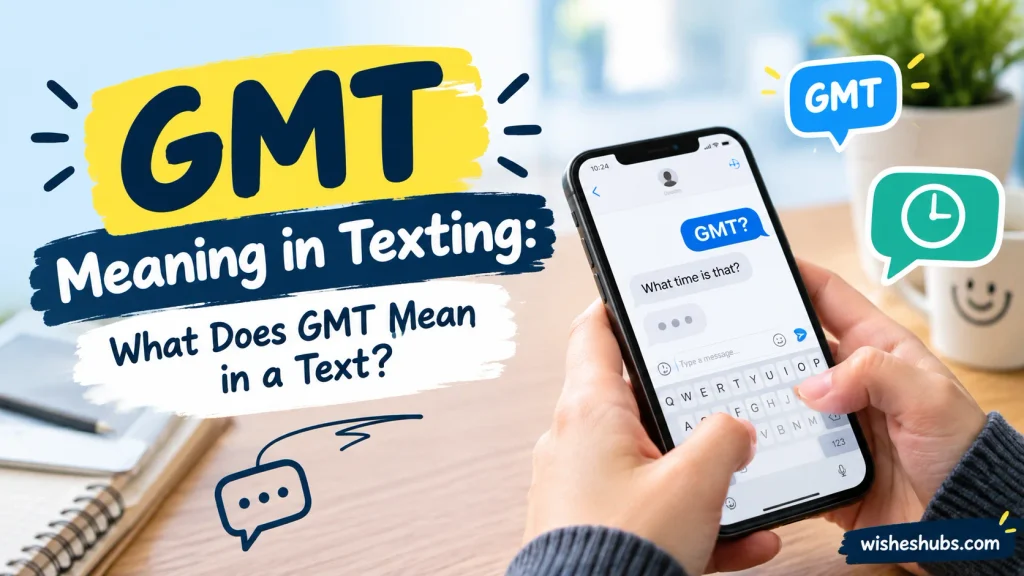
Seeing GMT in a text can leave you wondering whether it’s another piece of internet slang. In most conversations, however, GMT meaning in texting relates to time rather than slang. The abbreviation commonly appears when people discuss schedules, international events, meetings, travel, or different time zones.
Because texting often crosses borders, people need a shared time reference. GMT stands for Greenwich Mean Time, a traditional time standard associated with the prime meridian at Greenwich, London. You may see someone write “8 GMT” or “14:00 GMT” when they want everyone to understand the exact reference time.
However, GMT can become confusing when daylight saving time enters the picture. A person in the United Kingdom, for example, doesn’t use GMT year-round. The UK switches between GMT and British Summer Time (BST). That’s why understanding the context matters before converting a GMT time into local time.
Whether you encountered GMT in a group chat, work message, gaming community, or travel conversation, the surrounding words usually reveal its meaning. Once you understand the basic time-zone concept, messages containing GMT become much easier to decode.
Quick Answer: What Does GMT Mean in Texting?
GMT meaning in texting usually refers to Greenwich Mean Time. People use it as a time reference when discussing meetings, online events, travel, gaming schedules, livestreams, and international communication.
For example:
“The meeting starts at 15:00 GMT.”
This means the meeting starts at 3:00 PM according to GMT.
GMT is traditionally associated with the mean solar time at the Prime Meridian, 0° longitude, which passes through Greenwich in London. In modern technical timekeeping, UTC (Coordinated Universal Time) serves as the primary international standard. GMT remains extremely common in everyday language and many practical time-zone references.
So, if someone texts:
- “Are you free at 18 GMT?” — They mean 6:00 PM GMT.
- “The stream starts at 20:00 GMT.” — The stream begins at 8:00 PM GMT.
- “What’s 12 GMT in your time?” — They want you to convert noon GMT into your local time.
In a texting context, GMT is usually about coordinating time, not slang.
What Does GMT Stand For?
GMT stands for Greenwich Mean Time.
The name comes from Greenwich, an area of London associated with the historic Royal Observatory. Greenwich became the reference point for the Prime Meridian, which is defined as 0° longitude.
The term “mean” matters because traditional GMT was based on an average solar-time concept rather than the exact position of the Sun at a particular instant.
Today, people often use GMT as a straightforward reference for UTC+0. However, GMT and UTC aren’t technically the same thing.
GMT vs. UTC
The distinction between GMT and UTC can seem unnecessarily fussy at first. It becomes useful when you need precise information.
| Term | Full Name | Main Role |
| GMT | Greenwich Mean Time | Traditional time reference associated with Greenwich |
| UTC | Coordinated Universal Time | Modern international time standard |
| BST | British Summer Time | UK daylight-saving time |
UTC is the modern standard used for international timekeeping. It is maintained using highly precise atomic clocks and adjusted in relation to Earth’s rotation through international timekeeping systems.
GMT has historical and everyday importance. You’ll still see it on websites, schedules, software documentation, travel information, and messages.
For ordinary texting, the distinction usually doesn’t change the clock reading at UTC+0. The technical difference matters more when discussing precise timekeeping.
GMT Meaning in Text Messages
When someone types GMT in a text message, they’re usually giving or asking for a time based on the GMT reference.
This becomes particularly useful when two people live in different countries.
Imagine someone in New York texts a colleague in London:
“Can we talk at 4 GMT?”
The sender isn’t asking the other person to guess which local clock they mean. GMT gives both people a common reference.
You may encounter GMT in conversations involving:
- International meetings
- Online events
- Gaming tournaments
- Livestreams
- Travel
- Flight schedules
- Remote work
- Software releases
- Sports events
- Online classes
- Customer support hours
The abbreviation essentially works like a timestamp anchor. Everyone can convert that reference into their own local time.
Examples of GMT in Texting
Here are some natural examples:
Text: “The webinar starts at 18:00 GMT.”
Meaning: The webinar starts at 6:00 PM GMT.
Text: “Can you join the call at 14 GMT?”
Meaning: The sender wants you available at 2:00 PM GMT.
Text: “What time is 21 GMT for you?”
Meaning: The sender wants to know the equivalent local time.
Text: “The server maintenance begins at 00:00 GMT.”
Meaning: Maintenance begins at midnight GMT.
Text: “I’ll be online after 17 GMT.”
Meaning: The person expects to be available after 5:00 PM GMT.
How GMT Is Used in Different Conversations
The meaning stays essentially the same across these situations. What changes is why someone needs a shared time reference.
GMT in Work and Business Chats
International teams often use GMT when employees work across multiple time zones.
For example:
“The client call is scheduled for 13:00 GMT.”
A team member in one country can convert 13:00 GMT into local time. Another employee elsewhere can perform the same conversion.
This approach prevents the classic scheduling headache where everyone says “3 PM” while silently imagining a different clock.
GMT can be especially useful for remote teams, international companies, and customer-support operations.
Some organizations may instead use UTC because it is the modern technical standard. Others use a specific regional time zone.
GMT in Gaming and Online Communities
Gaming communities often coordinate events across countries.
A tournament announcement might say:
“Registration closes at 19:00 GMT.”
A player doesn’t need to know where the organizer lives. They only need to convert the announced time.
GMT also appears in discussions about:
- Server resets
- Game updates
- Maintenance windows
- Tournament start times
- Community events
- Esports broadcasts
For global online communities, a shared reference can make scheduling much cleaner.
GMT in Travel Conversations
Travel creates another common reason for mentioning GMT.
Someone might text:
“The flight departs at 10 GMT.”
The important detail is that GMT does not automatically mean local airport time. Travelers should check the actual time zone listed by the airline, airport, itinerary, or booking confirmation.
A departure from London, for example, may use local UK time. During British Summer Time, the UK’s local clock operates at UTC+1, not GMT.
That one-hour difference can turn a harmless assumption into a missed connection.
GMT in Social Media and Online Events
Online organizers frequently publish times in GMT or UTC because their audiences may live worldwide.
A livestream could be advertised as:
“Live at 19:00 GMT.”
Someone in another country can convert the time before the broadcast begins.
This practice is common for international digital events because a single standardized reference is easier than listing dozens of local times.
GMT Time Zone Explained
GMT is traditionally associated with UTC+0.
The “+0” means there is no hour difference from the UTC reference.
For example:
12:00 GMT = 12:00 at UTC+0
Once you move east or west from this reference, the offset changes.
What Does GMT+5 Mean?
GMT+5 means five hours ahead of GMT.
For example:
12:00 GMT → 17:00 at GMT+5
That’s a five-hour difference.
Pakistan Standard Time is UTC+5, which means Pakistan’s standard clock time is five hours ahead of UTC. Unlike some regions, Pakistan does not currently observe a seasonal daylight-saving clock change.
What Does GMT-5 Mean?
GMT-5 means five hours behind GMT.
For example:
12:00 GMT → 07:00 at GMT-5
The sign matters.
- GMT+5 → five hours ahead
- GMT-5 → five hours behind
A simple way to remember it is to treat GMT as the center point on a number line.
GMT-5 ← GMT-1 ← GMT/UTC+0 → GMT+1 → GMT+5
The farther you move eastward in time-zone offsets, the more hours you generally add. Moving westward generally means subtracting hours.
GMT vs. Local Time
A GMT timestamp doesn’t automatically tell you what time it is where you live.
Suppose someone sends:
“Call me at 16:00 GMT.”
If your location uses UTC+5, the equivalent is:
16:00 + 5 hours = 21:00
So the call would occur at 9:00 PM local time.
However, time-zone conversion isn’t always as simple as adding a fixed number. Some locations observe daylight saving time, which changes their local offset during part of the year.
That’s why reliable time-zone conversion tools should account for the date as well as the location.
Why the Date Matters
Consider someone scheduling an event months in advance.
A city might use one UTC offset during winter and another during summer. If the conversion ignores the date, the result can be off by an hour.
This is one reason named time zones can be more reliable for scheduling than generic abbreviations.
For example, “America/New_York” identifies a regional time zone with its seasonal rules. “GMT-5” simply describes a numerical offset.
Also Read This: ISTG Slang Meaning: What Does ISTG Mean in Texting?
GMT vs. Other Common Time-Zone Abbreviations
GMT is only one of many abbreviations you’ll encounter in messages.
| Abbreviation | Meaning | Common Context |
| GMT | Greenwich Mean Time | International time reference |
| UTC | Coordinated Universal Time | Global time standard |
| BST | British Summer Time | UK daylight-saving period |
| EST | Eastern Standard Time | Eastern North America |
| CST | Central Standard Time | Central North America |
| MST | Mountain Standard Time | Mountain North America |
| PST | Pacific Standard Time | Pacific North America |
There’s an important catch here.
Time-zone abbreviations can be ambiguous.
For instance, “CST” can refer to different time standards in different parts of the world. The same abbreviation doesn’t always guarantee the same offset.
For international communication, a numerical offset such as UTC+5 can sometimes provide greater clarity.
Better still, when the date matters, use a recognized regional time-zone identifier or a scheduling system that handles daylight-saving rules automatically.
Is GMT Always About Time?
Not necessarily.
Abbreviations can have multiple meanings across different communities. However, GMT most commonly refers to Greenwich Mean Time when the conversation involves schedules or clocks.
Context provides the strongest clue.
If someone writes:
“GMT 8 PM?”
they’re almost certainly discussing a time.
If the conversation has nothing to do with schedules, locations, or time zones, you shouldn’t automatically assume the abbreviation has the same meaning.
Look at the words surrounding it.
Words That Often Signal the Time Meaning
The following terms strongly suggest that GMT refers to Greenwich Mean Time:
- Time
- Hour
- Meeting
- Schedule
- Date
- Event
- UTC
- Zone
- Today
- Tomorrow
- Starts
- Ends
- Deadline
- Live
- Call
For example:
“The event starts tomorrow at 17 GMT.”
The context makes the meaning obvious.
How to Tell What GMT Means in a Text
When an abbreviation looks unclear, don’t stare at the three letters forever. Read the surrounding message first.
Use this quick checklist:
- Look for a clock time.
Numbers such as 12:00, 18:00, or 21:30 strongly suggest a time-zone reference. - Check for scheduling language.
Words like “meeting,” “call,” “starts,” or “deadline” are useful clues. - Look for another time-zone term.
Mentions of UTC, EST, PST, BST, or UTC+5 provide additional context. - Consider the conversation topic.
Travel, gaming, work, and online events frequently involve time zones. - Ask if you’re still unsure.
A quick clarification beats showing up four hours early.
When You Should Ask for Clarification
If someone sends:
“Let’s meet at 18 GMT.”
and you’re uncertain, ask:
“Just confirming, you mean 18:00 GMT?”
Or, if you need the local conversion:
“What time would that be for me?”
These questions are simple, natural, and practical.
How to Reply When Someone Uses GMT in a Text
Your response depends on whether you understand the time reference.
If You Understand the Time
You can simply confirm:
“Sounds good. I’ll be there at 18 GMT.”
If You Need the Local Conversion
Try:
“What time is that in my time zone?”
This is especially useful when the sender lives in another country.
If You Don’t Know What GMT Means
A straightforward response works:
“What does GMT mean here?”
There’s no need to guess.
If You Want to Confirm the Schedule
You could write:
“Just confirming, the meeting is at 14:00 GMT, right?”
A quick confirmation can prevent confusion later.
Common Mistakes People Make With GMT
GMT looks simple. Time zones aren’t always so forgiving.
Assuming GMT Equals UK Local Time All Year
The United Kingdom uses GMT during standard time and BST (UTC+1) during its daylight-saving period.
So GMT should not automatically be treated as the UK’s local clock throughout the entire year.
Treating GMT and UTC as Technically Identical
For many everyday purposes, GMT and UTC display the same clock time at UTC+0.
Technically, however, UTC is the modern international time standard, while GMT has historical and astronomical roots.
Forgetting Daylight Saving Time
A local conversion can change depending on the date.
If someone gives you a GMT time for an event months away, check the destination’s seasonal time rules.
Confusing the Plus and Minus Signs
The difference between GMT+5 and GMT-5 is 10 hours.
That’s not a tiny typo.
Always check whether the offset moves ahead or behind GMT.
Ignoring the Date
When converting times near midnight, the local date may change.
For example, adding several hours to a late-night GMT time could move the event into the following calendar day.
GMT Meaning in Texting: Real-World Case Study
Consider an international gaming community with players in Pakistan, the UK, and the United States.
The organizer posts:
“Tournament begins Saturday at 18:00 GMT.”
A player in Pakistan uses UTC+5, so the start time becomes 11:00 PM Saturday.
A UK participant’s local time depends on whether the UK is observing GMT or BST on that date.
A participant in a US time zone must also account for the applicable local offset and daylight-saving rules.
The important lesson isn’t the arithmetic alone.
The organizer has created one common reference point. Each participant converts that reference into their own local time.
That approach becomes particularly valuable when dozens or thousands of people join the same event.
GMT Meaning in Texting: Key Facts
Here are the most useful facts to remember:
- GMT means Greenwich Mean Time.
- GMT is traditionally associated with 0° longitude at Greenwich.
- GMT corresponds to UTC+0 in ordinary clock-time usage.
- UTC is the modern international time standard.
- The UK does not use GMT as its local clock year-round.
- The UK uses BST (UTC+1) during its daylight-saving period.
- GMT is commonly used for international scheduling.
- A GMT time needs conversion when you’re working with another time zone.
- Daylight-saving rules can change a location’s local offset.
- Context usually reveals whether “GMT” refers to the time standard.
GMT Meaning in Texting: Examples at a Glance
| Text Message | What It Means |
| “Call me at 10 GMT.” | Call at 10:00 GMT. |
| “The stream starts at 20:00 GMT.” | The stream begins at 8 PM GMT. |
| “Are you free at 15 GMT?” | Asking about availability at 3 PM GMT. |
| “What’s 12 GMT in your time?” | Asking for the recipient’s local equivalent. |
| “Maintenance starts at 00 GMT.” | Maintenance begins at midnight GMT. |
| “The event ends at 22:00 GMT.” | The event ends at 10 PM GMT. |
FAQs:
What does GMT mean when someone sends a time?
When someone includes GMT beside a time, they usually mean the time is based on Greenwich Mean Time. For example, “9 GMT” means 9:00 according to the GMT reference.
Is GMT commonly used in text messages?
Yes. People may use GMT in messages when coordinating with someone in another country. It’s particularly useful for remote work, online events, gaming, and international calls.
What does “6 PM GMT” mean?
“6 PM GMT” means 6:00 PM at GMT/UTC+0. You may need to convert it to your local time before planning around it.
Why would someone use GMT instead of their local time?
GMT provides a common reference point for people in different locations. Instead of saying “6 PM” and leaving everyone guessing, the sender specifies the time standard.
Can GMT appear with a date in a text?
Yes. A message might say, “The event starts at 10:00 GMT on October 15.” Including the date helps avoid confusion when different regions have different calendar days.
Does GMT mean UK time?
Not always. The UK uses GMT during standard time and British Summer Time (BST) during its daylight-saving period. Therefore, GMT shouldn’t automatically be treated as UK local time throughout the year.
What does 00:00 GMT mean?
00:00 GMT means midnight at GMT/UTC+0. Depending on your time zone, that moment could occur later in the morning, afternoon, or evening.
Can GMT mean something else in texting?
It can, depending on the conversation. However, when GMT appears alongside a clock time, date, schedule, or time-zone discussion, Greenwich Mean Time is the natural interpretation.
Is GMT ahead or behind my local time?
That depends on your location. Countries and regions use different UTC offsets, so you need to compare your applicable local offset with GMT/UTC+0.
What’s the easiest way to understand GMT in a text?
Think of GMT as a reference clock. If someone gives you a time in GMT, convert that time to your local time zone before deciding when the event happens.
Conclusion:
GMT meaning in texting usually refers to Greenwich Mean Time, a familiar reference for international schedules and online communication.
Whether you’re planning a meeting, joining a livestream, or checking an event time, understanding GMT helps you avoid time-zone confusion. Always check your local UTC offset and daylight-saving rules before converting a GMT time. A quick conversion can save you from being early, late, or completely off schedule.

“Explore unique wishes, greetings, and celebration ideas with Emma Brooke at Wisheshubs.com – your go-to place for inspiring messages!”






1 thought on “GMT Meaning in Texting: What Does GMT Mean in a Text?”