
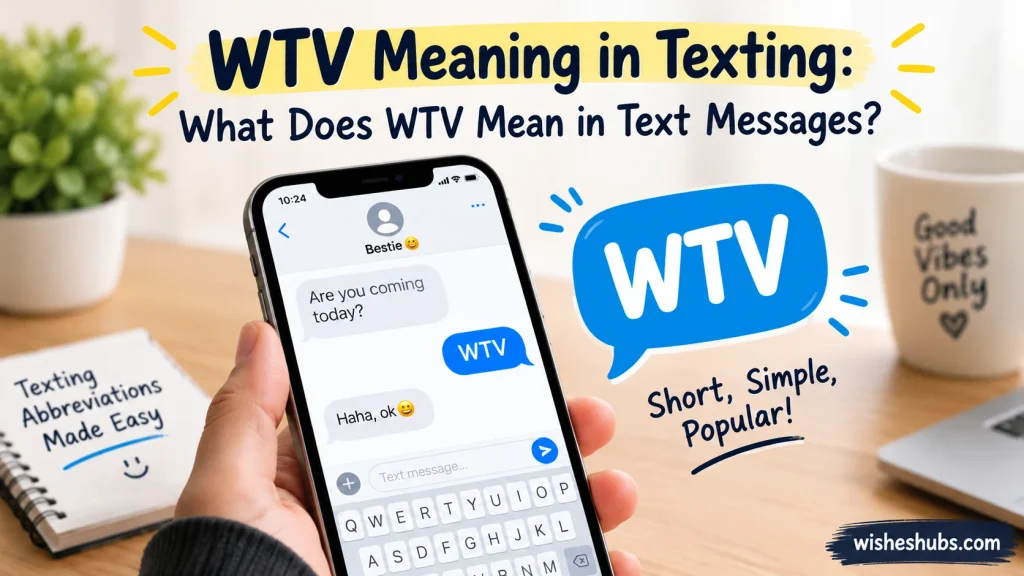
Have you ever received a message saying WTV and wondered what it means? The WTV Meaning in Texting is usually whatever, a common abbreviation used in casual chats. Its exact tone can change with the context and conversation.
When someone types WTV, they may mean whatever, I don’t mind, or it’s up to you. In some conversations, however, it can sound dismissive or show indifference. Understanding the surrounding message helps you identify the sender’s real intention.
Texting slang often uses short forms to make digital communication faster and easier. WTV works in the same way as abbreviations such as IDK, IDC, and NVM. You may see it in text messages, social media chats, group conversations, and other informal online discussions.
The good news is that WTV is simple once you understand its common meaning and usage. This guide explains what WTV stands for, how people use it, and how its tone changes with context. You’ll also learn when to use WTV and how to respond naturally.
Quick Answer: What Does WTV Mean in Texting?
WTV means whatever in texting and online conversations. It’s an informal abbreviation people use to express indifference, flexibility, acceptance, or dismissal.
Depending on the context, WTV can mean:
- Whatever
- I don’t mind
- It’s up to you
- Either choice is fine
- I don’t care
- Let’s drop the subject
For example:
“WTV, you choose the movie.”
Here, WTV probably means the person has no preference.
But consider:
“WTV. I’m done arguing.”
In this case, WTV sounds dismissive or frustrated.
So, the abbreviation itself is simple. The tricky part is understanding its tone and context.
What Does WTV Stand For?
WTV stands for whatever.
It’s a shortened form commonly used in informal digital communication. Like many texting abbreviations, it removes unnecessary letters while keeping the general meaning easy to understand.
You may see it in:
- Text messages
- Group chats
- Social media comments
- Direct messages
- Gaming chats
- Casual online conversations
- Messaging apps
WTV isn’t appropriate for every situation. A business email, school assignment, job application, or formal letter should normally use whatever instead.
The abbreviation works because texting often favors speed and brevity. Instead of typing all seven letters in whatever, someone can simply type WTV.
What Does WTV Mean in a Text Message?
When someone sends WTV in a text, they usually communicate some form of indifference or flexibility.
However, the intended meaning can shift depending on what happened before the message.
WTV can mean “I don’t mind”
Suppose two friends are deciding where to eat:
Friend: “Pizza or tacos?”
You: “WTV. I’m hungry.”
Here, WTV means either option works.
There’s no obvious irritation. The sender simply doesn’t have a strong preference.
WTV can mean “It’s up to you”
Someone might say:
“WTV you want is fine with me.”
This means the other person can make the decision.
WTV can mean “I don’t care”
The meaning becomes sharper in certain conversations.
“WTV. Do what you want.”
That response may suggest indifference, annoyance, or emotional distance.
WTV can mean “Let’s stop talking about it”
During an argument, WTV can act almost like a verbal door closing.
“WTV. We’re going in circles.”
The sender probably wants to end the disagreement rather than continue explaining their position.
Is WTV Rude or Dismissive?
WTV isn’t automatically rude. Its tone depends heavily on context.
This is one of the most important things to understand about the WTV meaning in texting.
A casual “wtv 😂” can feel playful. A blunt “WTV.” after an argument can feel cold.
When WTV sounds neutral
WTV usually feels harmless when:
- You’re discussing everyday choices.
- The sender genuinely has no preference.
- The conversation remains friendly.
- An emoji softens the response.
- The abbreviation appears inside a longer sentence.
For example:
“WTV works for me 😂.”
That sounds relaxed.
When WTV can sound dismissive
WTV may sound rude when:
- Someone uses it as a one-word response.
- The conversation involves an argument.
- The sender follows it with a period.
- The other person has raised a serious concern.
- The sender uses it to shut down the conversation.
Compare these two messages:
| Text | Likely Tone |
| “wtv 😂” | Playful or casual |
| “WTV works for me.” | Flexible |
| “WTV, you decide.” | Indifferent |
| “WTV.” | Potentially dismissive |
| “WTV. I’m done.” | Clearly frustrated |
Punctuation isn’t a perfect tone detector. Still, it can influence how a short message feels.
How Is WTV Used in Texting?
The WTV text meaning changes slightly according to the situation. Here are the most common practical uses.
WTV for Showing Indifference
Someone may use WTV when they don’t have a strong opinion.
“What time should we leave?”
“WTV. I’m free all afternoon.”
The sender doesn’t care which time you choose.
WTV for Accepting Someone’s Choice
WTV can also show that someone is happy to let another person decide.
“Should we watch a comedy or thriller?”
“WTV you want.”
The sender is essentially saying, You choose.
WTV for Ending an Argument
This version carries more emotional weight.
“You never listen to me.”
“WTV. I’m not arguing anymore.”
Here, WTV isn’t really about choosing between options. It works as a dismissal.
WTV for Showing Mild Annoyance
Sometimes the abbreviation communicates frustration without directly saying, “I’m annoyed.”
“WTV. Believe what you want.”
The phrase suggests the sender doesn’t want to continue defending their position.
WTV in a Casual Conversation
Friends often use WTV without any negative meaning.
“Where do you want to hang out?”
“WTV, I’m good anywhere.”
In this situation, the abbreviation simply keeps the conversation quick.
WTV Meaning in Different Contexts
A major mistake is treating every WTV message as though it has the same emotional meaning.
Context changes everything.
WTV From a Friend
When a friend says WTV during casual planning, it often means whatever you prefer.
For example:
“Coffee or smoothies?”
“WTV, I’m good.”
There’s probably no hidden message.
WTV During an Argument
During conflict, the same abbreviation can feel much harsher.
“Can we talk about what happened?”
“WTV. It’s pointless.”
Here, the sender may feel frustrated or emotionally checked out.
WTV in a Group Chat
In group conversations, WTV often helps someone avoid a minor decision.
“Beach or park?”
“WTV works.”
The person isn’t necessarily uninterested in the group. They simply don’t care which option wins.
WTV in a Flirty Conversation
This situation requires extra caution.
If someone responds:
“WTV 😂”
they might be joking or acting playfully indifferent.
However:
“WTV.”
could sound uninterested.
Don’t assume WTV automatically means someone likes you or dislikes you. The surrounding conversation matters more than the abbreviation alone.
WTV Meaning on Snapchat, TikTok, Instagram, and Other Apps
The basic WTV meaning generally stays the same across social platforms.
You may encounter WTV on:
- Snapchat
- TikTok
- Discord
- Facebook Messenger
- Regular SMS
- Other messaging services
The platform doesn’t usually create a completely different definition.
For instance, someone commenting “WTV 😂” on Instagram and someone texting “wtv lol” on WhatsApp are generally using the same abbreviation for whatever.
What changes is the social context.
A public comment might sound sarcastic. A private message between close friends could sound completely normal.
WTV Examples in Real Text Conversations
Seeing WTV inside actual conversations makes the meaning much easier to recognize.
Example: Choosing Food
Alex: “Chinese or Mexican?”
Sam: “WTV. I’m hungry.”
Meaning: Sam doesn’t have a preference.
Example: Choosing a Movie
Alex: “Comedy or horror tonight?”
Sam: “WTV you want.”
Meaning: Alex can choose.
Example: Ending an Argument
Alex: “You’re not listening.”
Sam: “WTV. I’m done arguing.”
Meaning: Sam wants to stop the disagreement.
Example: Casual Planning
Alex: “Want to meet at six or seven?”
Sam: “WTV works.”
Meaning: Either time is acceptable.
Example: Frustration
Alex: “I think you’re wrong.”
Sam: “WTV. Believe what you want.”
Meaning: Sam sounds irritated and doesn’t want to debate further.
Example: Playful Conversation
Alex: “You definitely picked the worst movie.”
Sam: “WTV 😂”
Meaning: Sam may be jokingly brushing off the criticism.
The surrounding words provide the missing emotional clues.
How to Tell What Someone Means by WTV
If you’re unsure what a WTV message means, don’t focus on the abbreviation alone.
Instead, examine the entire exchange.
Look at what came before it
Ask yourself what question or statement triggered WTV.
If someone asked:
“Pizza or burgers?”
then WTV probably means either one is fine.
If someone said:
“You’re being unfair.”
and received WTV as a response, the abbreviation may sound more dismissive.
Check the punctuation
A message like:
“wtv 😂”
feels different from:
“WTV.”
Punctuation doesn’t establish meaning by itself. It simply provides another clue.
Notice emojis
Emojis can soften a short abbreviation.
“wtv 😂” may sound playful.
“wtv 🙄” can suggest annoyance.
Again, the relationship and conversation remain important.
Consider the relationship
A close friend may use WTV casually.
Someone you barely know might make the same message feel more abrupt.
That’s why interpreting slang requires social context, not just a dictionary definition.
Also Read This: Sent as a Text Message Meaning: What It Really Means on iPhone
WTV vs. Whatever
WTV and whatever have essentially the same basic meaning. The biggest difference involves formality and style.
| WTV | Whatever |
| Informal abbreviation | Full word |
| Common in texting | Used in speech and writing |
| Quick and casual | More versatile |
| Best for informal chats | Suitable for many contexts |
| Can look abrupt alone | Usually clearer in formal communication |
For example:
Casual:
“WTV, you choose.”
More standard:
“Whatever you choose is fine.”
Both communicate a similar idea. The second version simply sounds more complete.
WTV vs. IDC, IDK, NVM, and Similar Text Slang
WTV often appears alongside other texting abbreviations. These terms can overlap, yet they don’t mean exactly the same thing.
| Abbreviation | Meaning | Typical Use |
| WTV | Whatever | Indifference or flexibility |
| IDC | I don’t care | Stronger expression of not caring |
| IDK | I don’t know | Uncertainty |
| NVM | Never mind | Dropping a subject or correcting yourself |
| TBH | To be honest | Introducing an honest opinion |
WTV vs. IDC
These two are especially easy to confuse.
WTV can mean:
“Either option works.”
IDC more directly means:
“I don’t care.”
For example:
“Pizza or burgers?”
“WTV.”
This can simply mean either is fine.
But:
“Pizza or burgers?”
“IDC.”
sounds more strongly indifferent.
WTV vs. IDK
IDK means I don’t know.
That’s uncertainty rather than indifference.
“What movie should we watch?”
“IDK.”
The person doesn’t know what to choose.
“What movie should we watch?”
“WTV.”
The person doesn’t care which movie you choose.
That’s a subtle difference, but it matters.
WTV vs. NVM
NVM means never mind.
It often appears when someone withdraws a question or decides not to continue.
“Can you help me?”
“Actually, NVM.”
WTV doesn’t normally carry that exact meaning.
Is WTV a Slang Word or an Abbreviation?
WTV is best understood as informal texting or internet shorthand for whatever.
It isn’t the standard form used in formal English. Instead, it belongs to the abbreviated language people often use online.
This type of shorthand works because readers can quickly infer the intended phrase.
Similar examples include:
- LOL — laughing out loud
- IDK — I don’t know
- BTW — by the way
- NVM — never mind
- IMO — in my opinion
WTV fits into the same broad world of informal digital communication.
When Should You Use WTV?
WTV works best when the conversation is casual.
Good situations for WTV
Use it when you’re:
- Texting close friends
- Messaging family members casually
- Talking in a relaxed group chat
- Making simple plans
- Chatting informally online
- Responding to low-stakes choices
For example:
“Where should we eat?”
“WTV, you pick.”
That’s perfectly natural in a casual conversation.
Situations where WTV isn’t ideal
Avoid it in:
- Business emails
- Job applications
- Academic assignments
- Professional messages
- Formal complaints
- Important customer communication
Instead of:
“WTV works.”
write:
“Either option works for me.”
The second sentence communicates the same basic idea with much greater clarity.
How Should You Respond When Someone Says WTV?
Your response should depend on the tone behind the message.
If WTV sounds casual
You can keep things simple:
- “Cool, you pick.”
- “Sounds good.”
- “Works for me.”
- “Let’s go with pizza.”
If the person seems undecided
Try:
- “No preference?”
- “Want me to choose?”
- “Either one?”
- “What sounds better to you?”
If WTV sounds annoyed
Don’t immediately escalate.
You could say:
- “No worries. We can drop it.”
- “Okay, let’s leave it there.”
- “If something’s bothering you, we can talk about it.”
If you’re genuinely confused
Ask directly:
“What do you mean by WTV here?”
A quick clarification can prevent an unnecessary misunderstanding.
Does WTV Mean “Whatever” All the Time?
In ordinary texting, whatever is the standard meaning of WTV.
Still, abbreviations can appear in other contexts. A set of letters may represent something completely different in a company, organization, technical field, or proper name.
Therefore, context remains essential.
If you see WTV inside a normal text conversation about plans, opinions, or disagreements, whatever is the most likely interpretation.
If it appears in a technical document or specialized setting, don’t automatically apply the texting definition.
WTV vs. WTVR: Are They the Same?
You may occasionally see WTVR used as another informal abbreviation related to whatever.
The extra R represents the ending sound in -ever.
In casual digital communication, however, WTV is already enough to convey the intended idea.
A useful distinction is:
- WTV → whatever
- WTVR → whatever
The exact form a person chooses often comes down to personal texting habits.
Common Mistakes People Make With WTV
Even simple texting slang can cause misunderstandings.
Assuming WTV always sounds rude
It doesn’t.
“WTV, you choose 😂” can sound completely relaxed.
Treating WTV and IDC as identical
They overlap, but WTV can communicate flexibility while IDC more directly communicates a lack of concern.
Using WTV in formal writing
Texting shortcuts rarely belong in professional or academic communication.
Ignoring the conversation
A standalone WTV doesn’t provide enough information to judge someone’s attitude accurately.
Read the messages before and after it.
Assuming punctuation has one fixed meaning
A period may make WTV feel sharper, yet punctuation isn’t a universal emotional code.
Look at the complete message.
A Simple Case Study: Why Context Changes WTV
Consider one abbreviation appearing in three different conversations.
Case A: Restaurant Choice
“Thai or Italian?”
“WTV, I’m hungry.”
Interpretation: The sender doesn’t have a preference.
Case B: Scheduling
“Should we meet at 6 or 7?”
“WTV works.”
Interpretation: Either time is acceptable.
Case C: Argument
“Can you explain why you did that?”
“WTV. I’m done.”
Interpretation: The sender sounds frustrated and wants to end the discussion.
The letters haven’t changed.
The context did.
That’s the key to understanding WTV in real conversations.
FAQs:
What does WTV mean in texting?
WTV usually means “whatever” in texting. It can show indifference, flexibility, or acceptance. The exact meaning depends on the conversation. For example, “WTV, you choose” usually means the sender doesn’t mind which option you pick.
What does WTV stand for?
WTV stands for whatever. It’s an informal texting abbreviation that people use in casual conversations, social media messages, and group chats. It helps shorten a common word while keeping the intended meaning easy to understand.
Is WTV rude in a text?
WTV isn’t always rude. It can sound friendly when someone uses it to show they have no preference. However, a short reply like “WTV.” during an argument may sound dismissive, annoyed, or uninterested.
Does WTV mean I don’t care?
WTV can sometimes mean “I don’t care,” but that isn’t always its intended meaning. It may simply mean “whatever you prefer” or “either option works.” The surrounding conversation usually reveals whether the sender sounds relaxed or genuinely indifferent.
What does WTV mean from a girl?
When a girl texts WTV, it generally means “whatever.” Her personal tone and the conversation determine the exact intention. It could show flexibility, casual indifference, or frustration. The abbreviation itself doesn’t have a different meaning based on gender.
What does WTV mean from a guy?
A guy using WTV generally means “whatever” as well. He might use it when he doesn’t have a preference or wants to keep a conversation brief. If the discussion involves conflict, WTV may instead suggest annoyance or dismissal.
What does WTV mean on Snapchat?
On Snapchat, WTV usually means “whatever.” People commonly use it in casual messages when discussing plans, opinions, or simple choices. Its tone can range from playful and relaxed to dismissive, depending on the conversation and accompanying emojis.
What’s the difference between WTV and IDC?
WTV means “whatever,” while IDC means “I don’t care.” These abbreviations can overlap, but WTV may simply express flexibility. IDC usually sounds more direct and can suggest stronger indifference toward the subject being discussed.
Can WTV mean something other than whatever?
In ordinary texting, whatever is the most common meaning of WTV. However, the same letters can represent different terms in specialized contexts. If WTV appears outside a casual conversation, check the surrounding information before assuming it refers to texting slang.
How should you respond when someone says WTV?
Your response depends on the sender’s tone. If they’re being casual, you can say “You pick” or “Works for me.” If they sound annoyed, stay calm and avoid escalating the conversation. When the meaning isn’t clear, simply ask what they mean.
Conclusion:
The WTV Meaning in Texting is usually whatever, but its tone can vary. It may express flexibility, indifference, acceptance, or frustration. Understanding the surrounding conversation helps you interpret the abbreviation correctly.
Because texting relies heavily on context and tone, WTV doesn’t always carry the same emotional message. A friendly “WTV 😂” can feel playful, while “WTV.” during an argument may sound dismissive. Pay attention to the words, punctuation, and situation.
For casual digital communication, WTV offers a quick way to say whatever. It’s useful in texts and informal chats, but formal writing calls for clearer language. When you understand its meaning, usage, and tone, responding to WTV becomes much easier and more natural.

“Explore amazing wishes and greetings on Wisheshubs.com by Daniel Edward. Find birthday, anniversary, and special occasion messages easily!”
1 thought on “WTV Meaning in Texting: What Does WTV Mean in Text Messages?”