
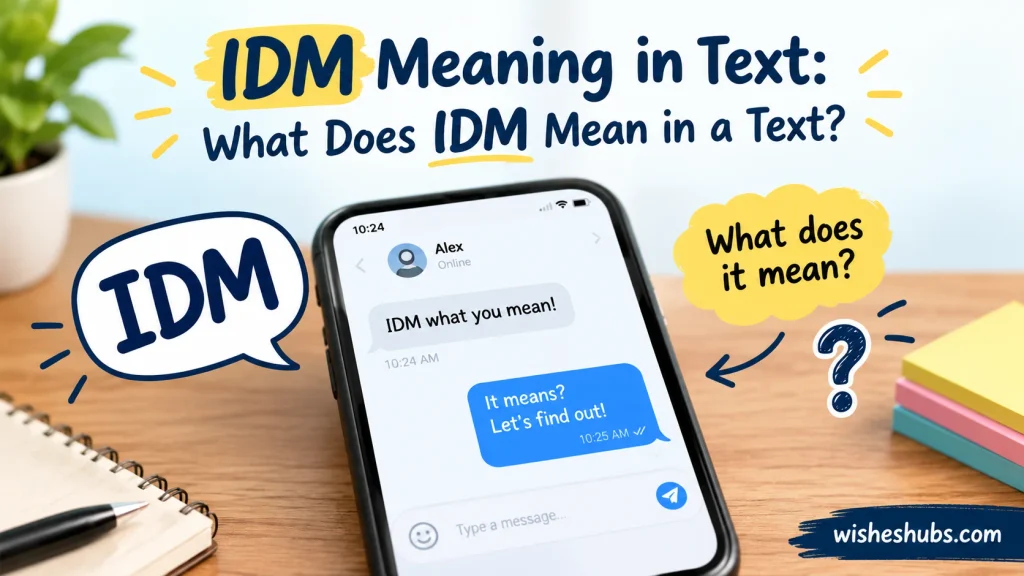
Ever wondered what IDM means when it appears in a chat? The IDM Meaning in Text usually points to “I Don’t Mind,” a phrase showing acceptance, flexibility, or no strong preference during casual conversations with friends, family, or online contacts.
Texting shortcuts can feel confusing when you see them without context. IDM is common in casual messages because it quickly tells someone that a choice, suggestion, or request doesn’t bother you. Whether you’re discussing plans, food, movies, or meeting times, understanding this abbreviation helps you read the message naturally, understand its tone, and respond with confidence in a quick, natural way without overthinking the reply.
Although I Don’t Mind is the most common texting meaning, IDM can describe different things in other contexts. Technology discussions may use IDM for Internet Download Manager, while music conversations can use it for Intelligent Dance Music. The surrounding words, topic, and conversation purpose provide useful context clues that reveal which meaning the sender intended in everyday communication, especially online.
Understanding IDM in texting also means recognizing its tone. The abbreviation usually sounds neutral, relaxed, and flexible, rather than strongly enthusiastic. It can mean “either option works” or “that doesn’t bother you.” However, a very short reply may sometimes feel distant. Looking at the complete conversation gives you a clearer interpretation than the abbreviation alone, especially when tone matters or the relationship feels uncertain.
Quick Answer
IDM means “I Don’t Mind” in texting and casual online conversations. It tells someone that you don’t have a strong preference or don’t object to their suggestion.
For example:
Friend: “Should we meet at 6 or 7?”
You: “IDM, either works for me.”
Here, IDM means the sender is comfortable with either option.
The abbreviation can also have other meanings. In technology, IDM commonly refers to Internet Download Manager. In music discussions, it can mean Intelligent Dance Music. Context tells you which definition applies.
What Does IDM Mean in Text?
The most common IDM meaning in text is “I Don’t Mind.”
People use the abbreviation to express a lack of objection or preference. In plain English, they’re saying something like:
- “Either option is fine with me.”
- “That doesn’t bother me.”
- “You can choose.”
- “I’m okay with that.”
- “I have no preference.”
Imagine you’re deciding where to eat with a friend. They ask, “Thai food or Mexican?” If you don’t care which one you get, “IDM” gives them the green light to choose.
The important detail is that IDM doesn’t necessarily express excitement. Someone saying “IDM” isn’t automatically saying, “That sounds amazing!” They’re usually saying, “That’s fine with me.”
What Does IDM Stand For?
IDM stands for “I Don’t Mind.”
The abbreviation takes the first letters of the main words:
- I → I
- D → Don’t
- M → Mind
Texting abbreviations like this save time and space. They’re especially common in casual chats where people already understand the shorthand.
You might see it written as IDM, idm, or occasionally within a longer sentence. Capitalization generally doesn’t change the basic meaning.
What Does IDM Mean in a Conversation?
The exact meaning of IDM in a conversation depends on what came before it.
Someone might use IDM when making plans, answering a preference question, accepting a request, or responding to a minor inconvenience.
When Someone Asks You to Choose
If someone asks you to pick between two options, IDM usually means either choice works.
“Do you want coffee or tea?”
“IDM. You choose.”
The person isn’t necessarily avoiding the question. They simply don’t have a strong preference.
When Someone Asks for Permission
IDM can also communicate that something isn’t a problem.
“Do you mind if I bring Sarah?”
“IDM.”
In this situation, the sender means “I don’t mind.”
When Someone Asks About a Preference
IDM can signal flexibility.
“Do you want to sit inside or outside?”
“IDM, wherever you want.”
Here, the sender leaves the decision open.
When Someone Mentions an Inconvenience
The abbreviation can also mean that something doesn’t bother the sender.
“I might be ten minutes late. Is that okay?”
“IDM.”
That response means the delay isn’t a serious issue for them.
Is IDM Positive, Negative, or Neutral?
IDM is generally neutral. Depending on context, it can also sound relaxed, agreeable, or mildly positive.
There’s an important distinction here. “I don’t mind” isn’t the same as “I love it.”
For example:
“Want pizza tonight?”
“IDM.”
That probably means pizza is acceptable. It doesn’t necessarily mean pizza was the person’s first choice.
Tone can also change depending on the surrounding words.
| Message | Possible impression |
| “IDM 😊” | Friendly and relaxed |
| “IDM, you choose.” | Flexible |
| “IDM honestly.” | Casual acceptance |
| “IDM, either works.” | Clear and neutral |
| “idm.” | Could feel brief or indifferent |
Don’t treat these interpretations as fixed rules. Text doesn’t carry voice tone or facial expressions, so the same abbreviation can feel different in different conversations.
Does IDM Mean “I Don’t Care”?
Not exactly.
IDM and IDC can overlap, but they aren’t perfect substitutes.
IDM means “I Don’t Mind.” It generally communicates that something doesn’t bother you or that you have no preference.
IDC means “I Don’t Care.” Depending on context, it can sound much more dismissive.
Compare these examples:
“Which movie should we watch?”
“IDM, you choose.”
This sounds flexible.
Now consider:
“Which movie should we watch?”
“IDC.”
That response might sound like the person doesn’t want to participate in the decision.
The difference is subtle but important. IDM usually keeps the conversation cooperative, while IDC can sometimes create emotional distance.
Is IDM the Same as “It Doesn’t Matter”?
The phrases can express a similar idea, but they aren’t identical.
When you say “I don’t mind,” you’re describing your own reaction or preference.
When you say “It doesn’t matter,” you’re saying the choice itself isn’t important.
For example:
“Do you want to leave at 5 or 6?”
“IDM.”
This means either time works for you.
You could also say:
“It doesn’t matter to me.”
That carries a similar message. Still, the wording shifts the focus slightly.
IDM = I have no objection or strong preference.
It doesn’t matter = the choice isn’t important to me.
Context can make the two expressions function almost identically in casual conversation.
How to Use IDM in Text Messages
Using IDM is simple when you’re having an informal conversation.
Making Plans
“Want to meet Friday or Saturday?”
“IDM, whichever works for you.”
Choosing Food
“Burgers or tacos?”
“IDM. I’m hungry either way.”
Picking a Movie
“Comedy or horror?”
“IDM, you pick.”
Choosing a Location
“Coffee shop downtown or the one near campus?”
“IDM, both are fine.”
Responding to a Request
“Can I invite Jake?”
“Yeah, IDM.”
Handling a Small Change
“Can we start at 7 instead?”
“IDM.”
The key is simple: use IDM when you genuinely don’t object or don’t have a strong preference.
If you strongly dislike an option, IDM would give the wrong impression.
Realistic Examples of IDM in Texting
The best way to understand texting slang is to see it in everyday situations.
Example: Dinner Plans
Alex: “Pizza or Chinese tonight?”
Sam: “IDM. You pick.”
Alex: “Pizza it is.”
Here, IDM means Sam has no preference.
Example: Meeting Time
Mia: “6:30 or 7?”
Noah: “IDM, whenever you’re ready.”
The sender is flexible about the time.
Example: Weekend Plans
Friend: “Want to go Saturday or Sunday?”
You: “IDM. Saturday works too.”
IDM signals that either day is acceptable.
Example: Group Decision
Friend: “Should we watch the new action movie?”
You: “IDM. I’m down.”
Here, IDM shows acceptance rather than strong enthusiasm.
Example: Bringing Someone Along
Friend: “Mind if I bring my cousin?”
You: “IDM.”
The response means the extra person isn’t a problem.
Example: Choosing a Seat
Friend: “Window or aisle?”
You: “IDM.”
The sender doesn’t have a meaningful preference.
What Does IDM Mean on Snapchat?
On Snapchat, IDM usually has the same meaning: “I Don’t Mind.”
Snapchat conversations often move quickly, so abbreviations fit naturally into short replies.
For example:
“Want to call later?”
“IDM.”
The sender is saying they don’t object to the idea.
Another example:
“Should I post this?”
“IDM lol.”
The meaning still centers on acceptance or lack of objection.
The platform doesn’t automatically give IDM a special Snapchat-specific definition. The surrounding conversation matters more than the app you’re using.
Also Read This: FJB Meaning in Text: What Does FJB Mean in Texting?
What Does IDM Mean on Instagram, WhatsApp, TikTok, and Discord?
Across major messaging and social platforms, IDM generally retains the same texting meaning when used in casual conversation.
| Platform | Common meaning of IDM | Typical use |
| I Don’t Mind | DMs and casual replies | |
| Snapchat | I Don’t Mind | Quick chats |
| I Don’t Mind | Personal and group messages | |
| Discord | I Don’t Mind | Casual or gaming conversations |
| TikTok | I Don’t Mind | Comments and direct messages |
For instance, someone on Discord might write:
“VC or text?”
“IDM.”
The meaning is still “I Don’t Mind.”
Likewise, an Instagram DM might say:
“Want to go tomorrow?”
“IDM.”
The platform changes. The abbreviation doesn’t.
How to Reply When Someone Says IDM
Your response depends on what decision you’re discussing.
If the person says “IDM” after you ask them to choose, you can simply make the decision.
If You Need to Choose
Try:
- “Okay, let’s do pizza.”
- “Cool, I’ll pick.”
- “Let’s go at 6.”
- “Sounds good. I’ll decide.”
- “Perfect, let’s do Saturday.”
If You Want Their Actual Opinion
Sometimes “IDM” doesn’t tell you what the person prefers. If their preference matters, ask directly.
“I know you don’t mind, but which one would you actually prefer?”
That’s especially useful when you’re making a decision that affects both people.
If IDM Seems Unusually Short
Don’t immediately assume the person is annoyed.
Text messages lack many signals that exist in face-to-face conversations. A short “IDM” might simply mean they’re busy, relaxed, or genuinely indifferent about the choice.
Can IDM Sound Rude or Dismissive?
IDM isn’t inherently rude. Still, a very short reply can occasionally feel dismissive.
Consider these two messages:
“IDM, whatever works for you!”
and:
“idm.”
Both can technically mean “I Don’t Mind.” Yet they may create different impressions.
The first sounds warm and cooperative. The second provides very little emotional information.
Why Does This Happen?
Text removes several communication cues:
- Voice tone
- Facial expression
- Body language
- Timing
- Vocal emphasis
As a result, readers sometimes fill in the gaps themselves.
That’s why context matters more than the abbreviation alone.
If a close friend regularly sends short messages, “idm” probably isn’t worth overthinking. If someone suddenly switches from detailed replies to one-word answers, the broader conversation may matter more.
IDM vs IDK vs IDC vs IMO
Texting abbreviations can look surprisingly similar. However, these four expressions serve very different purposes.
| Abbreviation | Full meaning | What it communicates |
| IDM | I Don’t Mind | No strong preference or objection |
| IDK | I Don’t Know | Uncertainty or lack of knowledge |
| IDC | I Don’t Care | Lack of concern or interest |
| IMO | In My Opinion | Personal viewpoint |
Consider the difference:
IDM: “Which restaurant?” → “Either is fine.”
IDK: “Which restaurant is open?” → “I don’t know.”
IDC: “Which restaurant?” → “I don’t care.”
IMO: “Which restaurant is better?” → “IMO, the Italian place.”
These abbreviations may look similar on your screen, yet they communicate very different ideas.
Other Meanings of IDM
Although I Don’t Mind is the common interpretation in casual texting, IDM has established meanings in other fields.
IDM as Internet Download Manager
In technology discussions, IDM commonly refers to Internet Download Manager, software designed to manage and accelerate file downloads.
The official product is commonly known as Internet Download Manager (IDM).
For example:
“Install IDM before downloading the file.”
In this context, nobody is saying “I Don’t Mind.” The subject is clearly software.
IDM as Intelligent Dance Music
In electronic music discussions, IDM can refer to Intelligent Dance Music.
The term has been used for a style or broad category associated with experimental electronic music, complex rhythms, detailed sound design, and electronic production.
For example:
“That playlist has a lot of IDM.”
Here, the abbreviation clearly refers to music rather than texting slang.
Why Context Matters
These meanings aren’t interchangeable.
| Context | Likely IDM meaning |
| “Pizza or pasta? IDM.” | I Don’t Mind |
| “Download it with IDM.” | Internet Download Manager |
| “I listen to IDM.” | Intelligent Dance Music |
This is why looking at the entire sentence often solves the mystery immediately.
How to Know Which IDM Meaning Someone Intended
When IDM appears in a message, use context as your first clue.
Look at the Topic
Ask yourself what you’re discussing.
If the conversation involves:
- Food
- Plans
- Friends
- Preferences
- Invitations
then I Don’t Mind is the likely meaning.
If you’re discussing:
- Downloads
- Computer software
- Files
then Internet Download Manager may be intended.
If you’re discussing:
- Electronic music
- Artists
- Genres
- Music production
then Intelligent Dance Music could be the answer.
Read the Words Around IDM
A sentence often makes the meaning obvious.
“What should we order? IDM.”
That’s clearly texting slang.
Compare it with:
“I’m using IDM to download the archive.”
Now the technology meaning is obvious.
Consider the Purpose of the Message
If IDM appears as a direct response to a question, “I Don’t Mind” is usually the sensible interpretation.
If IDM appears as the name of a tool or genre, a different definition probably applies.
Is IDM Formal or Informal?
IDM is primarily informal.
It’s suitable for casual communication with people who understand texting shorthand.
You might use it in:
- Text messages
- Group chats
- Social media DMs
- Casual Discord conversations
- Informal conversations with friends
You generally shouldn’t rely on it in:
- Job applications
- Formal business emails
- Academic papers
- Legal documents
- Professional reports
Instead of writing:
“IDM which day works.”
A professional message would be clearer as:
“Either day works for me.”
There’s no prize for squeezing three words into three letters when clarity matters more.
Should You Write IDM in Uppercase or Lowercase?
Both IDM and idm can mean “I Don’t Mind.”
Capitalization usually reflects the person’s typing style rather than a completely different definition.
For example:
“IDM, you choose.”
and:
“idm honestly”
can carry the same basic meaning.
Don’t assume that uppercase automatically signals anger. Likewise, lowercase doesn’t automatically signal friendliness.
Context beats capitalization.
Case Study: Understanding IDM Through Context
Consider a simple conversation between two friends.
Jordan: “Should we watch a movie tonight?”
Taylor: “IDM.”
Jordan: “Comedy or thriller?”
Taylor: “IDM, you pick.”
Jordan: “Cool. Let’s watch a thriller.”
Taylor’s first “IDM” already suggests a lack of preference. The second message makes that meaning even clearer by adding “you pick.”
Now change the context:
Jordan: “What software do you use for downloads?”
Taylor: “IDM.”
Here, the likely meaning changes completely. Taylor probably means Internet Download Manager.
The Lesson
The abbreviation itself doesn’t contain enough information to identify every possible meaning.
The surrounding words provide the missing clues.
Common Mistakes When Interpreting IDM
A few misunderstandings appear repeatedly in casual chats.
Mistaking IDM for IDC
Don’t automatically read “I Don’t Mind” as “I Don’t Care.”
IDM usually sounds less dismissive.
Assuming IDM Shows Excitement
Someone saying IDM isn’t necessarily excited about the suggestion.
They may simply accept it.
Treating IDM as a Universal Definition
IDM has legitimate meanings outside texting. Always check the topic.
Overanalyzing a Short Reply
A short “IDM” doesn’t automatically mean someone is upset.
Look at the broader conversation before drawing conclusions.
FAQs:
What does IDM mean in text?
IDM usually means “I Don’t Mind” in texting. People use it when they have no strong preference, don’t object to something, or are comfortable letting someone else make a decision.
What does IDM stand for in texting?
In casual conversations, IDM stands for “I Don’t Mind.” For example, if someone asks, “Pizza or burgers?” and you reply “IDM,” you’re saying that either option works for you.
Is IDM a positive or negative expression?
IDM is generally neutral rather than clearly positive or negative. It usually shows acceptance or flexibility. However, the tone can depend on the surrounding conversation, wording, punctuation, and relationship between the people chatting.
Does IDM mean I don’t care?
Not exactly. IDM means “I Don’t Mind,” while IDC means “I Don’t Care.” IDM usually sounds more cooperative because it suggests that something is acceptable, whereas IDC can sometimes sound dismissive or uninterested.
Is IDM the same as “it doesn’t matter”?
IDM and “it doesn’t matter” can have similar meanings in casual conversations. IDM focuses on having no objection or preference, while “it doesn’t matter” suggests that the choice isn’t particularly important to the speaker.
What does IDM mean on Snapchat?
On Snapchat, IDM usually means “I Don’t Mind.” Someone might use it when responding to questions about plans, food, meeting times, or other choices. The conversation’s context helps confirm the intended meaning.
How should you reply when someone says IDM?
If someone says IDM, you can simply make the decision if you’re choosing between options. For example, reply with “Okay, let’s go with Saturday” or “Cool, I’ll pick the restaurant.”
Is IDM formal or informal?
IDM is informal texting slang. It’s suitable for friends, casual chats, social media messages, and relaxed conversations. For professional emails, academic writing, or formal communication, writing “I don’t mind” provides clearer and more appropriate wording.
What are the other meanings of IDM?
Besides “I Don’t Mind,” IDM can refer to Internet Download Manager in technology conversations. It can also mean Intelligent Dance Music in discussions about electronic music. The subject of the conversation usually reveals the intended meaning.
What is the difference between IDM and IDK?
IDM means “I Don’t Mind,” while IDK means “I Don’t Know.” IDM expresses acceptance or a lack of preference. IDK expresses uncertainty or a lack of knowledge, so the two abbreviations shouldn’t be confused.
Conclusion:
IDM Meaning in Text usually refers to “I Don’t Mind,” a casual abbreviation that shows acceptance, flexibility, or no strong preference during everyday digital conversations.
Whether you’re choosing dinner, making plans, or responding to a simple request, IDM often means the other person is comfortable with your choice. Still, context matters because the abbreviation can have different meanings in technology and music.
When you see IDM in texting, check the conversation before interpreting it. In most casual chats, “I Don’t Mind” is the right meaning. Once you understand the context, this small abbreviation becomes much easier to read and use.

Emily Harris shares simple, heartfelt wishes, quotes, and messages to help you celebrate every special moment beautifully.
1 thought on “IDM Meaning in Text: What Does IDM Mean in a Text?”