
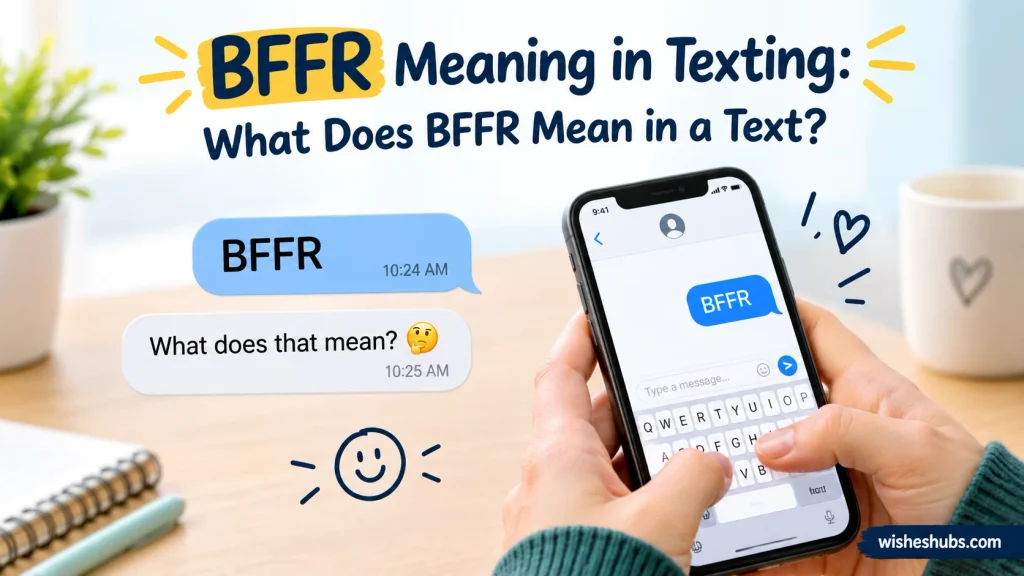
Have you ever received BFFR in a chat and wondered what it means? The BFFR Meaning in Texting usually refers to “be fucking for real,” a popular texting abbreviation people use to show disbelief, challenge a claim, or ask someone to be serious.
Online conversations move quickly, so texting slang helps people express strong reactions with fewer words. BFFR has become a familiar internet abbreviation in casual chats and social media. Depending on the conversation, it can communicate disbelief, sarcasm, skepticism, humor, or frustration. Understanding the context matters because the same four letters can sound playful between friends yet surprisingly blunt during an argument.
If someone sends “BFFR 😂,” they may simply be joking about something that sounds ridiculous. However, “BFFR.” can feel much more direct when the conversation turns serious. The abbreviation appears in text messages, group chats, comments, and online conversations, making its tone worth understanding before you use it. Knowing the meaning, usage, context, and emotional tone helps you interpret the message correctly.
Because internet slang changes quickly, knowing a definition alone isn’t always enough. You also need to understand how BFFR is used, when it sounds appropriate, and which polite alternatives fit formal situations. This guide explains the BFFR slang meaning, common examples, tone differences, related abbreviations, and practical responses in simple, everyday language.
Quick Answer
BFFR usually means “be fucking for real.” People use it in texting and online conversations to express disbelief, challenge something they consider unrealistic, or tell someone to be serious. Depending on the context, BFFR can sound funny, sarcastic, skeptical, blunt, or confrontational.
For example:
Person 1: “I can finish this entire project in ten minutes.”
Person 2: “BFFR 😂”
Here, BFFR essentially means “Come on, be serious.”
The abbreviation contains profanity, so it’s generally best suited to casual conversations, social media, memes, and chats with people who are comfortable with informal language.
What Does BFFR Mean in Texting?
The BFFR meaning in texting is usually “be fucking for real.”
People use the expression when they think someone’s statement sounds unbelievable, exaggerated, unrealistic, or simply ridiculous. It can also challenge someone who appears to be joking when the other person wants a serious answer.
In everyday English, BFFR can communicate several related ideas:
- Are you serious?
- Are you for real?
- Be serious.
- Come on.
- Be realistic.
- Stop kidding around.
- You can’t seriously believe that.
- Really? You’re saying that?
The exact interpretation depends on the conversation.
Imagine your friend tells you they bought a luxury car for $20. You might reply:
“BFFR 😭”
You’re not necessarily angry. You’re expressing disbelief because the claim sounds absurd.
Now consider a different situation. Someone repeatedly denies something you’ve already proven. You respond:
“BFFR.”
That version can sound considerably sharper.
BFFR Meaning at a Glance
| Term | Meaning | Typical use |
| BFFR | Be fucking for real | Strong disbelief or emphasis |
| BFR | Be for real | Similar idea with less intensity |
| BFF | Best friends forever | Friendship |
| Seriously? | Are you serious? | Disbelief or surprise |
| Be for real | Be serious or honest | Casual response |
The extra F in BFFR adds emphasis. It gives the phrase more punch than the milder “BFR.”
What Does BFFR Stand For?
BFFR stands for “be fucking for real.”
Here’s the breakdown:
| Letter | Word |
| B | Be |
| F | Fucking |
| F | For |
| R | Real |
The phrase comes from the longer expression “be fucking for real.” Internet users shortened it into BFFR because abbreviations make fast-paced digital conversations easier.
The profanity also matters. Removing the expletive changes the strength of the phrase.
For instance:
“BFR.” sounds relatively casual.
“BFFR.” sounds more emphatic.
Neither expression has to indicate anger. The surrounding context determines whether the speaker is joking, skeptical, annoyed, or genuinely confrontational.
What Does BFFR Mean in Simple Words?
If internet slang isn’t your thing, think of BFFR as a stronger version of:
“Come on, seriously?”
Someone may use it when your statement doesn’t pass their common-sense test.
For example:
Friend: “I’m going to learn Spanish fluently this weekend.”
You: “BFFR.”
In plain English, you’re saying:
“Be serious. You aren’t going to become fluent in one weekend.”
That’s the heart of the expression.
BFFR doesn’t always demand literal honesty. Sometimes it works as humorous disbelief. A friend might tell you something obviously exaggerated, and BFFR becomes a playful way to call them out.
Why Do People Use BFFR in Texting?
The popularity of BFFR comes down to speed, emphasis, and internet culture.
Typing “Are you seriously saying this right now?” takes much longer than typing four letters. BFFR delivers the same emotional punch almost instantly.
People commonly use it to:
- Challenge exaggerated statements
- Express disbelief
- Call out unrealistic expectations
- React to an unbelievable excuse
- Tell someone to stop joking
- Question someone’s honesty
- Emphasize a strong reaction
- Add humor to a conversation
It’s particularly useful when a short reaction says more than a paragraph could.
Example of BFFR in Everyday Texting
Suppose your friend says:
“I didn’t study at all. I’m definitely getting a 100.”
You might answer:
“BFFR 😭”
The abbreviation communicates disbelief without requiring a long explanation.
That’s one reason internet slang works so well. It acts like emotional shorthand.
Is BFFR Rude or Offensive?
It can be.
BFFR contains profanity and can sound dismissive. Still, its tone depends heavily on the relationship between the people involved.
A close friend might send:
“BFFR 😂”
and everyone understands it as playful teasing.
A coworker might write:
“BFFR.”
during a disagreement. That could easily sound disrespectful or hostile.
When BFFR Sounds Playful
Friends often use BFFR when one person makes an outrageous claim.
“I only spent $300 at the mall.”
“BFFR 😭”
The sender may be joking about the obvious understatement.
When BFFR Sounds Serious
The phrase can become confrontational when someone uses it during an argument.
“You really think that’s a fair excuse?”
“BFFR.”
Here, the sender isn’t necessarily trying to make you laugh. They’re challenging your position.
When You Should Avoid BFFR
Avoid it when the setting requires professionalism or restraint.
Examples include:
- Job applications
- Formal emails
- Business communication
- Customer-service conversations
- Academic writing
- Professional meetings
- Messages to people you don’t know well
Even if your intended meaning is harmless, the profanity can make the message look unnecessarily aggressive.
BFFR Examples in Text Messages
Context provides the real meaning. Here are several common situations.
BFFR When Someone Makes an Exaggerated Claim
Alex: “I can run 50 miles without training.”
Sam: “BFFR 💀”
Meaning: “Come on. Be realistic.”
The sender isn’t necessarily angry. They’re reacting to an extreme claim.
BFFR When Someone Gives a Weak Excuse
Alex: “I didn’t reply because I didn’t see your message for three days.”
Sam: “BFFR.”
Meaning: “Seriously? You expect me to believe that?”
Here, the phrase carries more skepticism.
BFFR During Friendly Teasing
Friend: “I’m definitely the best cook in this group.”
You: “BFFR 😂”
Meaning: “You know that’s not true.”
The laughing emoji helps signal a playful tone, although emojis never guarantee someone’s intention.
BFFR When Someone Suggests an Unrealistic Plan
Friend: “Let’s leave at 10 PM and drive six hours before midnight.”
You: “BFFR.”
Meaning: “That plan isn’t realistic.”
In this situation, BFFR challenges the practicality of the idea.
What Does BFFR Mean From a Friend?
When a friend says BFFR, don’t automatically assume they’re angry.
Close friends often use strong slang with each other without intending offense. The phrase may simply mean:
“Come on, you know better than that.”
For example:
“I don’t need a jacket. It’s only 20 degrees outside.”
“BFFR 😂”
A friend might use BFFR because your statement sounds ridiculous to them.
Still, context matters. If you’ve already had an argument, the same abbreviation can carry a much harsher tone.
Look at the entire conversation rather than interpreting four letters in isolation.
What Does BFFR Mean From a Girl or Guy?
The BFFR meaning doesn’t change based on whether a girl or guy sends it.
Some searches ask whether BFFR has a special romantic meaning when a particular person uses it. Usually, it doesn’t. The standard meaning remains “be fucking for real.”
What changes is the context.
If someone you’re dating sends:
“You think I’m jealous? BFFR 😂”
they may be teasing you.
If they send:
“BFFR. We’re not having this conversation again.”
the tone is much more serious.
The relationship and conversation matter far more than the sender’s gender.
BFFR vs. BFR: What’s the Difference?
BFFR and BFR are closely related, but BFFR has stronger wording.
| Abbreviation | Full phrase | Tone |
| BFR | Be for real | Casual |
| BFFR | Be fucking for real | Stronger and more emphatic |
Both can communicate disbelief or a demand for seriousness.
The main difference is intensity.
Think of it this way:
BFR = “Come on, seriously?”
BFFR = “Come on, seriously?!”
The second version carries more force because of the profanity.
Neither abbreviation should automatically be interpreted as hostile. Context remains the deciding factor.
Also Read This: UT Meaning in Texting: What Does UT Mean in a Text?
BFFR vs. BFF: Don’t Confuse These Abbreviations
This is an easy mistake to make.
BFF usually means “best friends forever.”
BFFR usually means “be fucking for real.”
The final R completely changes the phrase.
| Abbreviation | Meaning |
| BFF | Best friends forever |
| BFFR | Be fucking for real |
So if someone writes:
“She’s my BFF.”
They’re talking about a close friend.
If someone writes:
“BFFR.”
They’re expressing disbelief or telling someone to get serious.
Despite sharing the letters BFF, these abbreviations have completely different meanings.
How to Tell What Someone Means by BFFR
Because BFFR can sound playful or harsh, examine the clues around it.
Check the Previous Message
Ask what prompted the response.
If someone just made an absurd joke, BFFR probably carries a humorous tone.
If someone made a serious claim, it may express genuine skepticism.
Look at the Punctuation
Compare:
BFFR 😂
with:
BFFR.
The first may feel lighter. The second can feel more abrupt.
Punctuation isn’t a perfect tone detector, though. People have different texting habits.
Consider the Relationship
A close friend can use profanity casually.
A stranger using the same expression may sound far more aggressive.
Notice the Emojis
Emojis can provide useful clues.
Common examples include:
- 😂 — laughing
- 😭 — exaggerated amusement
- 💀 — “that is ridiculously funny”
- 🤦 — frustration or disbelief
- 😒 — annoyance
Still, don’t treat emojis as absolute proof of intent.
How to Respond When Someone Says BFFR
Your response should match the situation.
If They’re Clearly Joking
Keep the energy light.
- “Okay, okay 😂”
- “I was kidding!”
- “You got me.”
- “Fine, you caught me.”
If They’re Challenging Your Claim
Explain yourself instead of immediately becoming defensive.
For example:
“I’m serious. Here’s what actually happened.”
That response addresses the issue behind the slang.
If They Sound Angry
Stay focused on the actual disagreement.
You could say:
“What part doesn’t sound realistic to you?”
This moves the conversation away from the abbreviation and toward the problem.
If You Can’t Read Their Tone
Ask directly:
“Are you joking or being serious?”
That’s often better than guessing.
How to Use BFFR Correctly
BFFR works best in casual digital communication.
You might see or use it in:
- Text messages
- Group chats
- Social-media comments
- Memes
- Casual online discussions
- Conversations with close friends
Before sending it, consider your audience.
If your friend tells you they’re going to become a professional athlete after one workout, BFFR might fit perfectly.
If your manager proposes a questionable deadline, replying “BFFR” probably isn’t the smartest career move.
The meaning may remain understandable in both situations. The social consequences won’t.
What Are Some Polite Alternatives to BFFR?
Sometimes you want the same message without profanity.
Casual Alternatives
- Are you serious?
- Seriously?
- Be for real.
- Come on.
- Really?
- You’re kidding, right?
Neutral Alternatives
- Are you actually serious?
- Is that really what you mean?
- Can you explain that?
- That doesn’t sound realistic.
- Are you sure about that?
Professional Alternatives
- Could you clarify that?
- Is that accurate?
- Could you explain your reasoning?
- Can we verify that information?
- Could we discuss a more realistic option?
These alternatives preserve the underlying message while removing the profanity.
Where Is BFFR Commonly Used?
BFFR belongs primarily to informal internet and texting language.
People commonly encounter it in social-media conversations, memes, comments, and private messages. Its short format makes it particularly suitable for quick reactions.
Popularity on social media doesn’t mean everyone uses it. Slang varies by age, community, platform, and personal style.
Where Did BFFR Come From?
The expression “be for real” existed before BFFR became a recognizable internet abbreviation.
The stronger phrase “be fucking for real” also predates its recent social-media popularity. Online slang communities used the expression before BFFR became especially visible across mainstream platforms.
Dictionary.com notes that the phrase has roots in social-media usage dating back to the late 2000s. The abbreviation later became much more prominent during the early 2020s as short-form internet language spread widely.
That distinction is important.
BFFR didn’t suddenly appear from nowhere in the 2020s. The abbreviation became more recognizable during that period, while the underlying phrase has a longer history.
It’s also difficult to credit one person as the definitive inventor of BFFR. Internet slang typically develops organically across communities rather than launching from one official source.
Is BFFR a Gen Z Slang Term?
BFFR is strongly associated with modern internet slang, especially the language used across social media.
However, calling it exclusively “Gen Z slang” oversimplifies the story.
The expression “be for real” is older. The profanity-based version also existed before BFFR became highly visible online. Younger internet users helped push the abbreviation into wider mainstream use.
So a more accurate description is:
BFFR is modern internet slang built from an older expression.
You may see it used by people from different age groups, particularly those who spend time in online communities.
Is BFFR Appropriate for Work or School?
Generally, no.
The problem isn’t that people can’t understand it. Many can. The issue is that BFFR contains profanity and can sound dismissive.
A workplace message such as:
“BFFR, that deadline isn’t possible.”
could easily create unnecessary friction.
A more professional version would be:
“That deadline doesn’t seem realistic. Could we discuss a more practical timeline?”
The second message communicates the same concern without sounding confrontational.
Better Professional Alternatives
| Instead of BFFR | Try |
| BFFR | Are you serious? |
| BFFR | Could you clarify? |
| BFFR | Is that accurate? |
| BFFR | That doesn’t seem realistic. |
| BFFR | Could we discuss this further? |
For formal communication, clarity beats slang every time.
BFFR in Social Media and Online Culture
BFFR fits naturally into the fast-moving language of social media.
A person might comment:
“You paid $500 for that? BFFR 😭”
Another user might write:
“BFFR, you knew exactly what you were doing.”
In these situations, the abbreviation functions almost like an emotional reaction button. It signals disbelief, skepticism, or mockery without requiring a lengthy explanation.
Its compact form also works well with memes and short-form posts. Four letters can carry a surprisingly large amount of attitude.
That’s the appeal of internet slang: maximum expression with minimum typing.
Real-World Context Examples for BFFR
Case Study: A Ridiculous Excuse
Imagine a friend cancels plans at the last minute.
Friend: “I forgot we had plans because my calendar was too full.”
You: “BFFR 😭”
Here, BFFR challenges the excuse. The crying emoji suggests the sender may find the situation amusing rather than genuinely hostile.
Case Study: An Unrealistic Goal
Someone says:
“I’m going to save $10,000 by next Friday.”
A response such as:
“BFFR.”
means something like:
“Be realistic. That’s not happening.”
The phrase doesn’t necessarily attack the person. It challenges the claim.
Case Study: A Serious Argument
During an argument, someone says:
“You never told me about the meeting.”
The other person has screenshots proving otherwise.
“BFFR. I literally sent you the message yesterday.”
Now BFFR sounds much more confrontational. The sender uses it to reject a claim they believe is clearly false.
These examples demonstrate an important point: BFFR has one core definition but many possible tones.
Key Facts About BFFR
- BFFR usually means “be fucking for real.”
- It expresses disbelief, skepticism, or a demand for seriousness.
- The abbreviation contains profanity.
- It can be playful or confrontational.
- BFR carries a similar meaning but usually sounds less intense.
- BFF means “best friends forever” and has a completely different meaning.
- BFFR works best in casual communication.
- Context determines the intended tone.
- The expression predates its recent surge in mainstream internet popularity.
- BFFR doesn’t have a special definition based on the sender’s gender.
- Professional and academic settings generally call for more neutral alternatives.
FAQs:
What does BFFR mean in texting?
BFFR usually means “be fucking for real.” People use this texting abbreviation to express disbelief, challenge an unrealistic statement, or tell someone to be serious. Depending on the context, it can sound playful, sarcastic, skeptical, or confrontational.
What does BFFR stand for?
BFFR stands for “be fucking for real.” Each letter represents a word in the phrase. It’s mainly used in casual texting, social media, group chats, and online conversations where informal language is common.
Is BFFR rude?
BFFR can sound rude because it contains profanity and may come across as blunt or dismissive. However, close friends often use it as playful banter. The relationship, conversation, punctuation, and emojis can all affect its tone.
Is BFFR a bad word?
BFFR itself isn’t a single swear word, but its full phrase contains the profanity “fucking.” Because of that, it’s considered informal and potentially offensive in some situations. It’s better suited to casual conversations than professional or formal communication.
What does BFFR mean from a friend?
When a friend says BFFR, they may mean “come on, be serious” or “you can’t really mean that.” Friends often use the abbreviation jokingly when someone makes an exaggerated, unrealistic, or obviously unbelievable statement.
What is the difference between BFR and BFFR?
BFR means “be for real,” while BFFR means “be fucking for real.” Both express disbelief or ask someone to be serious. However, BFFR usually feels stronger and more emphatic because it includes profanity.
Does BFFR mean best friends forever?
No. BFF commonly means “best friends forever,” while BFFR usually means “be fucking for real.” Although the abbreviations look similar, they have completely different meanings and serve different purposes in texting.
Can BFFR be used jokingly?
Yes. People frequently use BFFR as a joke when reacting to an exaggerated or ridiculous comment. For example, a friend might say they’re going to become fluent in a new language overnight, and someone could reply, “BFFR 😂” to tease them.
How should you respond when someone says BFFR?
Your response depends on the tone and context. If they’re joking, you can respond with humor. If they’re challenging something you said, explain your point. When their tone isn’t clear, asking “Are you joking or being serious?” can prevent unnecessary misunderstanding.
Is BFFR appropriate for work?
Generally, BFFR isn’t suitable for professional communication because it contains profanity and can sound dismissive. In workplace conversations, alternatives such as “Are you serious?”, “Could you clarify?”, or “That doesn’t seem realistic” are safer choices.
Conclusion:
BFFR Meaning in Texting usually refers to “be fucking for real,” a casual expression that communicates disbelief, skepticism, or a demand for seriousness in digital conversations.
The meaning becomes clearer when you consider context, tone, punctuation, emojis, and your relationship with the sender. A friend may use BFFR as harmless teasing, while the same abbreviation can sound confrontational during an argument.
Ultimately, BFFR works best in casual texts, group chats, social media, and friendly conversations. Since it contains profanity, choose more neutral alternatives in professional or formal situations where clarity and respect matter most.

“Explore Mark Hill at Wisheshubs.com – your go-to place for best wishes, greetings, and celebrations. Easy, fun, and ready to share!”
1 thought on “BFFR Meaning in Texting: What Does BFFR Mean in a Text?”