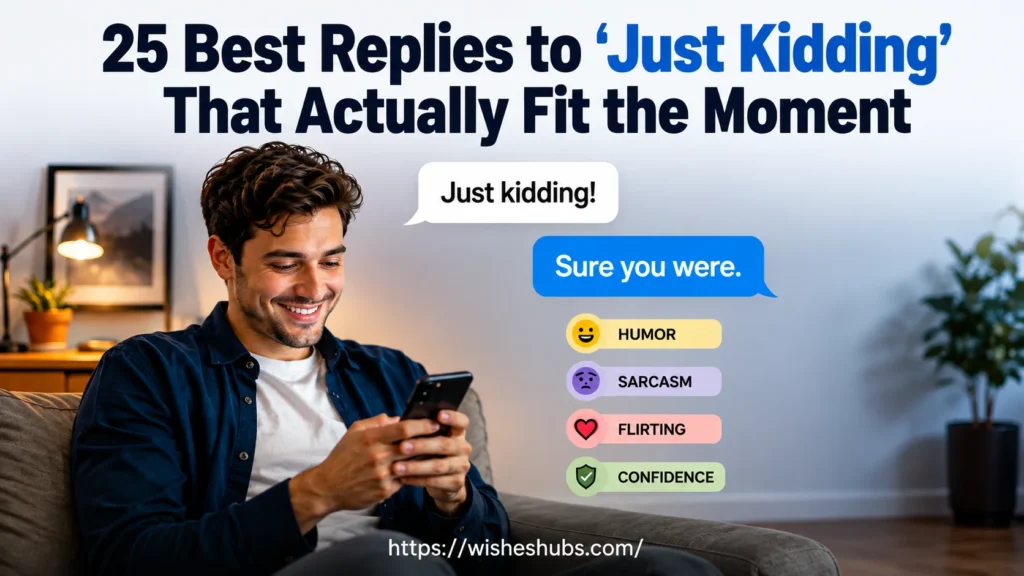
Ever been caught off guard after someone says, “Just kidding,” and wondered what to say next? Finding the right response can keep the conversation fun, confident, and natural without making things awkward. In this guide, we explore 25 Best Replies To “Just Kidding”, covering witty comebacks, playful responses, polite answers, and clever lines for different social situations. Whether you are chatting with friends or navigating business communication, choosing the right words matters.
A good response depends on the relationship, tone, and context behind the joke. Some situations call for humor and sarcasm, while others require a more polite or professional response. Understanding English usage, grammar, and conversational tone can help you respond naturally without sounding forced.
We’ll also explain which replies work best during meetings, casual conversations, online chats, and other everyday interactions.
From lighthearted comebacks to more thoughtful responses, this article helps you choose words with confidence and consistency. While terms such as scheduling, time management, online booking, broadcasting, calendar, and project management may seem unrelated, professional communication often requires the same clarity and context.
Whether you need a casual comeback or a response suitable for formal writing, you’ll find practical examples that match the situation and make your communication more effective.
Quick Answer: The Best Replies to “Just Kidding”
If you need a response right now, start here.
| Situation | Good reply |
| Friendly teasing | “Nice try. I almost believed you.” |
| They fooled you | “Okay, you got me.” |
| You suspect they meant it | “Sure you were.” |
| Their joke was obvious | “I figured.” |
| They backtracked quickly | “Good save.” |
| You want dry humor | “Convenient.” |
| They made you laugh | “Okay, that was actually good.” |
| You want to tease them | “You really committed to that one.” |
| You want to flirt | “Were you really kidding, though?” |
| You’re interested in them | “I was hoping you weren’t kidding.” |
| The joke wasn’t funny | “That one didn’t really land.” |
| The comment crossed a line | “I know you’re joking, but that wasn’t cool.” |
| You want clarification | “If you meant it, you can just say it.” |
The trick isn’t finding the most savage comeback. It’s choosing a response that matches the moment.
What Does “Just Kidding” Actually Mean?
At its simplest, “just kidding” means the speaker wants you to understand that the previous statement wasn’t meant literally or seriously. The phrase can follow a joke, exaggeration, tease, prank, or deliberately misleading statement.
For example:
“I ate the last slice of pizza. Just kidding.”
The speaker immediately tells you that the statement wasn’t true.
However, conversation gets more interesting when the phrase appears after something that sounds believable.
“I think you should quit your job and become a magician. Just kidding.”
Here, the speaker isn’t necessarily correcting a factual misunderstanding. They’re signaling a shift in tone.
Linguistic research backs this up. A corpus study of 1,200 instances found four major functions for “just kidding” and related expressions: inoculating against a bad reaction, repairing failed humor, returning to seriousness, and setting up a new joke. (ScienceDirect)
That explains why one response doesn’t fit every situation.
Sometimes “just kidding” means “I fooled you.”
Sometimes it means “That joke didn’t work.”
Sometimes it means “Let’s get serious again.”
And sometimes it means “I’m about to keep this joke going.”
25 Best Replies to “Just Kidding”
Funny and Playful Replies to “Just Kidding”
When the original comment was harmless, playful humor usually works best. You don’t need to turn every exchange into a verbal heavyweight championship.
“Nice try. I almost believed you.”
This is one of the safest replies because it acknowledges the joke without making the conversation awkward.
Use it when the other person delivered their line convincingly enough to catch you for a moment.
Example:
Them: “I told everyone about your embarrassing karaoke video. Just kidding.”
You: “Nice try. I almost believed you.”
The response works because you’re giving them credit for the attempt while still teasing them.
“Sure you were.”
Short. Dry. Effective.
This reply works especially well when you suspect there might have been a little truth hiding inside the joke.
Them: “I think your new haircut looks terrible. Just kidding.”
You: “Sure you were.”
You don’t need an emoji. You don’t need an explanation. The ambiguity does the heavy lifting.
“You really committed to that joke.”
Use this when someone lets the joke run long before revealing that they weren’t serious.
It has a playful edge without sounding hostile.
Example:
Them: “Bad news. I accidentally told your boss you were quitting.”
You: “What?”
Them: “Just kidding!”
You: “You really committed to that joke.”
That exchange keeps the focus on their dramatic delivery rather than turning the conversation into an argument.
“Okay, you got me.”
Sometimes the simplest answer wins.
If the joke genuinely fooled you, admit it. You don’t lose anything by acknowledging a good prank.
In fact, being willing to lose a tiny conversational battle often makes you more likable. You’re showing that you don’t need to win every exchange.
“I was about to take you seriously.”
This works when the original statement sounded surprisingly plausible.
It also leaves room for the conversation to continue.
Them: “I’m moving to another country tomorrow. Just kidding.”
You: “I was about to take you seriously.”
If they have a good sense of humor, they can now explain why the joke seemed believable.
Witty Replies to “Just Kidding”
A witty response doesn’t have to sound rehearsed. In fact, the best ones usually feel spontaneous.
“That explains a lot.”
This line is intentionally vague.
The other person may wonder whether you believed them, whether you suspected the joke, or whether you’re teasing them right back.
That uncertainty gives the reply its charm.
“I’ll pretend I believed you.”
This response works particularly well with friends who enjoy dry humor.
You’re technically accepting their explanation while quietly refusing to give them full credit.
Them: “I was just kidding.”
You: “I’ll pretend I believed you.”
It sounds casual rather than combative.
“And here I thought you were being serious.”
Use this when the other person’s statement temporarily changed the direction of the conversation.
It’s especially effective when you want to highlight how convincing the joke sounded.
“Good save.”
This one is ideal when the person clearly realized that their joke wasn’t landing.
Instead of arguing about whether they meant it, you turn their recovery into the punchline.
Them: “You’re the most annoying person here. Just kidding.”
You: “Good save.”
The response is short enough to work naturally in a text conversation.
“You almost had me there.”
This is a friendly way to acknowledge that their joke worked.
It also gives the other person a small conversational victory without making you sound overly impressed.
Use it when you actually found the joke clever.
Sarcastic Replies to “Just Kidding”
Sometimes the situation calls for more bite. If you’re talking with a close friend who enjoys sarcasm, these responses can land nicely.
With coworkers, strangers, or someone already annoyed, though, choose carefully. Text removes facial expressions and vocal tone, which makes dry sarcasm easier to misread.
“Oh, now you’re kidding?”
This works when someone waits for your reaction before revealing the joke.
It gently calls attention to the timing.
The phrase becomes especially effective when the original statement sounded suspiciously sincere.
“Convenient.”
One word can say quite a lot.
Use it when someone seems to have discovered the “just kidding” escape route only after realizing you didn’t appreciate the comment.
Because it’s so short, delivery matters. In person, a smile can make it playful. In text, an emoji may prevent the message from sounding genuinely angry.
“That was your escape plan?”
This turns the person’s attempt to retreat from the joke into another joke.
It’s best reserved for relationships where sarcastic banter already exists.
Don’t use it when someone is sincerely trying to apologize.
“Bold strategy.”
This is a wonderfully dry response to an ambitious joke that didn’t quite work.
It doesn’t directly accuse the person of anything. Instead, it lets the absurdity speak for itself.
“You’re really sticking with the ‘just kidding’ defense.”
This works when someone repeatedly says something provocative and then hides behind the same phrase.
It can stay playful among friends.
If the situation feels genuinely uncomfortable, however, skip the sarcasm and say what actually bothers you.
Flirty Replies to “Just Kidding”
A “just kidding” moment can create an opening for flirting when the original comment carried romantic or suggestive energy.
The key is reciprocity. If the conversation already contains mutual teasing, these lines can feel natural. If there hasn’t been any flirtation, a dramatic response may come across as forced.
“Were you really kidding, though?”
This is probably the most useful flirty response.
Why?
Because it doesn’t force an answer. You’re giving the other person a chance to clarify whether there was more behind the joke.
Them: “I might have to take you out sometime. Just kidding.”
You: “Were you really kidding, though?”
Now the ball is in their court.
“For a second, I thought you meant it.”
This line subtly reveals that you noticed the possibility of genuine interest.
It works particularly well when the original joke was a compliment.
“You had me there. I kind of liked it.”
This response turns the joke into an opportunity.
It’s more direct than the previous options, so use it when the conversation already feels comfortable.
“Maybe you should stop kidding around.”
This is playful without being overly serious.
The double meaning gives it a flirtatious quality while keeping the exchange light.
“I was hoping you weren’t kidding.”
This is the boldest option in the group.
Use it when you genuinely want the other person to know you’re interested.
There’s no need to hide behind another joke. Sometimes directness has more charm than a perfectly polished comeback.
Confident Replies to “Just Kidding”
Confidence doesn’t mean having the harshest comeback.
Often, it means not reacting more strongly than the situation deserves.
“I figured.”
This is perfect when the joke was obvious.
It communicates that you weren’t fooled without turning the exchange into a competition.
“I know.”
Simple. Calm. Slightly mischievous.
Use it when you want to show that the person’s attempt didn’t surprise you.
“I had a feeling.”
This response works when you suspected the person was joking from the beginning.
It also keeps the conversation moving instead of forcing an explanation.
“You don’t have to convince me.”
Use this when the other person seems worried that you took the joke seriously.
It can sound reassuring while maintaining a playful tone.
“Okay, comedian.”
This is an easygoing response when someone is clearly trying to entertain you.
It works especially well with friends and family.
Let’s Read Our Other Topics: Plus 99 Proven Brother Like Friend Birthday Wishes
When “Just Kidding” Isn’t Funny
Here’s where the conversation changes.
Not every “just kidding” deserves a clever comeback.
Someone might make a personal insult, criticize your appearance, mock something sensitive, or say something hurtful before adding, “I’m just kidding.”
The phrase doesn’t automatically erase the impact.
A 2015 study found that “just kidding” often helps speakers manage social relationships and avoid negative reactions. Researchers called one common function “inoculation,” meaning the speaker uses the phrase to reduce the chance that a potentially problematic joke will cause trouble.
That doesn’t mean every person who says “just kidding” has bad intentions. Context matters.
Consider these two examples:
Harmless:
“I’m stealing your fries. Just kidding.”
Potentially hurtful:
“Nobody here actually likes you. Just kidding.”
Those statements don’t carry the same social weight.
If someone uses humor to disguise a genuine insult, responding with another joke may only encourage the behavior.
“I know you’re joking, but that wasn’t cool.”
This is direct without being aggressive.
Use it when you want the person to understand that the problem wasn’t your inability to understand humor.
You understood the joke.
You simply didn’t appreciate it.
“I can take a joke. That one just didn’t land.”
This response works especially well when someone says you’re “too sensitive” after you react negatively.
You’re not arguing about their intention. You’re explaining your reaction.
“What made that funny?”
This question can stop an awkward exchange in its tracks.
It doesn’t insult the person. Instead, it asks them to explain the humor behind their comment.
That can be useful when someone makes an offensive remark and then tries to dismiss it as a joke.
“Okay. Let’s leave that one there.”
Sometimes you don’t need the perfect comeback.
You just need an exit.
This response works well when you don’t want to escalate the conversation.
“If you meant something else, just say it.”
Use this when the “joke” sounds suspiciously close to a real opinion.
For example:
Them: “Maybe you should find a different job. Just kidding.”
You: “If you meant something else, just say it.”
That response moves the conversation from performance to honesty.
Replies to “I’m Just Kidding” When They Probably Meant It
Occasionally, the joke feels less like a joke and more like a trial balloon.
Someone says something. They watch your reaction. Then they retreat.
“I’m just kidding.”
Maybe they were joking.
Maybe they weren’t.
You don’t have to guess.
“Are you?”
This is one of the cleanest ways to test the situation.
It invites the person to clarify without accusing them of lying.
“Was there a little truth in that?”
Use this when the original comment sounded unusually specific.
It gives the other person room to admit what they actually think.
“You don’t have to hide behind the joke.”
This is more serious.
Use it when you genuinely believe the person is using humor to avoid saying something directly.
“If you meant it, you can just say it.”
This works particularly well when the relationship allows honest conversation.
It shifts the focus away from the joke and toward the underlying message.
“I had a feeling you weren’t completely kidding.”
This response sits somewhere between teasing and directness.
It works when you want to leave the door open for a more honest answer.
Best Replies to “Just Kidding” Over Text
Texting creates one major problem: you can’t hear the other person’s tone.
A message such as “Sure you were” might sound hilarious from a close friend and genuinely irritated from someone you barely know.
That’s why short replies often work best.
Here are some ready-to-send options:
- “Nice save 😂”
- “Sure you were.”
- “I almost believed you.”
- “Okay, you got me.”
- “Good one.”
- “Convenient.”
- “Good save.”
- “Uh-huh. Sure.”
- “I knew it.”
- “Okay, comedian.”
- “You almost had me.”
- “That was suspiciously believable.”
- “Were you really kidding?”
- “I was about to believe you.”
- “That one was actually good.”
If you’re unsure how the message will land, add a small cue such as 😂, 😏, or lol. Don’t overdo it. One signal can clarify the mood without making the message look staged.
What Does “JK” Mean?
JK means “just kidding.”
It’s an informal abbreviation commonly used in text messaging and social media. Merriam-Webster lists JK as an informal abbreviation for “just kidding,” while Collins also identifies it as a messaging and social-media abbreviation. (Merriam-Webster)
You might see it written in several ways:
- JK
- jk
- J/K
- j/k
The meaning stays essentially the same.
For example:
“I’m selling your birthday gift. JK.”
The writer uses “JK” to signal that the preceding statement wasn’t serious.
Because text lacks facial expression and vocal tone, abbreviations like this can help signal intent. Still, JK can’t magically make every comment harmless. Context remains important.
“Just Kidding” vs. “Just Joking” vs. “JK”
These phrases perform very similar jobs, although they can create slightly different impressions.
| Phrase | Typical setting | Tone |
| Just kidding | Conversation and texting | Casual |
| I’m just kidding | Spoken conversation | Casual and explanatory |
| Just joking | Conversation | Casual |
| JK | Texting and social media | Very informal |
| J/K | Older-style texting | Informal |
The academic literature treats “just kidding,” “just joking,” and JK as related variants that can perform similar conversational functions. (ScienceDirect)
In everyday use, the difference usually comes down to style rather than meaning.
How to Choose the Right Reply to “Just Kidding”
The easiest way to choose a response is to identify what you want to accomplish.
| If you want to… | Try this style |
| Keep the mood light | Playful |
| Admit they fooled you | Good-natured |
| Tease them back | Witty |
| Match their sarcasm | Dry |
| Show romantic interest | Flirty |
| Call out a backtrack | Sarcastic |
| Get the truth | Direct |
| Stop an uncomfortable conversation | Firm |
| Stay professional | Neutral |
| Avoid unnecessary conflict | Brief |
There’s another useful rule: match the intensity of your reply to the intensity of the original comment.
If someone jokes about stealing your fries, don’t respond as though they’ve committed a felony.
Likewise, if someone makes a cruel personal remark and then says “just kidding,” you don’t need to laugh simply to keep the peace.
Case Studies: Choosing the Right “Just Kidding” Response
Case Study: A Friend Pulls a Harmless Prank
Your friend texts:
“I accidentally deleted the photos from your phone. Just kidding.”
The best response is playful:
“Nice try. I almost believed you.”
There’s no need for sarcasm or confrontation because the joke itself remains harmless.
Case Study: A Crush Makes a Romantic Joke
They say:
“I might actually take you on a date. Just kidding.”
Instead of shutting the door, you can test the waters:
“Were you really kidding, though?”
That response keeps the flirtation alive while inviting them to be more direct.
Case Study: Someone Makes a Personal Dig
A coworker says:
“Maybe you’re not cut out for this job. Just kidding.”
A savage comeback could create a bigger problem than the original comment.
A better response is:
“I know you’re joking, but that wasn’t cool.”
You stay composed while making the boundary clear.
Read Our More Topics: Plus 99 Heartfelt Girl Quotes Birthday Wishes
Case Study: Someone Backtracks After a Suspicious Comment
A friend says:
“Honestly, I think you should break up with them. Just kidding.”
You suspect the joke contains a real opinion.
Try:
“If you meant something, you can just say it.”
That response creates space for an honest conversation.
What Not to Say After “Just Kidding”
A clever comeback can still be the wrong choice.
Avoid responses that:
- attack someone’s appearance
- expose a personal insecurity
- escalate a harmless joke
- turn a workplace exchange hostile
- mock someone who is genuinely apologizing
- assume bad intentions without evidence
- make a serious situation sound trivial
- rely on insults simply to sound “savage”
Don’t confuse confidence with cruelty.
A strong response can be funny without being nasty.
If the other person made a harmless joke, laugh and move on. If they crossed a boundary, say so. The goal isn’t to produce the most devastating sentence possible.
It’s to handle the conversation well.
Why “Just Kidding” Can Feel Awkward
The phrase creates an interesting conversational switch.
Before it appears, you’re interpreting the statement literally. After it appears, you’re expected to reinterpret what happened.
Researchers describe this as part of the phrase’s pragmatic role in conversation. Their study found that speakers use “just kidding” not only to repair failed jokes but also to manage rapport, meaning the social relationship between people in the conversation.
That explains a familiar experience.
Someone says something shocking.
You react.
They say, “Just kidding.”
Suddenly, you’re expected to laugh.
But your reaction may have already happened.
That’s why the best response sometimes isn’t another joke. A calm “Okay, got it” can be enough.
The Best “Savage” Replies to “Just Kidding”
If the relationship supports sharp banter, you can turn up the heat without becoming insulting.
Try:
- “Good save. Almost believable.”
- “That retreat was impressive.”
- “Convenient timing.”
- “You really needed that escape hatch.”
- “Nice recovery.”
- “I was waiting for the backpedaling.”
- “That’s one way to rewrite history.”
These lines work because they target the situation, not the person’s vulnerabilities.
That’s an important distinction.
Good banter punches at the moment. Bad banter punches at the person.
The Best Response Isn’t Always a Comeback
Sometimes the smartest reply is surprisingly boring.
If someone says:
“I’m just kidding.”
You can simply say:
“Okay.”
That’s it.
When someone tries to provoke you, a dramatic comeback can give the exchange more energy than it deserves.
Likewise, if someone sincerely explains that they were joking, accepting the clarification can keep the conversation comfortable.
Humor works best when both people are participating willingly.
FAQs
1. What does “just kidding” mean?
“Just kidding” usually means the speaker was joking and did not intend their statement to be taken seriously.
2. What is a good reply to “just kidding”?
A good reply depends on the situation. You can use a funny, playful, sarcastic, or polite response based on the conversation.
3. How do I respond to “just kidding” from a friend?
With a friend, keep things light and natural. Try saying “Nice try!”, “You almost got me,” or “I knew you were joking.”
4. What is a funny response to “just kidding”?
You can turn the joke back on them with a playful response like “Too late, I already believed you!” or “That was almost convincing.”
5. What is a sarcastic reply to “just kidding”?
If sarcasm fits your relationship, try “Sure you were!” or “That’s what they all say.” Use sarcastic replies only when the tone feels appropriate.
6. How should I respond to “just kidding” professionally?
In business communication, keep your response simple and respectful. “Understood,” “Got it,” or “Thanks for clarifying” are suitable choices.
7. Can “just kidding” be rude?
Yes. When someone makes a hurtful or offensive comment and then says “just kidding,” the phrase can sometimes dismiss the impact of their words.
8. What is a flirty reply to “just kidding”?
A playful response could be “Are you sure you’re kidding?” or “I think you meant that.” Choose a response that matches your relationship and the conversation.
9. How can I reply to “just kidding” without sounding rude?
Use a friendly response that acknowledges the joke. “Haha, you got me!”, “No worries,” and “I figured you were joking” are easy options.
10. Why is choosing the right reply to “just kidding” important?
The right response helps maintain the tone and flow of a conversation. It can show confidence, humor, and social awareness while keeping the interaction comfortable.
Conclusion
Knowing how to respond when someone says “just kidding” can make everyday conversations easier and more enjoyable. The best reply depends on the situation, your relationship with the speaker, and the tone of the original comment. A funny comeback may work perfectly with a friend, while a polite and professional response may be better in the workplace.

“Explore amazing wishes and greetings on Wisheshubs.com by Daniel Edward. Find birthday, anniversary, and special occasion messages easily!”