
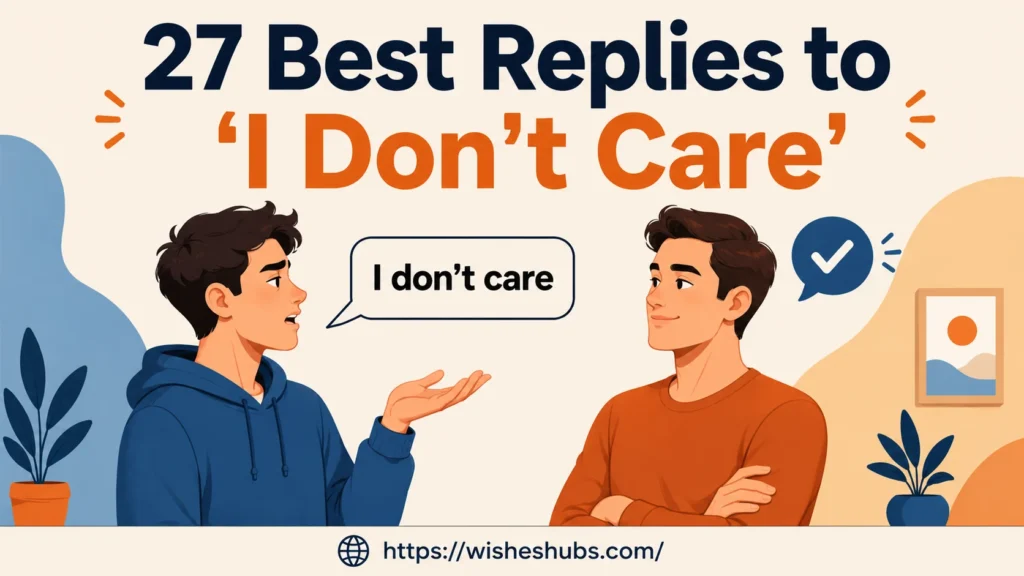
Someone just said “I don’t care” to your face. Maybe it stung. Maybe it made you angry. Maybe you just stood there, mouth open, with nothing to say.
Here’s the thing: not every “I don’t care” means the same thing. Sometimes it’s a shield. Sometimes it’s a weapon. And sometimes, believe it or not, the person genuinely doesn’t care and that’s okay too.
This guide breaks down the best replies to “I don’t care” by situation, not just by vibe. You’ll get sarcastic comebacks, calm and confident lines, funny replies for friends, professional responses for work and family, and even a few honest ways to handle it when someone truly means it. Let’s get into it.
Why People Say “I Don’t Care” in the First Place
Before you fire back a reply, it helps to understand what’s actually going on. “I don’t care” almost never exists in a vacuum. It’s usually a stand-in for something else.
Here are the four most common reasons people say it:
| Reason | What’s Really Going On |
| Dismissal | They want to end the conversation and make you feel small doing it |
| Deflection | They do care, but admitting it feels risky or embarrassing |
| Genuine apathy | They truly have no opinion or stake in the outcome |
| Self-protection | They’re avoiding disappointment by pretending indifference upfront |
Once you know which one you’re dealing with, picking the right reply gets a lot easier. A sarcastic line works great on a dismissive friend. It’ll backfire badly on a stressed-out coworker who’s just deflecting.
When It’s Meant to Hurt You
Sarcastic and Savage Replies
Some people say “I don’t care” specifically to get under your skin. In these moments, you don’t owe them a calm, measured response. A sharp comeback can shut the conversation down fast and honestly, it feels good.
These work best with siblings, exes, frenemies, or anyone testing you on purpose. Use them with people you know can take it.
1. “Cool story, tell it again.” — Mocks the pointlessness of what they just said.
2. “I didn’t ask, but thanks for confirming.” — Turns their dismissal back on them.
3. “Noted. Moving on without you.” — Signals you’re not waiting around for their buy-in.
4. “That’s the most interesting thing you’ve said all day.” — Sarcasm dressed up as a compliment.
5. “I’ll pencil that in under ‘things nobody asked about.'” — Playful but pointed.
6. “Wow, groundbreaking apathy. Truly inspiring.” — Over-the-top exaggeration deflates their attitude.
7. “Good thing I wasn’t looking for your permission.” — Reminds them their opinion isn’t required.
Quick tip: Sarcasm lands best when your tone stays light. Say these with a smile, not a scowl, and they read as witty instead of bitter.
When You Want to Shut It Down Calmly
Confident and Unbothered Replies
Not every situation calls for a jab. Sometimes the strongest move is to not engage with the drama at all. These replies work because they refuse to escalate and that refusal is its own kind of power.
This category is great for people you respect but disagree with, or moments where you just don’t have the energy for conflict.
• “That’s fair. I still care though.”
• “Okay. I’m going to handle it anyway.”
• “Got it. I’ll decide without you then.”
• “That’s your right. Doesn’t change my plan.”
• “Understood. Let me know if that changes.”
• “Alright, I’ll take that as a no from you.”
• “No worries. I’ll figure it out on my own.”
What makes these effective is simple: they don’t ask for permission and they don’t beg for engagement. You state your position, acknowledge theirs, and keep moving. No drama, no chasing them for a reaction they’ve already told you they won’t give.
When It’s Actually Funny (Playful and Humor Replies)
Between close friends, “I don’t care” is often just banter, not a real jab. In these cases, a funny reply keeps the mood light and can even turn into an inside joke.
8. “Devastating. I’ll need a minute.”
9. “My therapist is going to hear about this.”
10. “I’m putting that on your tombstone.”
11. “Bold words for someone who texted me first.”
12. “I’ll frame this moment of pure indifference.”
13. “Somewhere, a violin is playing just for you.”
Example in action:
Friend: “You wore that shirt to dinner? I don’t care.”
You: “Bold words for someone who texted me first about what to wear.”
See how that works? It’s teasing, not hostile — the kind of exchange that ends in laughter, not silence.
When It’s a Professional or Serious Setting
Work, family conflicts, and serious conversations call for a completely different approach. Sarcasm or jokes can make things worse fast. Here, the goal is to keep the conversation productive and avoid unnecessary tension.
| Reply | Best Used When |
| “I understand this isn’t a priority for you, but I need your input by Friday.” | Coworker deflecting a task |
| “I hear you. Can we revisit this once things calm down?” | Family conflict, high emotion |
| “That’s okay. I’ll move forward and keep you updated.” | Boss or client showing disinterest |
| “I get that this feels unimportant to you right now. It matters to me though.” | Partner or close family member |
| “Let’s park this for now and come back to it later.” | Meeting or group setting |
These replies acknowledge the other person’s position without agreeing to drop the issue. They keep the door open instead of slamming it shut, which matters a lot when you still have to work with, live with, or love this person tomorrow.
As conflict-resolution experts often point out, the goal in a professional disagreement isn’t to win — it’s to keep the relationship functional. A calm, clear response does that far better than a clever one.
When “I Don’t Care” Might Be Genuine
How to Respond Without a Comeback
Here’s the part most articles on this topic skip entirely: sometimes, people mean it. Genuine apathy is real, and it’s not always an insult.
If your friend truly doesn’t care what restaurant you pick, or your coworker really has no opinion on the font for a slide deck, forcing a “comeback” onto that moment is pointless — and a little awkward.
Try these instead:
• “No problem, I’ll just choose then.”
• “That works. I’ll take the lead on this one.”
• “Fair enough, I’ll decide and let you know.”
• “All good, this one’s on me to figure out.”
Other Topics: Plus 99 Long Time Best Friend Birthday Wishes
Case study:
Sarah asked her roommate which paint color to pick for the shared kitchen. Her roommate said, “Honestly, I don’t care, whatever you pick is fine.” Sarah initially felt brushed off; she almost snapped back with a sarcastic reply. But her roommate genuinely had no preference and just wanted her to enjoy the space she’d be looking at most. Sarah picked sage green. No conflict. No hurt feelings. Just a decision that needed making.
The lesson? Read the tone before you read the words. Flat, easy indifference usually means someone actually doesn’t care. Clipped, cold, or loaded indifference usually means something else is going on.
Quick-Reference Table:
All 27 Replies at a Glance
| # | Reply | Category | Tone |
| 1 | “Cool story, tell it again.” | Sarcastic | Savage |
| 2 | “I didn’t ask, but thanks for confirming.” | Sarcastic | Savage |
| 3 | “Noted. Moving on without you.” | Sarcastic | Savage |
| 4 | “That’s the most interesting thing you’ve said all day.” | Sarcastic | Savage |
| 5 | “I’ll pencil that in under ‘things nobody asked about.'” | Sarcastic | Savage |
| 6 | “Wow, groundbreaking apathy. Truly inspiring.” | Sarcastic | Savage |
| 7 | “Good thing I wasn’t looking for your permission.” | Sarcastic | Savage |
| 8 | “That’s fair. I still care though.” | Confident | Calm |
| 9 | “Okay. I’m going to handle it anyway.” | Confident | Calm |
| 10 | “Got it. I’ll decide without you then.” | Confident | Calm |
| 11 | “That’s your right. Doesn’t change my plan.” | Confident | Calm |
| 12 | “Understood. Let me know if that changes.” | Confident | Calm |
| 13 | “Alright, I’ll take that as a no from you.” | Confident | Calm |
| 14 | “No worries. I’ll figure it out on my own.” | Confident | Calm |
| 15 | “Devastating. I’ll need a minute.” | Humor | Playful |
| 16 | “My therapist is going to hear about this.” | Humor | Playful |
| 17 | “I’m putting that on your tombstone.” | Humor | Playful |
| 18 | “Bold words for someone who texted me first.” | Humor | Playful |
| 19 | “I’ll frame this moment of pure indifference.” | Humor | Playful |
| 20 | “Somewhere, a violin is playing just for you.” | Humor | Playful |
| 21 | “I understand this isn’t a priority, but I need your input by Friday.” | Professional | De-escalating |
| 22 | “I hear you. Can we revisit this once things calm down?” | Professional | De-escalating |
| 23 | “That’s okay. I’ll move forward and keep you updated.” | Professional | De-escalating |
| 24 | “I get that this feels unimportant. It matters to me though.” | Professional | De-escalating |
| 25 | “No problem, I’ll just choose then.” | Genuine | Neutral |
| 26 | “That works. I’ll take the lead on this one.” | Genuine | Neutral |
| 27 | “Fair enough, I’ll decide and let you know.” | Genuine | Neutral |
Final Thoughts: Read the Room Before You Reply
There’s no single “best” reply to “I don’t care”. There’s only the best reply for that specific moment. A sarcastic line that kills with a sibling will bomb your manager. A calm, professional response that works in a meeting will feel cold with a close friend joking around.
Before you respond, ask yourself one quick question: is this person trying to hurt me, deflect, joke around, or just being honest? Match your reply to the answer, and you’ll almost always land it right.
FAQs
What is the best reply to “I don’t care”?
The best reply depends on the situation and the person’s tone. If they are being dismissive, a confident response such as “That’s fair. I still care though” can keep you composed without escalating the situation.
How do you respond to “I don’t care” without being rude?
Acknowledge what they said and move forward. Try, “No worries, I’ll figure it out,” or “That’s okay, I’ll handle it from here.” These responses show confidence without creating unnecessary conflict.
What is a savage reply to “I don’t care”?
If the situation is playful and the person can take a joke, you could say, “Good thing I wasn’t looking for your permission.” Keep in mind that savage replies can easily make a serious situation worse.
What is a funny response to “I don’t care”?
With close friends, humor can work well. Try, “Devastating. I’ll need a minute,” or “Bold words for someone who texted me first.” The goal is to make the exchange playful rather than hostile.
How do you respond when someone says “I don’t care” during an argument?
Stay calm and avoid immediately matching their attitude. You can say, “I hear you. We can talk about this when things calm down.” This gives both people space while making it clear that the issue has not necessarily been resolved.
What should you say when your partner says “I don’t care”?
First, consider whether they genuinely mean it or are speaking out of frustration. A calm response such as, “I get that it feels unimportant to you, but it matters to me,” communicates your feelings without turning the conversation into another argument.
How should you respond to “I don’t care” at work?
Keep your response professional and focused on the task. For example, “I understand this isn’t a priority for you, but I still need your input by Friday.” This keeps the conversation productive and avoids unnecessary sarcasm.
What if someone genuinely doesn’t care?
You do not always need a comeback. If they truly have no preference, simply say, “Fair enough, I’ll decide then.” Sometimes accepting their indifference and making the decision yourself is the most effective response.
Should you ignore someone who says “I don’t care”?
Ignoring the comment can be appropriate when the person is clearly trying to provoke you. However, if their response affects an important decision or relationship, it is usually better to acknowledge it and decide whether the conversation needs to continue.
How do you know what reply to use?
Pay attention to their tone, your relationship with them, and the situation. A sarcastic comeback may work with a joking friend but could damage a professional relationship. When in doubt, choose a calm and confident response that protects your dignity without escalating the situation.
Conclusion
There is no single perfect response to “I don’t care.” The right reply depends on whether the person is joking, being dismissive, genuinely indifferent, or trying to avoid a difficult conversation. Before responding, read the situation and decide whether the moment calls for humor, confidence, honesty, or simply letting the comment go. Sometimes the strongest comeback is a clever line, while other times it is calmly saying,
“That’s okay, I’ll handle it,” and moving on.

Anna Brown is a passionate writer at WishesHubs, sharing heartfelt wishes, quotes, and messages for every special moment.
2 thoughts on “27 Best Replies to “I Don’t Care” (For Every Situation)”