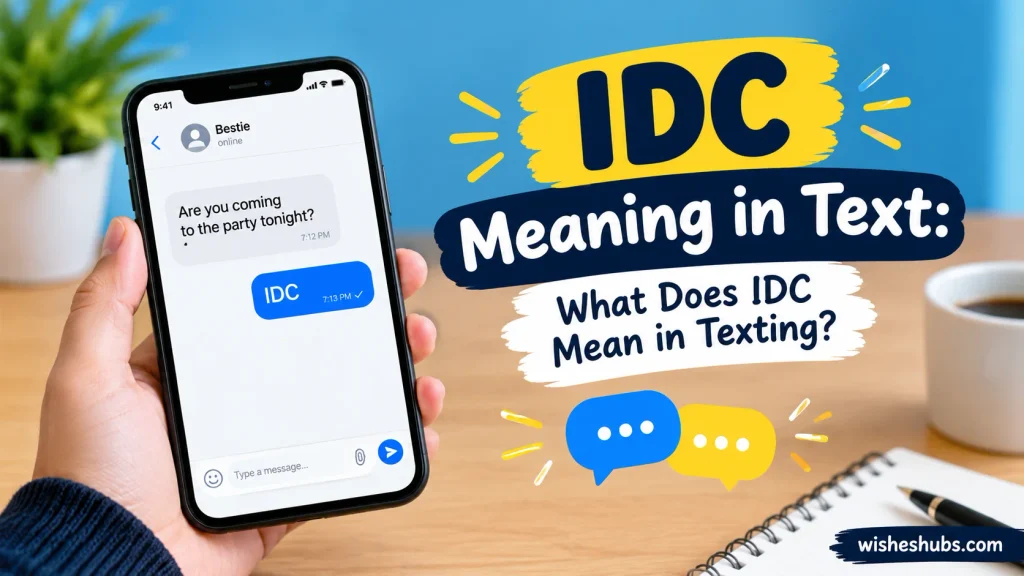
If you’ve received a message containing IDC, you may wonder what it means or how the sender feels. The IDC Meaning in Text is usually I Don’t Care, but its tone can change depending on the conversation, relationship, and context surrounding those three simple letters.
Texting abbreviations make conversations faster, but they can also create confusion. IDC is a common texting abbreviation that people use to show indifference, a lack of preference, or little interest in a topic. For example, someone might say IDC when choosing a restaurant, movie, meeting time, or weekend activity. Understanding the surrounding message helps you read the intended tone correctly.
Although IDC means I Don’t Care, it doesn’t always sound rude or negative. In casual conversations, it may simply mean either choice is fine or you can decide. However, during an argument or serious discussion, IDC can sound dismissive, cold, or frustrated. Context, punctuation, and the relationship between the people involved can all influence its meaning.
Knowing the IDC slang meaning can help you understand messages without jumping to conclusions. Whether you saw IDC in a text message, social media post, group chat, or private conversation, the surrounding words provide important clues. This guide explains what IDC stands for, its different tones, common examples, polite alternatives, and the best ways to respond when someone sends IDC.
Quick Answer: What Does IDC Mean in Text?
IDC means I don’t care in texting, messaging, and online conversations. People use it when they don’t have a preference, aren’t interested in a topic, or don’t want to spend more time discussing something.
For example:
Person A: Pizza or burgers tonight?
Person B: IDC, you choose.
Here, IDC probably means either option is fine.
Now consider a different exchange:
Person A: I think you’re being unfair.
Person B: IDC what you think.
This version sounds much more dismissive and hostile. The abbreviation hasn’t changed. The context has.
What Does IDC Stand For?
IDC stands for I Don’t Care.
Each letter represents a word:
| Letter | Word |
| I | I |
| D | Don’t |
| C | Care |
It’s an initialism commonly used in informal digital communication. Instead of typing the complete phrase, people shorten it to three letters.
The abbreviation saves time and fits naturally into quick conversations. You’ll often see it in text messages, social media comments, direct messages, gaming chats, and group conversations.
However, convenience isn’t the only reason people use IDC. The shortened form can also make a statement feel more casual, blunt, or emotionally detached.
IDC Meaning in Text Messages
The IDC meaning in text messages generally remains I don’t care. What changes is the intention behind those words.
Someone might use IDC to communicate several different ideas:
- I have no preference.
- Either choice works for me.
- I’m not interested in this topic.
- This issue doesn’t concern me.
- I don’t want to argue about it.
- I’m frustrated with this conversation.
- I don’t want to continue discussing this.
That distinction matters.
Suppose a friend asks which coffee shop you prefer. Saying IDC could simply mean you’re happy with either one. If someone shares something deeply personal and receives IDC in response, the same abbreviation may feel cold or hurtful.
So don’t judge the meaning from the letters alone. Read the conversation around them.
IDC Meaning Depending on Context
Context acts like the missing punctuation in texting. It tells you how the sender intends the message to land.
When IDC Means No Preference
This is one of the most harmless uses.
Imagine you’re making plans with a friend:
Friend: Do you want Thai or Mexican food?
You: IDC. You pick.
Here, the speaker isn’t necessarily uninterested in eating. They simply don’t have a strong preference.
Other examples include:
- IDC where we go.
- IDC what movie we watch.
- IDC which one you choose.
- IDC what time we leave.
In these situations, IDC can mean “I’m flexible.”
When IDC Means Lack of Interest
Sometimes someone uses IDC because they genuinely don’t care about a subject.
For example:
Friend: Did you hear what happened between Sarah and Mike?
You: IDC about their drama.
Here, the person doesn’t want to engage with the gossip. The tone may sound blunt, but the message mainly communicates lack of interest.
When IDC Means Frustration
During an argument, IDC can take on a sharper edge.
Person A: You never listen to what I say.
Person B: IDC anymore.
This doesn’t necessarily mean the person literally has no feelings. Instead, it may signal emotional exhaustion or frustration.
The sender could be saying, in effect, “I’m done discussing this.”
When IDC Sounds Dismissive
The most negative use appears when someone dismisses another person’s feelings or opinions.
Person A: That really hurt my feelings.
Person B: IDC.
That response can feel harsh because the speaker appears to reject the other person’s emotional concern.
In sensitive conversations, IDC can sound much colder than the sender intended.
Is IDC Rude?
IDC isn’t automatically rude. Its tone depends heavily on context, relationship, and wording.
Compare these two messages:
IDC. You choose.
IDC what you think.
The first can sound casual and cooperative. The second can sound openly dismissive.
The surrounding conversation also matters. Friends who regularly use casual slang may interpret IDC differently from coworkers or acquaintances.
What Makes IDC Sound Rude?
Several factors can make the abbreviation feel harsher:
- The conversation involves personal feelings.
- The sender uses IDC during an argument.
- The message dismisses someone’s opinion.
- The sender adds aggressive language.
- The relationship already feels tense.
- The recipient expected empathy or support.
A useful rule is simple: If someone is sharing something emotionally important, avoid using IDC unless you clearly explain what you mean.
IDC Meaning and Tone
Three letters can carry different emotional shades.
| Tone | Possible Meaning | Example |
| Neutral | No preference | IDC where we eat. |
| Casual | Either choice works | IDC, pick one. |
| Uninterested | Not interested in the topic | IDC about that show. |
| Annoyed | Frustrated with the discussion | IDC anymore. |
| Dismissive | Rejecting someone’s concern | IDC what you think. |
| Playful | Pretending not to care | IDC 😏 |
Notice something important: the abbreviation itself doesn’t determine the emotion.
Words surrounding IDC, punctuation, emojis, and the relationship between the people can all influence interpretation.
IDC Meaning From a Girl or Guy
The IDC meaning from a girl or guy doesn’t change simply because of the sender’s gender.
IDC still generally means I don’t care.
What matters more is the situation.
For example, if someone you’re dating says:
IDC, you choose the restaurant.
They may simply be giving you control over the decision.
However, if they respond:
IDC about your opinion.
That sounds considerably more dismissive.
IDC in Dating Conversations
Texting can make relationship messages especially easy to misread. Without facial expressions or vocal tone, a short response can feel more dramatic than intended.
Don’t automatically assume that IDC means:
- They dislike you.
- They’re ending the relationship.
- They’re angry.
- They’ve lost romantic interest.
- They’re trying to hurt you.
Look at the pattern of communication, not one abbreviation.
A single IDC rarely provides enough information to determine someone’s feelings.
How to Reply When Someone Says IDC
Your best response depends on what the person seems to mean.
Casual Response
If they’re saying they have no preference, keep things simple:
- No worries, I’ll pick.
- Sounds good.
- I’ll decide then.
- Cool, let’s go with pizza.
Friendly Response
If you want to keep the conversation warm:
- Haha, okay, I’ll choose for us.
- Fair enough. I’ve got a plan.
- Works for me. Let’s do it.
Serious Response
If IDC appears during an emotional conversation, don’t immediately fire back.
You could say:
- Are you saying you don’t care about the issue?
- I want to understand what you mean.
- If you’re frustrated, we can talk about it later.
- It sounds like you’re upset. Do you want some space?
These responses give the other person room to clarify.
Playful Response
With close friends, IDC can invite a humorous reply:
- Fine, democracy has left the chat.
- Your vote has been officially canceled.
- Great. I’m choosing something ridiculous.
The key is knowing your audience.
Also Read This: WTH Meaning in Text: What Does WTH Mean in Messages?
IDC Examples in Texting
Real conversations make the meaning easier to understand.
Choosing a Restaurant
Alex: Sushi or burgers?
Sam: IDC. I’m hungry either way.
Meaning: Sam has no preference.
Picking a Movie
Alex: What should we watch tonight?
Sam: IDC. Pick something good.
Meaning: Sam is letting Alex decide.
Discussing Gossip
Alex: Did you hear what happened at work?
Sam: IDC about office drama.
Meaning: Sam isn’t interested in the subject.
During an Argument
Alex: You should at least hear me out.
Sam: IDC anymore.
Meaning: Sam may feel frustrated or emotionally exhausted.
Dismissing an Opinion
Alex: I don’t think that’s fair.
Sam: IDC what you think.
Meaning: This sounds openly dismissive.
Ending a Conversation
Alex: Can we keep arguing about this?
Sam: IDC. I’m done.
Meaning: The sender doesn’t want to continue the discussion.
IDC Meaning on Social Media and Messaging Apps
You’ll encounter IDC across many informal digital spaces.
Common places include:
- Text messages
- Instagram DMs
- Snapchat
- TikTok comments
- Discord
- Facebook Messenger
- Group chats
- Online gaming chats
The platform doesn’t usually change the basic slang definition. IDC still commonly means I don’t care.
What changes is the surrounding social context.
A comment under a funny post might use IDC casually. A private message during an argument could carry much more emotional weight.
That’s why reading only the abbreviation can lead to a wrong interpretation.
IDC vs. IDK: What’s the Difference?
IDC and IDK look similar, but they communicate completely different ideas.
| Abbreviation | Full Meaning | Main Idea |
| IDC | I Don’t Care | No concern or preference |
| IDK | I Don’t Know | Lack of knowledge |
Consider these examples:
What time does the movie start?
IDK.
The person doesn’t know.
Now:
What time should we meet?
IDC.
The person doesn’t have a preference.
Confusing the two could completely change the meaning of a conversation.
IDC vs. IDGAF
IDC and IDGAF both communicate indifference. However, IDGAF is considerably stronger.
IDGAF stands for I don’t give a fuck. It contains profanity and usually sounds more aggressive or emphatic.
| Expression | Strength | Typical Impression |
| I don’t mind | Low | Polite |
| IDC | Moderate | Casual or blunt |
| I don’t care | Moderate | Direct |
| IDGAF | High | Aggressive or emphatic |
If you’re talking with someone professionally, IDC and especially IDGAF aren’t good choices.
For everyday conversations, the right phrase depends on how direct you want to sound.
Other Ways to Say IDC
Sometimes you want to express the same idea without sounding dismissive.
Try these alternatives:
- I don’t mind.
- It’s up to you.
- Either is fine.
- Whatever works for you.
- I have no preference.
- I’m good with anything.
- You can choose.
- I’m fine either way.
- It doesn’t matter to me.
- I’m flexible.
For example, instead of:
IDC where we eat.
You could say:
I’m good with anywhere. You choose.
The second version sounds warmer while communicating essentially the same idea.
When Should You Avoid Using IDC?
Although IDC works well in casual texting, some situations call for more care.
Formal Communication
Avoid IDC in:
- Business emails
- Job applications
- Professional messages
- Customer service communication
- Academic writing
- Formal requests
Use clearer language such as I don’t have a preference or Either option works for me.
Sensitive Conversations
If someone discusses grief, conflict, relationship problems, or personal struggles, IDC can sound unnecessarily harsh.
For example, saying:
IDC how you feel.
can shut down a conversation instantly.
A more thoughtful response would acknowledge the person’s concern before explaining your own position.
When Someone Wants Your Opinion
If someone asks you to choose between two important options, simply saying IDC may leave them doing all the decision-making.
Instead, try:
I don’t have a strong preference, but I’d lean toward the first option.
That gives them useful information without pretending you care deeply about something that doesn’t matter much to you.
Common Misunderstandings About IDC
Does IDC Always Mean Someone Is Angry?
No.
Someone might use IDC simply because they don’t have a preference.
Does IDC Mean Someone Doesn’t Care About You?
Not necessarily.
IDC usually refers to a specific topic or decision. The surrounding conversation tells you whether the statement concerns the relationship itself.
Does IDC Mean I Don’t Know?
No.
IDC means I don’t care. IDK means I don’t know.
Is IDC Always Rude?
No.
It can sound perfectly casual among friends. In sensitive situations, however, it may come across as dismissive.
Does Capitalization Change the Meaning?
Usually, no.
IDC, idc, and Idc generally represent the same phrase. The choice often reflects typing style rather than a completely different definition.
Does an Emoji Change the Tone?
It can.
For example:
IDC 😂
may sound playful.
Meanwhile:
IDC.
could feel much more blunt in a tense conversation.
The emoji doesn’t create a new definition. It can influence how the reader interprets the attitude.
Does IDC Have Other Meanings?
Yes. IDC can represent other terms outside casual texting.
For example, International Data Corporation (IDC) is a well-known technology market research and intelligence company.
That meaning obviously differs from texting slang.
When you encounter IDC in an ordinary text message, however, I don’t care is usually the relevant interpretation.
Context remains the deciding factor. A technology report discussing market research won’t use IDC in the same way as a friend sending a quick message.
A Simple Case Study: Why Context Matters
Consider this short exchange:
Friend A: Should we meet at 6 or 7?
Friend B: IDC.
At first glance, the message might seem cold. Yet Friend B may simply mean either time works.
Now change the conversation:
Friend A: I was really upset by what you said yesterday.
Friend B: IDC.
Suddenly, the same abbreviation feels much harsher.
What Changed?
The abbreviation stayed exactly the same.
The context changed.
| Situation | Likely Interpretation |
| Choosing dinner | No preference |
| Choosing a movie | Either option works |
| Discussing gossip | Not interested |
| Heated argument | Frustration |
| Emotional conversation | Potentially dismissive |
This illustrates an important rule for texting slang:
Never interpret an abbreviation in isolation when the surrounding conversation provides additional clues.
How to Tell What Someone Means by IDC
When you’re unsure about someone’s intention, examine several clues.
Look at the Previous Messages
What were you discussing before they said IDC?
If you were choosing between restaurants, the meaning is probably straightforward. If you were arguing about a relationship issue, the message deserves more careful interpretation.
Consider Their Normal Texting Style
Some people use abbreviations constantly. Others rarely use them.
If someone normally sends short messages like idk, lol, brb, and IDC, the abbreviation may simply reflect their everyday texting style.
Check the Punctuation
Compare:
- idc lol
- IDC 😂
- IDC.
- IDC!
These can create different impressions even though the underlying phrase remains the same.
Look at What Happens Next
The next message can reveal more than the abbreviation itself.
Someone who says IDC and immediately helps make plans probably means they have no preference.
Someone who stops responding during an argument may be signaling frustration or withdrawal.
FAQs:
What does IDC mean in text?
IDC means I Don’t Care in texting. People commonly use it to express indifference, no preference, or a lack of interest. The exact tone depends on the conversation. In casual situations, it can simply mean either option is fine.
What does IDC stand for?
IDC stands for I Don’t Care. It’s a common texting abbreviation used in informal conversations. People use it to make messages shorter and faster, especially when chatting with friends, family, or people they know well.
Is IDC rude in texting?
IDC can sound rude, but it isn’t always rude. When someone says IDC while choosing food or making plans, it may simply mean they have no preference. During an argument, however, IDC can sound dismissive, cold, or disrespectful.
What does IDC mean from a girl?
The IDC meaning from a girl is generally I Don’t Care. Her gender doesn’t change the abbreviation’s definition. To understand her intention, consider the conversation, wording, relationship, and tone instead of assuming IDC automatically signals anger or disinterest.
What does IDC mean from a guy?
When a guy says IDC, it usually means I Don’t Care. The meaning doesn’t change based on gender. Depending on the situation, he could mean either choice works, he isn’t interested in the topic, or he’s frustrated with the conversation.
How should you respond to IDC?
Your response should match the situation. If IDC means no preference, you can simply make the decision. If it appears during an argument, ask for clarification instead of reacting quickly. A calm response can prevent a short abbreviation from creating unnecessary conflict.
What is the difference between IDC and IDK?
IDC means I Don’t Care, while IDK means I Don’t Know. IDC expresses indifference or no preference, whereas IDK shows uncertainty or a lack of information. Although the abbreviations look similar, they communicate completely different ideas in a text conversation.
Can IDC have a different meaning?
Yes. IDC can represent other terms in business, technology, or professional contexts. However, in ordinary texting and casual online conversations, IDC most commonly means I Don’t Care. Always consider the subject and surrounding information before deciding which meaning applies.
Is IDC still used in texting?
Yes, IDC remains a recognizable texting abbreviation. People use it in casual messages, social media conversations, group chats, and other informal digital communication. Its meaning stays consistent, although the tone can range from casual indifference to strong dismissal.
What are polite alternatives to IDC?
If you want to sound softer, try I don’t mind, either is fine, it’s up to you, I have no preference, or whatever works for you. These expressions communicate flexibility without making your message sound unnecessarily blunt or dismissive.
Conclusion:
The IDC Meaning in Text is usually I Don’t Care, but the intended tone depends on context. It can show no preference, indifference, frustration, or disinterest. Understanding the surrounding conversation helps you interpret these three letters accurately.
When someone uses IDC, don’t immediately assume they’re angry or don’t care about you. The message may simply mean you can choose. However, during sensitive conversations, the abbreviation can sound cold or dismissive, especially without additional explanation or supportive wording.
For a friendlier tone, consider alternatives such as I don’t mind, either is fine, or it’s up to you. These phrases express a similar idea while sounding more considerate. Ultimately, context, relationship, and conversation tone determine what IDC really communicates.

Emily Harris shares simple, heartfelt wishes, quotes, and messages to help you celebrate every special moment beautifully.