
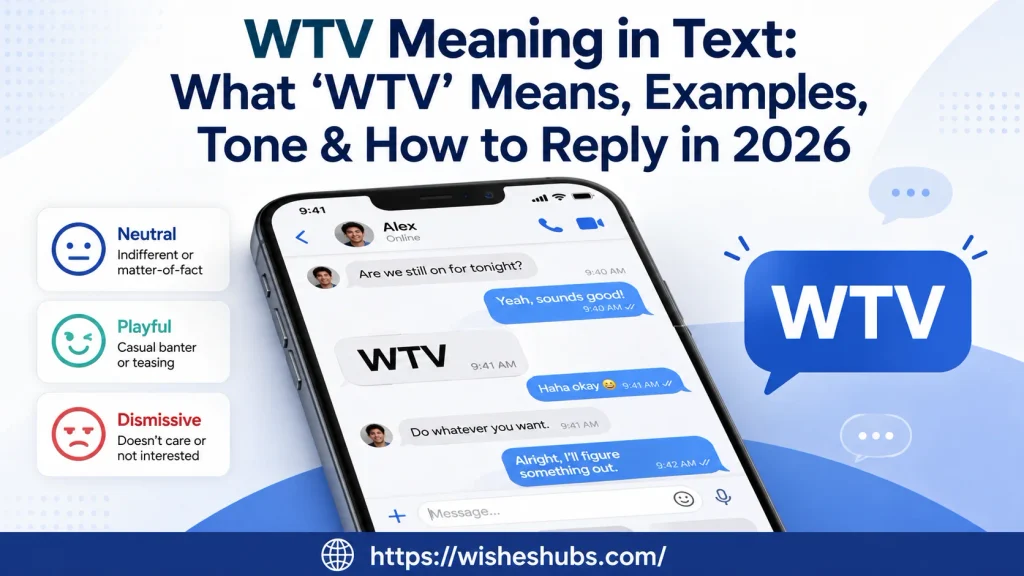
If someone texts you “WTV”, the basic meaning is simple: “whatever.” The tricky part comes next.
Depending on the conversation, WTV can mean I don’t mind, you choose, I don’t care, it’s fine, or I’m done arguing. The three letters stay the same. The tone changes with the situation.
That makes WTV meaning in text less straightforward than it first appears. A friend might write “wtv works 😂” and sound completely relaxed. Someone in the middle of an argument might send only “WTV” and sound irritated or dismissive.
So, what does WTV actually mean? How can you tell whether someone is joking, annoyed, indifferent, or simply flexible? And what should you say when someone sends it?
This guide breaks down the meaning, tone, examples, social-media usage, similar abbreviations, and practical replies.
What Does WTV Mean in Text?
WTV usually means “whatever” in text messages, online chats, and casual digital conversations.
It is an informal abbreviation that shortens the full word “whatever.” Dictionaries and slang references also identify WTV as a texting or internet abbreviation for “whatever.”
In everyday conversation, “whatever” can communicate several ideas:
- I don’t mind.
- Any option is fine.
- It doesn’t matter to me.
- I don’t care.
- Let’s move on.
- I’m tired of discussing this.
The surrounding words usually reveal which meaning applies.
For example:
“Pizza or burgers? WTV works for me.”
Here, WTV sounds neutral. The sender doesn’t have a preference.
Now compare it with:
“I already explained everything. WTV.”
That version feels much colder. The sender may be dismissing the discussion or signaling frustration.
WTV Meaning at a Glance
| Detail | Meaning |
| WTV stands for | Whatever |
| Type | Informal texting abbreviation |
| Common use | Texts, chats, DMs, social media |
| Possible tone | Neutral, casual, playful, indifferent, annoyed, dismissive |
| Formal writing? | Generally no |
| Main factor affecting tone | Context |
The important takeaway is simple: WTV doesn’t have one fixed emotional meaning.
Its dictionary-style meaning is “whatever.” Its conversational meaning depends on how someone uses it.
What Does WTV Stand For?
WTV stands for “whatever.”
The abbreviation removes most of the letters from the original word and keeps a compact form that works well in fast digital conversations. Wiktionary lists wtv as internet and text-messaging slang for “whatever.”
You might see it written as:
- WTV
- wtv
- Wtv
The capitalization usually doesn’t create a completely different definition. People often use lowercase in casual messages because lowercase typing feels informal.
For example:
“wtv you want is fine”
means:
“Whatever you want is fine.”
Likewise:
“WTV, I’m done talking about it.”
means:
“Whatever. I’m done talking about it.”
The first sentence communicates flexibility. The second sounds dismissive.
That’s the central idea behind WTV meaning in text: the abbreviation provides the shortcut, while the surrounding conversation provides the emotional context.
What Does WTV Mean in Texting?
In texting, WTV often appears when someone wants to keep a response short.
Imagine a friend asks:
“Do you want Chinese food or pizza?”
You reply:
“wtv works.”
You’re essentially saying, “Either choice works for me.”
Now imagine a different conversation:
“You never listen when I explain this.”
“WTV.”
The second response can sound like “Whatever. I don’t want to discuss this anymore.”
The abbreviation itself hasn’t changed. The situation has.
That distinction matters because digital messages don’t carry many of the cues that exist during face-to-face conversations. A spoken “whatever” might come with a smile, shrug, laugh, or playful voice. A text message gives you only the words unless the sender adds punctuation, emojis, or additional context.
That is why a short message such as “wtv” can leave room for interpretation.
The Different Meanings of WTV in Text
Although “whatever” remains the core definition, people use it in several practical ways.
WTV Can Mean “I Don’t Mind”
This is one of the most harmless uses.
Someone may use WTV when they genuinely don’t care which option you choose.
Example:
A: “Should we watch a comedy or a thriller?”
B: “Wtv works for me.”
Here, the sender isn’t rejecting the question. They simply don’t have a preference.
Other examples include:
- “Wtv you want.”
- “Pick wtv.”
- “Wtv is fine.”
- “We can eat wtv you want.”
In these cases, replacing WTV with “whatever” preserves the meaning.
WTV Can Mean “You Choose”
Sometimes WTV effectively hands the decision to another person.
A: “Where should we go tonight?”
B: “Wtv. You pick.”
This doesn’t necessarily mean the person feels annoyed. They may simply want someone else to make the decision.
The difference often appears in the rest of the message.
Compare:
“Wtv you want 😂”
with:
“WTV. Just pick something.”
The first feels relaxed. The second feels more impatient.
WTV Can Mean “I Don’t Care”
The word “whatever” can also express indifference.
“WTV. It doesn’t matter anymore.”
Here, the sender isn’t saying every option is equally enjoyable. They’re saying the outcome no longer matters much to them.
This use becomes more emotionally loaded when the conversation already contains disagreement.
WTV Can Sound Dismissive
A standalone “WTV” can shut down a conversation.
For example:
A: “Can we please talk about what happened?”
B: “WTV.”
That reply doesn’t provide much information. It may communicate that the sender doesn’t want to continue the discussion.
Dictionary.com describes WTV as a short form of “whatever” that can imply not caring, boredom, or a lack of interest.
Still, dismissive isn’t guaranteed. You need to read the surrounding exchange.
WTV Can Express Frustration
A person might use WTV after becoming tired of repeating themselves.
“I’ve told you what I think. WTV.”
In that setting, the abbreviation can carry frustration or resignation.
You shouldn’t treat this as proof that the sender is angry. It simply becomes a reasonable interpretation when the previous messages point in that direction.
WTV Can Be Playful
WTV isn’t always serious.
Friends often use short slang expressions while joking around.
A: “Your movie choices are terrible 😂”
B: “Wtv 😂”
The emojis help signal that the exchange isn’t necessarily hostile.
Likewise:
“Wtv 😭 you know I’m right.”
can function as playful banter.
The lesson is worth remembering: never diagnose someone’s mood from WTV alone.
How to Tell What Someone Means by WTV
When you receive a message containing WTV, don’t stare at the three letters in isolation. Read the conversation around them.
Look at the Message Before WTV
The previous message often gives you the strongest clue.
If someone asks:
“Red shirt or blue shirt?”
and receives:
“Wtv.”
they probably mean that either option is acceptable.
If someone says:
“I’m upset that you ignored me.”
and receives:
“WTV.”
the same abbreviation feels much more dismissive.
Check What Comes After WTV
Additional words can completely change the interpretation.
| Message | Likely interpretation |
| “Wtv works for me.” | No preference |
| “Wtv you want.” | You choose |
| “Wtv 😂” | Potentially playful |
| “Wtv, forget it.” | Dismissive or frustrated |
| “WTV.” | Potentially cold or indifferent |
| “Wtv happens, we’ll deal with it.” | Whatever happens |
A longer message gives you more clues. A one-word response gives you fewer.
Pay Attention to Emojis
Emojis can soften or clarify a short message.
Compare:
“wtv 🙄”
with:
“wtv 😂”
The first can suggest annoyance or exasperation. The second can suggest joking or playful disagreement.
That doesn’t create a universal emoji dictionary. People use emojis differently. Context still wins.
Consider Your Relationship
A close friend can send:
“wtv lol”
without causing much concern.
A stranger or professional contact sending only:
“WTV.”
could feel abrupt because you don’t have an established communication style with them.
The relationship acts like background information. It helps you interpret a short message more accurately.
Consider What Was at Stake
A casual decision and an emotional disagreement aren’t equivalent.
If you’re choosing between two restaurants, WTV probably signals flexibility.
If you’re discussing a relationship problem, WTV may signal emotional withdrawal.
The bigger the emotional stakes, the more carefully you should read the context.
WTV Meaning in Text: Real Conversation Examples
The easiest way to understand this abbreviation is to see it in natural exchanges.
Choosing Dinner
Alex: “Pizza or burgers tonight?”
Sam: “Wtv works for me.”
Meaning: Either option is fine.
Letting Someone Pick
Alex: “What movie do you want?”
Sam: “Wtv you want.”
Meaning: You can choose.
Ending a Minor Disagreement
Alex: “I still think that restaurant is better.”
Sam: “Wtv 😂”
Meaning: Probably playful disagreement.
Ending a Serious Argument
Alex: “I wish you’d actually listen to what I’m saying.”
Sam: “WTV.”
Meaning: Potentially dismissive or emotionally withdrawn.
Showing Resignation
Alex: “They changed the schedule again.”
Sam: “Wtv. We’ll figure it out.”
Meaning: The change is frustrating but the sender doesn’t want to dwell on it.
Group Chat Example
Mia: “Movie at 7 or 8?”
Noah: “Wtv works.”
Liam: “8 then.”
Mia: “Done.”
Here, WTV simply speeds up decision-making.
There’s no hidden hostility. The sender doesn’t care which time the group chooses.
Is WTV Rude?
Not automatically.
That’s one of the biggest misunderstandings surrounding the term.
WTV can sound perfectly neutral:
“Wtv works for me.”
It can also sound dismissive:
“WTV.”
The difference comes from context, wording, timing, and relationship.
When WTV Usually Sounds Neutral
WTV is more likely to sound neutral when:
- Someone asks you to choose between options.
- You genuinely don’t have a preference.
- You add words that explain your position.
- The conversation already feels relaxed.
- You use a friendly emoji or casual phrasing.
For example:
“Wtv you want is fine with me.”
That’s much clearer than sending only:
“WTV.”
Related Article: ALR Meaning: What Does “ALR” Mean in Texting?
When WTV Can Sound Rude
The abbreviation can feel rude when:
- Someone is discussing a serious issue.
- You send it as a standalone response.
- The conversation already contains tension.
- You use it after someone explains their feelings.
- You repeatedly dismiss someone’s attempts to talk.
Consider this exchange:
Person A: “That really hurt my feelings.”
Person B: “WTV.”
Even though WTV technically means “whatever,” the reply can feel dismissive because it doesn’t acknowledge the emotional content of the message.
In a sensitive conversation, clearer language usually works better.
How to Reply When Someone Says WTV
Your best response depends on what the sender appears to mean.
If They Mean “I Don’t Mind”
Don’t overthink it.
You can simply make the decision:
- “Cool, I’ll pick.”
- “Okay, let’s do pizza.”
- “Sounds good.”
- “I’ll choose then.”
If They Sound Annoyed
Don’t immediately match their attitude.
Instead, give them an opening to explain.
Try:
- “Are you upset?”
- “Did something bother you?”
- “If you’re annoyed, we can talk about it.”
- “I don’t want to misunderstand you.”
A calm question often works better than another sarcastic abbreviation.
If They’re Clearly Ending the Conversation
Sometimes the smartest response is to stop pushing.
You could say:
- “Okay. We can talk later.”
- “No worries.”
- “I’ll give you some space.”
- “All right.”
Not every short message needs a courtroom-style rebuttal.
If They’re Being Playful
Match the energy if the relationship supports it.
For example:
“Wtv 😂 you know I’m right.”
Or:
“Fine, I’ll choose then 😂”
The goal isn’t to imitate slang perfectly. It’s to keep the response consistent with the conversation.
Best Replies to WTV by Situation
| Situation | Natural reply |
| They don’t care which option you choose | “Cool, I’ll pick.” |
| They’re being playful | “😂 Fair enough.” |
| They sound irritated | “Are you actually upset?” |
| They’re ending an argument | “Okay. We can talk later.” |
| You don’t understand their meaning | “What do you mean by wtv?” |
| They’re giving you the choice | “I’ll choose then.” |
| You’re unsure whether they’re joking | “Are you joking or are you annoyed?” |
| The conversation is getting tense | “Let’s pause and talk later.” |
The safest response isn’t always the cleverest one. Clarity beats sarcasm when the tone is uncertain.
WTV Meaning on Snapchat, Instagram, TikTok and Other Platforms
The core meaning of WTV generally doesn’t change simply because you move from one platform to another.
You can encounter the abbreviation in:
- Text messages
- Snapchat chats
- Instagram DMs
- TikTok comments
- WhatsApp conversations
- Discord chats
- Gaming conversations
- Group messages
Recent slang references likewise describe WTV as a casual abbreviation used across messaging and social platforms.
WTV on Snapchat
Snapchat conversations tend to favor short and informal messages. WTV can therefore appear as a quick response.
“Wtv 😂”
might be playful.
“WTV.”
could sound more dismissive.
The platform doesn’t determine the emotion. The conversation does.
WTV on Instagram
In Instagram DMs, WTV can work much like it does in ordinary texting.
Someone might say:
“Wtv you wanna post.”
That means the sender is leaving the decision to you.
WTV on TikTok
You may encounter WTV in comments or replies where users communicate quickly.
For example:
“Wtv 😂”
can function as a casual disagreement.
Because comments often lack context, however, interpreting tone can be harder than in a private conversation.
WTV in Group Chats
Group chats make WTV particularly useful for quick decisions.
“Dinner at 6 or 7?”
“Wtv works.”
The sender doesn’t need to dominate the discussion. They’re simply saying the choice can go either way.
What Does WTV Mean From a Guy?
WTV doesn’t have a special male-specific meaning.
If a guy texts “WTV,” the abbreviation still normally means “whatever.”
The mistake is assuming that the word itself reveals his feelings.
For example, WTV could mean:
- He genuinely doesn’t care which option you choose.
- He feels annoyed.
- He wants you to decide.
- He’s joking.
- He wants to end the conversation.
Look at his other messages instead.
If he writes:
“Wtv lol. You pick.”
that’s very different from:
“WTV. I’m done.”
The broader conversation tells you far more than the sender’s gender.
What Does WTV Mean From a Girl?
The same principle applies.
WTV doesn’t automatically mean something different when a girl sends it.
A message such as:
“wtv works 😂”
probably indicates flexibility or playful indifference.
A message such as:
“WTV. Whatever.”
may sound more dismissive.
Instead of relying on stereotypes, examine:
- What happened immediately before the message?
- What did she say afterward?
- Did she use emojis?
- Was there an argument?
- Does she normally text this way?
Those clues provide much stronger evidence than gender-based assumptions.
Does WTV Mean They’re Mad at You?
It can, but WTV alone doesn’t prove that someone is angry.
This is where many text conversations go sideways.
Suppose you ask:
“Where should we eat?”
They answer:
“Wtv.”
They probably don’t care which restaurant you choose.
Now suppose you write:
“Why did you ignore me yesterday?”
and receive:
“WTV.”
The second exchange has a very different emotional backdrop.
Signs That WTV May Reflect Irritation
Look for several clues together:
- The conversation was already tense.
- The sender stopped giving detailed replies.
- They switched from normal messages to one-word responses.
- They used annoyed or sarcastic emojis.
- They explicitly said they were tired of arguing.
- Their response doesn’t address your actual question.
One clue rarely tells the whole story.
Does WTV Mean They Don’t Like You?
No.
WTV isn’t a reliable indicator of romantic interest, friendship, attraction, or dislike.
Someone can send WTV because they’re busy, indifferent about a minor choice, joking, frustrated, or simply using their usual texting style.
If you’re trying to understand someone’s feelings, look at the broader pattern of communication.
For example, one “wtv” means very little. A repeated pattern of avoiding conversations, giving extremely short replies, and refusing to engage may tell you more.
Don’t build a whole emotional theory around three letters.
WTV vs. Similar Texting Abbreviations
Several texting abbreviations can look similar in meaning. They aren’t interchangeable.
| Abbreviation | Meaning | Main idea |
| WTV | Whatever | Indifference, flexibility, or dismissal |
| IDC | I don’t care | Direct lack of concern |
| IDK | I don’t know | Uncertainty |
| NVM | Never mind | Dropping or withdrawing a point |
| TBH | To be honest | Introducing an honest opinion |
| IKR | I know, right? | Agreement |
| WYD | What are you doing? | Asking about someone’s activity |
WTV vs. IDC
These two can overlap, but IDC is more direct.
“Wtv works.”
means:
“Whatever works is fine.”
Meanwhile:
“IDC.”
means:
“I don’t care.”
IDC can therefore sound stronger in some situations.
WTV vs. IDK
These express different ideas.
WTV = “Whatever.”
IDK = “I don’t know.”
If someone asks:
“Where should we go?”
and you don’t know the answer, IDK fits.
If you don’t care which place you visit, WTV may fit better.
WTV vs. NVM
NVM means “never mind.”
It often signals that someone has decided not to continue with a question or explanation.
“Can you send me that file? Nvm, I found it.”
WTV doesn’t carry that exact meaning.
WTV vs. “Whatever”
The difference is mainly formality and style.
“Whatever works.”
is standard casual English.
“Wtv works.”
is abbreviated internet language.
The underlying meaning remains similar.
Why People Use WTV in Text Messages
The reason is straightforward: short digital messages reward speed and convenience.
WTV takes three letters instead of the full word “whatever.” That makes it useful in quick chats.
It also fits the broader pattern of internet shorthand.
Other familiar abbreviations include:
- IDK — I don’t know
- IDC — I don’t care
- TBH — to be honest
- NVM — never mind
- BRB — be right back
- RN — right now
- WYD — what are you doing?
WTV belongs to this informal vocabulary of digital communication.
However, shorter doesn’t always mean clearer.
A full sentence can communicate tone more precisely:
“Either option works for me.”
That leaves little room for confusion.
A single:
“WTV.”
doesn’t.
Is WTV an Acronym or an Abbreviation?
WTV is commonly described as an abbreviation or initialism for “whatever.”
The terminology can vary depending on how linguistic categories are defined. In practical terms, the important point is simple: WTV is an informal shortened form used in texting and internet communication.
You don’t need to treat it like a formal English word.
It belongs to casual digital language. Its main purpose is convenience.
Is WTV Appropriate for Formal Writing?
Generally, no.
WTV works best in informal communication with people who understand the slang.
Avoid it in:
- Business emails
- Academic papers
- Job applications
- Formal reports
- Professional proposals
- Customer-service communication
- Official documents
Instead of:
“WTV works for me.”
write:
“Either option works for me.”
Instead of:
“WTV you decide.”
write:
“Whatever you decide is fine with me.”
The longer version may take a few extra seconds to type. In formal writing, clarity and professionalism matter more than saving keystrokes.
When You Should Avoid Using WTV
WTV can be convenient. Sometimes it’s the wrong tool.
Serious Conversations
If someone is telling you about a personal problem, “WTV” can sound like you don’t care.
Professional Communication
Slang can make a professional message look careless or overly casual.
Emotional Conflicts
During an argument, WTV can pour gasoline on a small fire.
If you actually mean:
“I need some time before we continue this conversation.”
say exactly that.
When You Have a Clear Opinion
If you know what you want, don’t hide behind “whatever.”
Instead of:
“WTV.”
say:
“I’d prefer the earlier time.”
Clear communication saves everyone guesswork.
Common Misunderstandings About WTV
“WTV Always Means Someone Is Angry”
False.
It can indicate genuine flexibility or casual indifference.
“WTV Always Means I Don’t Care”
Not necessarily.
In:
“Wtv you want.”
the sender may simply be giving you control over the choice.
“WTV Is Always Rude”
No.
The phrase can be completely harmless in a casual conversation.
“WTV Means They Don’t Like Me”
There’s no solid basis for that conclusion.
One abbreviation can’t establish someone’s feelings toward you.
“WTV Has a Different Meaning on Every Social App”
Usually not.
The common texting meaning remains “whatever.”
“Capital Letters Always Make WTV Angry”
Not necessarily.
Capitalization can affect how a message feels. It doesn’t create a universal emotional rule.
A person who normally types in uppercase may use WTV without any extra hostility.
A Simple Case Study: Why Context Changes WTV
Consider two conversations involving the exact same response.
Case One: Choosing Dinner
Jordan: “Should we get Thai food or burgers?”
Chris: “Wtv works for me.”
Here, WTV communicates flexibility.
Chris doesn’t have a strong preference. Jordan can make the decision.
Case Two: Relationship Argument
Jordan: “I want to explain why that upset me.”
Chris: “WTV.”
Here, WTV can communicate dismissal or emotional withdrawal.
The letters didn’t change.
The context did.
This is why searching for a single emotional definition can lead you astray. Texting slang works inside conversations. You need the surrounding words to interpret it accurately.
WTV Meaning in Text: Quick Reference Guide
| If someone says… | WTV probably means… |
| “Wtv works for me.” | Either option is fine |
| “Pick wtv you want.” | You can choose |
| “Wtv 😂” | Playful indifference or disagreement |
| “WTV.” during an argument | Possible frustration or dismissal |
| “Wtv happens.” | Whatever happens |
| “Wtv, I’m done.” | The sender wants to end the discussion |
| “Wtv you think.” | Potential disagreement or indifference |
This isn’t a rigid translation chart. It’s a practical guide.
Context remains the deciding factor.
FAQs
What does WTV mean in text?
WTV usually means “whatever.” People use it as a casual abbreviation in texts, chats, DMs, and online conversations.
What does WTV stand for?
WTV stands for “whatever.”
Is WTV slang?
Yes. WTV is informal internet and texting slang.
Is WTV rude?
It can be. A standalone WTV can sound dismissive, especially during an argument. In a casual statement such as “Wtv works for me,” it can simply express flexibility.
What does WTV mean from a guy?
It usually means “whatever.” The abbreviation doesn’t have a special male-specific definition. Context determines the tone.
What does WTV mean from a girl?
It also usually means “whatever.” Don’t assume the sender’s gender changes the meaning.
What does WTV mean on Snapchat?
On Snapchat, WTV generally means “whatever.” It can express flexibility, indifference, playfulness, or dismissal depending on the conversation.
What does WTV mean on Instagram?
WTV generally means “whatever” in Instagram DMs, comments, and casual conversations.
Does WTV mean someone is angry?
Not necessarily. It can indicate anger or frustration in a tense conversation. It can also be completely neutral.
How should I reply to WTV?
Match your reply to the context. If the person is flexible, make the decision. If they seem annoyed, ask whether something is wrong. If they’re ending an argument, give them some space.
Is WTV the same as “whatever”?
Essentially, yes. WTV is a shortened informal form of “whatever.”
Is WTV appropriate in a work email?
Generally, no. Use clear language such as “either option works for me” instead.
Does WTV mean they don’t like me?
No. A single WTV message doesn’t provide enough information to determine someone’s feelings toward you.
Conclusion:
The most common WTV meaning in text is straightforward: “whatever.”
What isn’t straightforward is the tone.
WTV can mean:
- Either option is fine.
- You can choose.
- I don’t really care.
- It’s not important.
- I’m joking.
- I’m frustrated.
- I don’t want to continue this conversation.
That’s why the best way to interpret WTV is to read the entire exchange rather than focusing on the abbreviation alone.
If someone writes:
“Wtv works for me.”
they’re probably saying that any option is acceptable.
If they write:
“WTV.”
after an argument, they may be shutting down the conversation.
And if they write:
“Wtv 😂”
they may simply be joking around.
When you’re unsure, don’t guess wildly. Ask.
A quick “Are you joking or are you annoyed?” can clear up more confusion than ten minutes of decoding texting slang.
Ultimately, WTV is a tiny abbreviation with a surprisingly wide emotional range. The three letters give you the words. The context gives you the meaning.

Emily Harris shares simple, heartfelt wishes, quotes, and messages to help you celebrate every special moment beautifully.
1 thought on “WTV Meaning in Text: What “WTV” Means, Examples, Tone & How to Reply”