
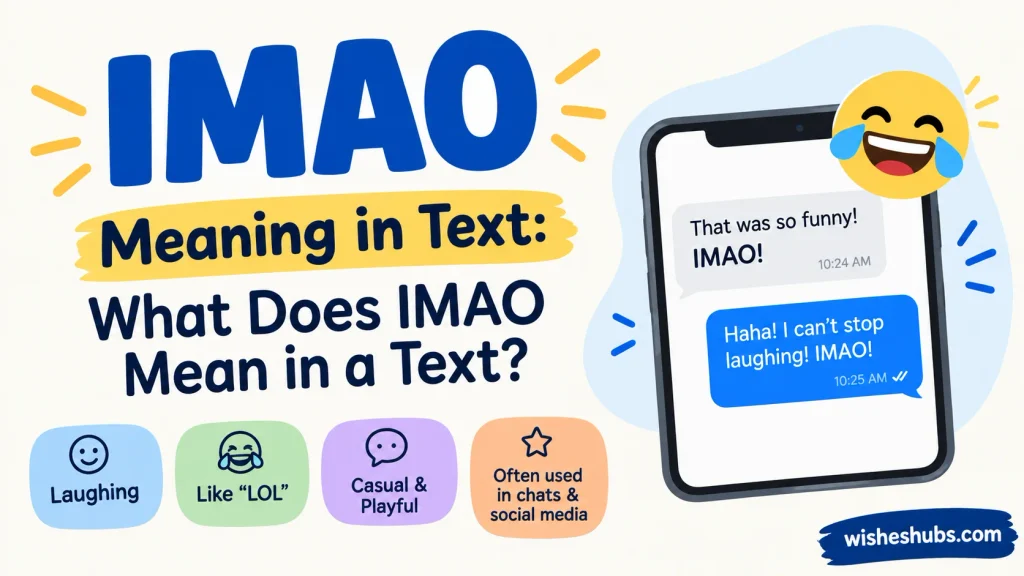
Ever wondered what IMAO Meaning in Text really means when someone uses it in a chat? This casual texting abbreviation can look confusing at first, especially beside familiar terms like IMO and LMAO.
In everyday text messages and online chats, IMAO usually means “In My Arrogant Opinion.” It adds a playful, confident twist to a personal opinion. Rather than sounding completely serious, the phrase often carries humor, sarcasm, or exaggerated confidence, depending on the conversation and relationship between the people involved.
You may see IMAO in social media comments, group chats, gaming conversations, forums, and other forms of digital communication. Its meaning becomes clearer when you consider the surrounding words, punctuation, and emojis. Understanding this internet slang can help you interpret messages accurately without mistaking playful confidence for genuine arrogance or hostility.
Because texting language changes quickly, similar abbreviations can easily cause confusion. IMO, IMHO, LMAO, and LMFAO serve different purposes even though their letters look somewhat alike. Knowing these distinctions gives you better contextual understanding and helps you use IMAO naturally when chatting with friends or participating in informal online conversations.
Quick Answer: What Does IMAO Mean in Text?
IMAO usually means “In My Arrogant Opinion.” It works as a playful version of IMO (“In My Opinion”) and signals that the writer is about to share a personal view with a deliberately confident or tongue-in-cheek tone.
For example:
“IMAO, that’s the best pizza place in town.”
Here, the person isn’t necessarily claiming to be arrogant. They’re adding a little humor to their opinion. Think of IMAO as putting a wink next to your statement.
IMAO at a Glance
| Detail | Meaning |
| IMAO | In My Arrogant Opinion |
| Type | Internet/texting abbreviation |
| Main purpose | Introduces a personal opinion |
| Tone | Playful, humorous, cheeky, or deliberately confident |
| Common setting | Texts, social media, forums, chats |
| Formal use | Generally inappropriate |
| Closest common abbreviation | IMO |
The key word is “arrogant.” It changes the flavor of the ordinary “in my opinion” phrase and gives the message a more playful edge.
What Does IMAO Stand For?
IMAO stands for “In My Arrogant Opinion.”
The abbreviation follows a straightforward pattern:
- I = In
- M = My
- A = Arrogant
- O = Opinion
The expression builds on the much more familiar abbreviation IMO, which means “In My Opinion.” Adding the letter A creates a humorous variation that exaggerates the speaker’s confidence.
For example:
“IMAO, my homemade burgers are better than restaurant burgers.”
The writer probably isn’t making a serious statement about personal superiority. The “arrogant” part adds comic exaggeration.
That distinction matters. IMAO generally isn’t an insult or an admission of actual arrogance. Its effect depends heavily on the conversation and the relationship between the people involved.
IMAO Meaning in Texting and Online Chats
The IMAO meaning in texting centers on expressing an opinion with a deliberately cheeky attitude.
Imagine someone saying:
“IMAO, this is the only movie worth watching this weekend.”
The basic message is simply an opinion. The IMAO abbreviation adds personality. It suggests, “Here comes my opinion, and I’m going to pretend I’m extremely confident about it.”
That playful framing makes IMAO useful in casual conversations. Friends might use it while debating food, movies, sports, music, games, fashion, or almost anything else that invites personal preferences.
What Tone Does IMAO Usually Convey?
IMAO can communicate several related tones:
- Playfulness: The writer doesn’t want the statement to sound overly serious.
- Confidence: The person presents the opinion strongly.
- Self-aware humor: The writer acknowledges that they’re being a little dramatic.
- Sarcasm: Depending on context, IMAO can make an exaggerated statement sound intentionally tongue-in-cheek.
- Personal preference: It clearly frames the statement as the writer’s own view.
However, tone isn’t built into the abbreviation alone. A sentence can change the meaning considerably.
Compare these:
“IMAO, chocolate ice cream is the best.”
That sounds playful and harmless.
Now consider:
“IMAO, nobody here understands how to do their job.”
That could sound sarcastic, dismissive, or genuinely arrogant depending on the conversation.
Context is king. The words around IMAO matter just as much as the abbreviation itself.
How to Use IMAO in a Text
Using IMAO isn’t complicated. You typically place it before a personal opinion, especially when you want the statement to sound humorous or deliberately overconfident.
IMAO at the Beginning of a Sentence
This is one of the clearest ways to use the abbreviation.
“IMAO, that was the funniest scene in the entire movie.”
“IMAO, homemade pizza beats frozen pizza every time.”
Starting with IMAO tells the reader immediately that a personal opinion follows.
IMAO at the End of a Sentence
Some people may place the abbreviation after their statement to add a humorous afterthought.
“That was easily the best episode, IMAO.”
This style feels more conversational. It resembles adding “in my very confident opinion” after making a bold claim.
IMAO as a Standalone Response
Using IMAO by itself is less straightforward.
If someone says:
“Who makes the best coffee around here?”
A response such as:
“IMAO, definitely Mike’s Coffee.”
works naturally because the abbreviation introduces an opinion.
A standalone “IMAO” without an opinion can leave the reader wondering what the person means. Unlike LOL or LMAO, IMAO isn’t primarily a laughter reaction.
IMAO Meaning With Examples
Realistic examples make texting slang much easier to understand. Here are several ways the abbreviation might appear in casual conversation.
| Text Example | Likely Meaning or Tone |
| “IMAO, that’s the best burger in the city.” | Playfully confident opinion |
| “IMAO, you should pick the blue one.” | Personal recommendation with humor |
| “That was the best game of the season, IMAO.” | Strong personal opinion |
| “IMAO, pineapple belongs on pizza.” | Playful or provocative opinion |
| “IMAO, nobody does breakfast better than my grandma.” | Affectionate, exaggerated confidence |
| “IMAO, this new update made the game worse.” | Strong personal judgment |
Notice the pattern. IMAO doesn’t describe an action or object. It frames the speaker’s opinion about something.
IMAO vs IMO: What’s the Difference?
This is one of the most important comparisons because IMAO and IMO are closely related.
IMO means “In My Opinion.”
IMAO usually means “In My Arrogant Opinion.”
The difference is the added A.
| Abbreviation | Meaning | Tone |
| IMO | In My Opinion | Neutral and casual |
| IMAO | In My Arrogant Opinion | Playful, cheeky, deliberately confident |
| IMHO | In My Humble Opinion | Modest or humorous |
| IMNSHO | In My Not-So-Humble Opinion | Strongly self-aware or humorous |
Consider these two messages:
“IMO, this is the better option.”
This sounds fairly neutral.
“IMAO, this is obviously the better option.”
The second version has a more exaggerated personality. The writer is jokingly presenting their opinion as though it’s unquestionably correct.
That extra letter does some heavy lifting.
IMAO vs LMAO: Are They the Same?
No. IMAO and LMAO have different meanings.
LMAO commonly means “Laughing My Ass Off.” People use it to express strong amusement.
IMAO, by contrast, generally means “In My Arrogant Opinion.” It introduces an opinion rather than directly expressing laughter.
| Abbreviation | Meaning | Main Function |
| IMAO | In My Arrogant Opinion | Introduces an opinion |
| LMAO | Laughing My Ass Off | Expresses strong amusement |
| LOL | Laughing Out Loud | Expresses laughter or amusement |
| LMFAO | Laughing My Freaking/Fucking Ass Off | Strong or emphatic amusement |
These abbreviations can look similar at a glance. That’s where confusion often starts.
For example:
“IMAO, that movie was terrible.”
The writer is giving an opinion.
Meanwhile:
“LMAO, that movie was terrible.”
The writer is saying the situation or statement is funny.
The surrounding sentence can sometimes make the difference obvious.
Is IMAO the Same as “In My Arrogant Opinion”?
Yes. “In My Arrogant Opinion” is the standard expansion associated with IMAO in internet slang.
The phrase intentionally plays with the conventional structure of IMO.
That’s part of what makes internet slang interesting. Users often modify familiar abbreviations to create humorous alternatives. IMAO adds “arrogant” to make the speaker sound mock-confident.
For instance:
“IMAO, my chili recipe could win a national competition.”
The speaker isn’t necessarily claiming genuine superiority. The phrase can function as a humorous exaggeration.
Still, don’t assume every person knows the abbreviation. IMAO is far less universally recognized than common expressions such as LOL, OMG, IMO, or LMAO.
Also Read This: IDM Meaning in Text: What Does IDM Mean in a Text?
Can IMAO Have Other Meanings?
Yes, context can create ambiguity.
Internet abbreviations aren’t standardized like technical terminology. Different communities can use the same letters differently. Some people may also type IMAO when they intended another abbreviation.
The most relevant possibilities include:
- In My Arrogant Opinion — the established slang expansion.
- A possible typo for LMAO — especially when someone is typing quickly.
- A mistaken or personalized expansion — uncommon uses can appear in individual conversations.
Because of that, don’t automatically assume an unusual interpretation if the sentence doesn’t make sense.
Look at the surrounding message first.
If someone writes:
“IMAO, I think we should leave early.”
“In My Arrogant Opinion” makes reasonable sense.
If the same abbreviation appears in a conversation where everyone is laughing about a ridiculous video, the sender might have made a typo or used the abbreviation differently.
When the meaning remains unclear, simply asking “What do you mean by IMAO?” is better than guessing.
When Should You Use IMAO?
IMAO works best in informal digital conversations where humor and personality are welcome.
Good Situations to Use IMAO
You can use it when:
- Talking with friends
- Sharing personal preferences
- Commenting on social media
- Chatting in informal online communities
- Discussing movies, music, food, games, or sports
- Making a deliberately bold or exaggerated statement
- Adding humor to an otherwise ordinary opinion
For example:
“IMAO, the second season was way better.”
That’s perfectly suited to casual conversation.
When You Should Avoid IMAO
Avoid it in settings where clear and professional language matters, such as:
- Job applications
- Formal business emails
- Academic papers
- Professional reports
- Legal documents
- Official workplace communication
Writing “IMAO” in a formal report could make the sentence look unnecessarily casual.
Instead of:
“IMAO, this strategy is the strongest option.”
A professional document would normally use:
“In my opinion, this strategy is the strongest option.”
The audience determines the right language. Slang has its place, but not every place is a group chat.
How to Respond When Someone Texts “IMAO”
Your response depends on what the person actually said.
If They’re Sharing a Funny Opinion
You can respond naturally:
- “Honestly, I agree.”
- “You might be right 😂”
- “That’s a bold take.”
- “I can’t even argue with that.”
- “Okay, that’s actually fair.”
If They’re Being Sarcastic
Match the playful tone if the relationship allows it.
For example:
Them: “IMAO, I’m obviously the best cook here.”
You: “Your confidence is impressive 😂”
If You Don’t Understand Their Meaning
Ask directly:
“Wait, what does IMAO mean here?”
That’s especially useful when the sentence doesn’t provide enough context.
Common Mistakes People Make With IMAO
A few misunderstandings appear frequently when people encounter unfamiliar texting abbreviations.
Confusing IMAO With LMAO
The letters look similar, but the meanings differ substantially. IMAO generally introduces an opinion while LMAO expresses laughter.
Treating IMAO as a Serious Admission of Arrogance
The word “arrogant” sounds harsh on paper. In casual texting, however, the phrase often works as self-deprecating humor or playful exaggeration.
Using IMAO in Formal Writing
Texting slang belongs mainly in informal communication. Professional readers may find unexplained abbreviations distracting.
Assuming Everyone Knows the Abbreviation
Common expressions such as LOL have widespread recognition. IMAO isn’t necessarily familiar to everyone.
Ignoring Context
An abbreviation doesn’t exist in isolation. The sentence, relationship, punctuation, emojis, and previous messages can all influence the tone.
IMAO in Different Digital Conversations
The IMAO meaning in text messages stays relatively consistent, but the tone can shift depending on the platform.
IMAO in Text Messages
Friends may use IMAO while debating everyday preferences.
“IMAO, that new restaurant is overrated.”
The message sounds like a strong personal take with a playful edge.
IMAO on Social Media
A commenter might use IMAO before making a bold statement about a movie, celebrity, sports team, game, or trending topic.
Because social media conversations move quickly, abbreviations help users express tone without writing a full phrase.
IMAO in Gaming Chats
Gamers may use IMAO while discussing strategies, characters, maps, updates, or memorable plays.
“IMAO, that character is still the best choice.”
The phrase signals that the statement reflects the player’s personal judgment.
IMAO in Group Chats
Group chats provide plenty of opportunities for playful disagreement.
“IMAO, anyone who skips dessert is making a terrible decision.”
Here, the exaggerated confidence is part of the joke.
IMAO Meaning on Social Media
Social media encourages short, expressive communication. That’s why abbreviations like IMAO can fit naturally into comments and quick replies.
However, digital tone can be surprisingly slippery. Without facial expressions or vocal cues, readers have to infer whether someone is joking.
An emoji can sometimes make the intended tone clearer:
“IMAO, my playlist is better than yours 😂”
The emoji signals that the statement probably isn’t a serious attack.
Without that cue:
“IMAO, my playlist is better than yours.”
The message could still be playful. Yet the reader has more room to interpret it as genuine arrogance.
Text has no facial expression. Context has to do that work.
IMAO Meaning in Different Contexts
| Situation | Likely Tone of IMAO |
| Friendly debate | Playful confidence |
| Food preference | Lighthearted opinion |
| Movie discussion | Personal judgment |
| Gaming conversation | Strong preference |
| Social media comment | Humorous or bold opinion |
| Argument | Potentially sarcastic or dismissive |
| Professional email | Usually inappropriate |
The same abbreviation can land differently depending on the relationship.
A close friend may understand:
“IMAO, you’re completely wrong.”
as playful teasing.
A stranger could interpret it as genuine arrogance.
That’s why tone depends on both language and context.
A Simple Way to Remember IMAO
If you keep mixing up IMAO with other abbreviations, remember this:
IMO = My opinion.
IMAO = My opinion, with a deliberately arrogant twist.
LMAO = I’m laughing hard.
You can think of the extra A in IMAO as the “attitude” letter. It adds a cheeky layer to an ordinary opinion.
Quick Memory Trick
IMAO → Opinion + exaggerated confidence
IMO → Opinion
LMAO → Laughter
This simple distinction covers most everyday situations.
FAQs:
What does IMAO mean in text?
IMAO usually means “In My Arrogant Opinion.” People use it to introduce a personal opinion with a playful, confident, or slightly exaggerated tone.
What does IMAO stand for?
IMAO stands for “In My Arrogant Opinion.” It works as a humorous variation of the more common abbreviation IMO, which means “In My Opinion.”
Is IMAO the same as IMO?
No. IMO means “In My Opinion,” while IMAO means “In My Arrogant Opinion.” The added “A” gives the phrase a more playful or deliberately confident tone.
Is IMAO the same as LMAO?
No. LMAO expresses strong laughter, while IMAO usually introduces an opinion. Their similar appearance can make them easy to confuse when reading a quick text.
How do you use IMAO in a text?
You can place IMAO before a personal opinion, such as “IMAO, that’s the best movie this year.” It can also appear at the end of a sentence in casual conversations.
Is IMAO considered slang?
Yes. IMAO is informal internet and texting slang. It works best in texts, social media comments, group chats, gaming conversations, and other relaxed settings.
Can IMAO sound sarcastic?
Yes. Depending on the conversation, IMAO can sound sarcastic or tongue-in-cheek. The surrounding words, emojis, and relationship between the speakers can help reveal the intended tone.
Is IMAO appropriate for professional communication?
Generally, no. IMAO is casual slang, so it’s better to use clear phrases such as “in my opinion” in professional emails, reports, academic writing, and formal communication.
How should you respond to IMAO?
Respond according to the tone of the message. You could agree, disagree, joke back, or ask for clarification if you’re unsure what the sender intended.
Does IMAO have more than one meaning?
“In My Arrogant Opinion” is the main texting meaning. However, abbreviations can vary between online communities. Context can help determine whether someone intentionally used IMAO or made a typing mistake.
Conclusion:
Understanding IMAO Meaning in Text makes casual digital conversations much easier to follow. The abbreviation usually means “In My Arrogant Opinion” and adds a playful, confident tone to personal opinions.
Knowing how IMAO differs from IMO, LMAO, and other texting slang helps you read messages more accurately. When you use it, keep the audience and context in mind for a natural, friendly conversation.

“Explore unique wishes, greetings, and celebration ideas with Emma Brooke at Wisheshubs.com – your go-to place for inspiring messages!”






1 thought on “IMAO Meaning in Text: What Does IMAO Mean in a Text?”