
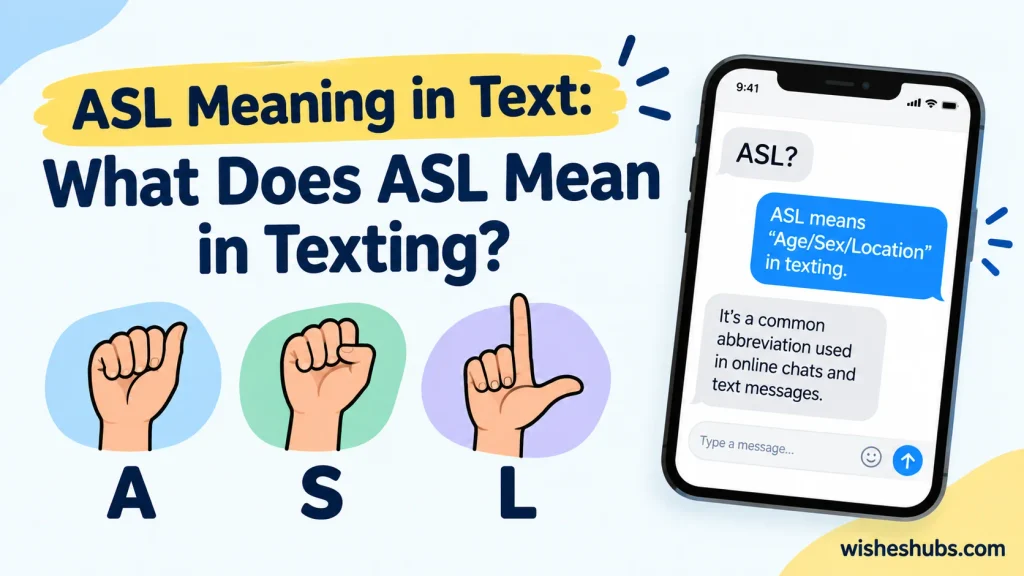
You get a message that simply says “ASL?” and suddenly you’re left wondering what the three letters mean. Is the person asking about your age, sex, and location? Or are they talking about American Sign Language? Context makes all the difference.
The ASL meaning in text has two major interpretations. In older online chat culture, ASL commonly means “Age, Sex, Location.” It was a quick way to ask someone basic personal details. Today, however, ASL is also widely recognized as the abbreviation for American Sign Language, especially when conversations involve signing, Deaf culture, accessibility, or language learning.
Understanding the difference can save you from an awkward reply. A message like “ASL?” can mean something quite different from “Do you know ASL?” The first often points toward an old-school chat abbreviation, while the second usually refers to American Sign Language. Here’s how to tell which meaning fits.
Quick Answer
ASL in texting traditionally means “Age, Sex, Location.” It was especially common in early internet chatrooms, instant messaging, and casual online conversations.
For example:
Person A: ASL?
Person B: 24, female, Texas.
However, ASL also means American Sign Language. Context usually tells you which meaning someone intends.
| ASL Meaning | What It Stands For | Common Context |
| ASL | Age, Sex, Location | Older online chats and informal conversations |
| ASL | American Sign Language | Deaf communication, signing, education, accessibility |
If someone sends only “ASL?”, the traditional chat interpretation is Age, Sex, Location. If they say “I’m learning ASL,” they almost certainly mean American Sign Language.
What Does ASL Stand for in Texting?
The most traditional ASL meaning in texting is Age, Sex, Location. Each letter represents one personal detail.
- A = Age
- S = Sex
- L = Location
The abbreviation became useful because online conversations often moved quickly. Instead of typing three separate questions, someone could simply write “ASL?”
Imagine joining an online chatroom and meeting a stranger for the first time. Rather than spending several messages asking basic questions, the person might type:
“Hey, ASL?”
They wanted to know your age, sex, and general location.
This usage belongs strongly to earlier internet culture. You may still encounter it today, especially in older online communities or conversations where someone intentionally uses vintage internet slang.
A = Age
The A asks about your age.
Someone using ASL in this sense might expect an answer such as:
“21”
or:
“I’m 27.”
The question doesn’t necessarily require an exact age. In casual online conversations, people may answer with a general age range instead.
S = Sex
The S traditionally refers to sex.
In older chat culture, people often used this abbreviation to ask whether someone was male or female. Modern conversations can be more nuanced because sex and gender aren’t interchangeable concepts.
That distinction matters if you’re interpreting an old abbreviation today. A person asking “ASL?” may be using the traditional terminology without intending to make a broader statement about gender.
L = Location
The final letter stands for location.
This could mean a city, state, country, or general region. For example:
“Chicago”
“California”
“UK”
A stranger doesn’t necessarily need your precise location. If you’re uncomfortable sharing personal information, a broad answer or no answer at all is perfectly reasonable.
What Does “ASL?” Mean in a Text Message?
When someone sends “ASL?” by itself, the traditional interpretation is “Age, Sex, Location?”
This usage is particularly likely when the conversation resembles an old-fashioned online chat.
For example:
“Hi, nice to meet you. ASL?”
The person probably isn’t asking whether you know American Sign Language. They’re asking for those three personal details.
However, the meaning changes dramatically when the surrounding conversation concerns signing.
For example:
“Do you know ASL?”
Here, American Sign Language makes much more sense.
Likewise:
“I took an ASL class this semester.”
That’s clearly about the language.
The important lesson is simple: don’t interpret ASL from the letters alone. Read the surrounding message.
ASL Meaning in Text vs. American Sign Language
The two meanings can look identical on the screen. Their contexts are completely different.
American Sign Language is a complete natural language used by many people in the United States and parts of Canada. It has its own grammar and linguistic structure. It isn’t simply English translated into hand movements.
That distinction makes the following examples much easier to understand:
| Text | Most Likely Meaning |
| “ASL?” | Age, Sex, Location |
| “Do you know ASL?” | American Sign Language |
| “I’m taking an ASL course.” | American Sign Language |
| “ASL? 25/F/NY.” | Age, Sex, Location |
| “She uses ASL to communicate.” | American Sign Language |
| “What does ASL stand for?” | Depends on surrounding context |
Capitalization doesn’t reliably settle the question. Context does.
Examples of ASL in Texting
Realistic examples make the difference much clearer.
Example: Traditional Online Chat
Alex: Hey! ASL?
Jordan: 23, female, Florida.
Here, ASL clearly means Age, Sex, Location.
The response follows the traditional format by giving an age, sex, and general location.
Example: American Sign Language
Alex: Do you know ASL?
Jordan: A little. I’m taking an introductory course.
In this case, ASL means American Sign Language.
The phrase “do you know” provides a strong contextual clue. People generally ask whether someone knows or speaks ASL, rather than asking whether they know someone’s age, sex, and location.
Example: Ambiguous Conversation
Alex: I keep seeing ASL online.
Jordan: What do you mean by ASL?
This exchange is genuinely ambiguous.
Without additional information, either meaning could fit. Asking for clarification is better than guessing.
Example: Dating or Casual Chat
Alex: Hey, ASL?
Jordan: 26, male, Ohio.
In this context, the abbreviation follows the older Age, Sex, Location pattern.
Modern dating platforms often use more direct questions instead. Someone might simply ask your age or where you’re from instead of using ASL.
How to Tell Which ASL Meaning Someone Intended
Fortunately, you don’t need to become an internet-slang detective.
Look at the words surrounding ASL.
Pay attention to the sentence
A standalone “ASL?” strongly points toward Age, Sex, Location in traditional chat terminology.
Meanwhile, sentences such as these usually indicate American Sign Language:
- “Do you know ASL?”
- “I’m learning ASL.”
- “She teaches ASL.”
- “My friend uses ASL.”
- “Where can I learn ASL?”
Consider the conversation topic
Context is the strongest clue.
If you’re discussing languages, interpreting, Deaf culture, accessibility, or signing, ASL almost certainly means American Sign Language.
If you’re chatting with a stranger and they suddenly ask “ASL?”, the traditional abbreviation is more likely.
Consider the platform
The same abbreviation can feel different depending on where you see it.
An ASL question in an old-school chatroom has a different flavor from an ASL reference in an educational group.
Online language evolves quickly. A phrase that was common twenty years ago may feel unfamiliar to someone who primarily uses newer social platforms.
Is ASL Still Used to Mean Age, Sex, Location?
Yes, but the usage isn’t as universal as it once was.
Age, Sex, Location became strongly associated with early internet chat culture. Chatrooms and instant-messaging platforms encouraged people to compress common questions into short abbreviations.
Today, users have many more ways to communicate. Social media profiles can already display age-related information, interests, location, or other details. As a result, people don’t need to rely on ASL as heavily.
Still, you may encounter it in:
- Older online communities
- Internet nostalgia discussions
- Anonymous chat spaces
- Some casual conversations
- Gaming or forum environments
- Conversations deliberately using older internet slang
The abbreviation hasn’t vanished. It simply isn’t understood in exactly the same way by every generation or online community.
Is It Safe to Answer “ASL?” From a Stranger?
Here’s where the meaning becomes more than a vocabulary question.
If someone asks for your age, sex, and location, you don’t have to answer. Those details can provide useful information about you, especially when combined with other personal information.
You can keep your response general.
For example, instead of sharing your exact location, you could say:
“I’m in Texas.”
You don’t need to provide your street, neighborhood, workplace, school, or exact whereabouts.
Safer ways to respond
If you’re comfortable but cautious:
- “I’m in the U.S. How about you?”
- “I’m in my twenties.”
- “I’d rather keep that private.”
- “Why do you ask?”
If you aren’t sure what the person means:
- “Do you mean Age, Sex, Location?”
- “Do you mean American Sign Language?”
A short clarification can prevent a surprisingly confusing conversation.
Also Read This: CMP Meaning in Text: What Does CMP Mean in a Text?
How to Respond When Someone Texts “ASL?”
Your best response depends on the situation.
If You Want to Answer
You can provide only the information you’re comfortable sharing.
For example:
“25, female, California.”
There’s no requirement to provide additional personal details.
If You Don’t Want to Share
A polite refusal works just fine:
“I don’t usually share personal details online.”
You can also keep it lighter:
“I keep that stuff private.”
There’s no need to explain yourself at length.
If You’re Unsure
Ask:
“Do you mean age, sex, location or American Sign Language?”
That response covers both major meanings in one sentence.
Common Misunderstandings About ASL Meaning in Text
Because ASL has two major meanings, confusion happens easily.
Assuming ASL Always Means American Sign Language
Someone who knows ASL as American Sign Language may naturally interpret every mention that way.
However, an isolated “ASL?” can have the older Age, Sex, Location meaning.
Assuming ASL Always Means Age, Sex, Location
The opposite mistake is equally common.
If someone says:
“I’m learning ASL.”
They’re almost certainly talking about American Sign Language.
The grammar and surrounding words provide the clue.
Thinking Capitalization Solves Everything
Both meanings commonly appear as ASL.
Capitalization isn’t a reliable decoder. The surrounding conversation matters far more.
Treating ASL as a Universal Modern Abbreviation
Not everyone recognizes Age, Sex, Location immediately.
Younger internet users may have never encountered the abbreviation in that sense. What feels obvious to one person can look like alphabet soup to another.
ASL and Internet Chat Culture
The Age, Sex, Location meaning belongs to a broader tradition of internet shorthand.
Early online communication often rewarded brevity. People typed quickly, sometimes using limited interfaces or text-heavy chat systems. Abbreviations reduced repetitive typing.
ASL became a compact way to ask three common introductory questions.
The pattern was straightforward:
Age → Sex → Location
That format also reflected the social dynamics of anonymous online spaces. People often wanted basic information about strangers before deciding whether to continue a conversation.
Today, communication platforms provide richer profiles and more contextual information. That’s one reason ASL feels less necessary than it once did.
Other Meanings of ASL You May See Online
The two meanings below are the important ones to recognize in ordinary online communication.
American Sign Language
American Sign Language is a natural visual language used by Deaf and hearing people.
It has its own linguistic structure rather than functioning as a simple word-for-word version of spoken English.
Age, Sex, Location
Age, Sex, Location is the traditional internet-chat expansion.
It’s best understood as an online abbreviation rather than a modern universal texting term.
When you see it as a standalone question, the meaning can often be identified from the conversation around it.
ASL Meaning on Different Platforms
The platform can influence how readers interpret the abbreviation.
Text Messages
In ordinary texting, American Sign Language is often the more recognizable meaning when ASL appears within a complete sentence.
A standalone “ASL?” can still mean Age, Sex, Location.
Social Media DMs
Direct messages can go either way.
Someone discussing language learning might write:
“I’m practicing ASL.”
Someone using old internet slang might write:
“ASL?”
The difference comes from context.
Dating Apps
The Age, Sex, Location interpretation may appear in conversations focused on personal introductions. However, modern dating apps generally make direct questions more common.
Gaming Chats
Gaming communities can preserve older internet shorthand. Still, ASL may also refer to American Sign Language when players discuss communication or accessibility.
Online Forums
Forum discussions often provide enough surrounding text to determine the intended meaning.
When in doubt, read the previous few messages. The answer is usually hiding in plain sight.
ASL vs. Similar Texting Abbreviations
ASL belongs to a larger family of internet abbreviations designed to make casual conversations faster.
| Abbreviation | Meaning | Typical Use |
| ASL | Age, Sex, Location | Older online chat |
| WYD | What You Doing? | Asking what someone is doing |
| WYA | Where You At? | Asking someone’s location |
| HBU | How About You? | Returning a question |
| LMK | Let Me Know | Asking someone to provide information |
| BRB | Be Right Back | Temporarily leaving a chat |
| LOL | Laughing Out Loud | Showing amusement |
One important distinction stands out.
WYA usually asks about someone’s current whereabouts. ASL, in its traditional sense, asks for broader introductory information that includes location.
A Practical Case Study: When Context Changes Everything
Consider two conversations.
Conversation A
Sam: Hey, what’s up?
Taylor: Not much. You?
Sam: ASL?
The standalone question appears after a casual introduction. Age, Sex, Location is the natural interpretation.
Conversation B
Sam: I’m thinking about taking a language course.
Taylor: Which one?
Sam: ASL.
Here, the surrounding topic makes American Sign Language the obvious meaning.
The letters didn’t change. The context did.
That’s the central rule to remember.
“The surrounding conversation usually tells you more than the abbreviation itself.”
FAQs:
What does ASL mean when someone texts it by itself?
When someone sends “ASL?” by itself, it traditionally means “Age, Sex, Location?” This usage comes from older internet chat culture. However, the exact meaning can change when the surrounding conversation points toward American Sign Language.
Why do people say ASL in online conversations?
People historically used ASL as a quick way to ask for basic personal information. Instead of typing three separate questions about age, sex, and location, they could use three letters. The abbreviation became especially familiar in early chatrooms and instant-messaging communities.
Can ASL have more than one meaning in texting?
Yes. ASL has two major meanings in online communication: Age, Sex, Location and American Sign Language. The surrounding conversation usually reveals which definition fits. For example, “Are you learning ASL?” almost certainly refers to American Sign Language.
What does ASL mean when talking about language?
When the conversation involves learning, speaking, teaching, translating, signing, or Deaf communication, ASL usually means American Sign Language. In that setting, interpreting ASL as “Age, Sex, Location” would make little sense.
Is “ASL?” an old-fashioned texting abbreviation?
In many cases, yes. The Age, Sex, Location meaning became strongly associated with earlier internet chat culture. Modern users still recognize or use it in some settings, but it’s less universal than many everyday texting abbreviations.
Does ASL mean the same thing as WYA?
No. WYA means “Where You At?” and usually asks where someone currently is. The traditional ASL abbreviation asks for three pieces of information: age, sex, and location. Although both can involve location, their meanings aren’t identical.
Can ASL mean gender instead of sex?
Traditionally, the S in ASL means “sex.” Some people may interpret or use that question as a way of asking about gender. However, sex and gender aren’t technically identical concepts, so you shouldn’t automatically assume what the sender intends.
What should you say if you don’t understand ASL?
The easiest response is to ask for clarification. You could say, “Do you mean Age, Sex, Location or American Sign Language?” This keeps the conversation moving without making you guess.
Is it okay to ignore an ASL question?
Absolutely. If a stranger asks for personal information, you aren’t obligated to answer. You can ignore the question, decline politely, or provide only information you’re comfortable sharing. Your privacy matters more than following an internet abbreviation.
Why does context matter so much with ASL?
ASL is a context-dependent abbreviation. The same three letters can represent completely different concepts. A message such as “ASL?” may indicate Age, Sex, Location, while “I’m studying ASL” points toward American Sign Language. The words around the abbreviation provide the missing clue.
Conclusion:
The ASL meaning in text isn’t always as straightforward as it looks. In traditional online chat, ASL stands for “Age, Sex, Location,” which offered a quick way to ask someone for basic personal details. That usage still appears occasionally, particularly in older internet communities and informal chats.
However, American Sign Language is another major meaning of ASL. When you see the abbreviation alongside words such as learn, speak, sign, interpreter, or Deaf, the language meaning is usually clear. Context acts like a compass here. It points you toward the right definition.
If someone simply texts “ASL?”, you can interpret it as Age, Sex, Location when the conversation supports that meaning. If you’re uncertain, ask what they mean. And if the question comes from a stranger, remember that you never need to reveal personal information you’re uncomfortable sharing.

“Explore amazing wishes and greetings on Wisheshubs.com by Daniel Edward. Find birthday, anniversary, and special occasion messages easily!”
1 thought on “ASL Meaning in Text: What Does ASL Mean in Texting?”