
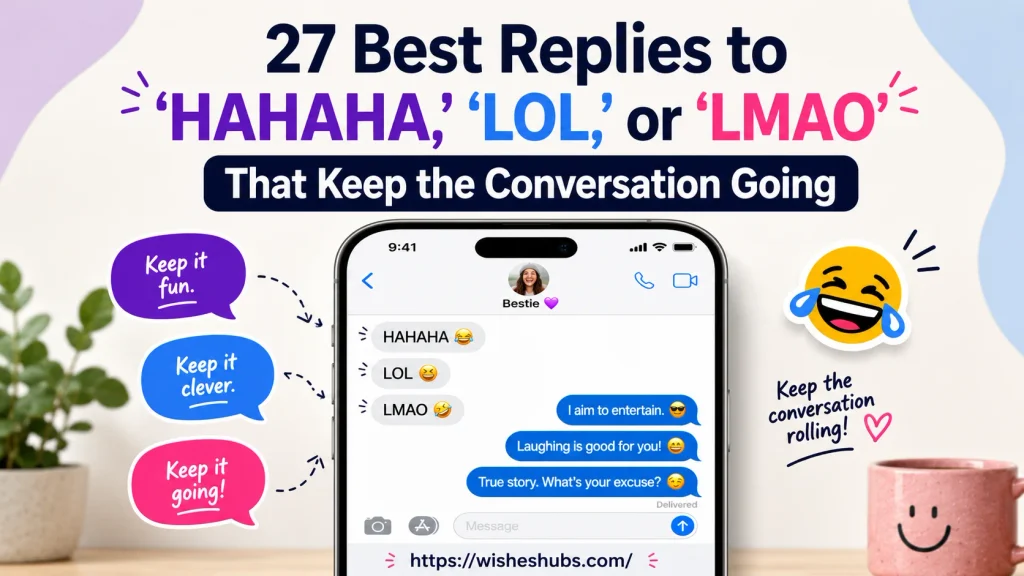
Have you ever received a simple “HAHAHA,” “LOL,” or “LMAO” and suddenly wondered what to say next? Finding the right response can feel surprisingly difficult, especially when tone matters.
This guide to 27 Best Replies To “HAHAHA”, “LOL”, Or “LMAO” explores natural, witty, playful, and context-appropriate responses for different conversations. Whether you are texting a friend, flirting, chatting casually, or handling business communication, the right reply can keep the conversation engaging without sounding forced.
Not every laugh carries the same meaning, and your response should match the situation. We will explain the subtle differences between “HAHAHA,” “LOL,” and “LMAO”, including their tone, intensity, and common English usage.
You will also discover when a funny comeback works better than a simple reaction, and when grammar, clarity, or formal writing should take priority. These distinctions can help you communicate more naturally while maintaining consistency across casual and professional conversations.
From quick text replies to more thoughtful responses, this article focuses on practical examples you can actually use.
The suggestions are designed around real online communication, conversational context, and search intent rather than repetitive phrases. You will find responses suited to humor, friendship, flirting, workplace chats, and everyday messaging.
Just as scheduling, time management, online booking, broadcasting, meetings, calendar planning, and project management require the right context, effective communication does too. By the end, you will know exactly how to respond confidently when someone sends “HAHAHA,” “LOL,” or “LMAO.”
What Do “HAHAHA,” “LOL,” and “LMAO” Mean in Texting?
Before choosing a reply, it helps to understand what you’re responding to.
LOL stands for “laughing out loud.” Cambridge Dictionary describes it as an informal abbreviation used in texts and social media when someone thinks something is funny or intends something as a joke.
LMAO means “laughing my ass off.” It’s more emphatic and very informal. People commonly use it when they find something particularly funny or want to emphasize their amusement.
HAHAHA works differently because it represents laughter more directly. Instead of using an abbreviation, the person types out the sound or appearance of laughter.
However, don’t treat these expressions like a precise emotional measuring stick.
Someone might send “lol” after genuinely laughing. Someone else might use “lol” simply to make a message feel lighter. Another person might type “LMAOOOOO” because they found something hilarious.
Text strips away facial expressions, voice, timing, and body language. As a result, the same three letters can carry different shades of meaning depending on the conversation.
Research into laughter in text-based dialogue also shows that written laughter can help manage conversational flow, relationships, and meaning. Researchers have identified written forms such as “haha” and “LOL” as ways people reproduce some of the social functions of laughter in ordinary conversation.
So don’t ask only, “What does LOL mean?”
Ask a better question:
“What is this person trying to do with the conversation?”
That’s where your reply starts.
27 Best Replies to “HAHAHA,” “LOL,” or “LMAO”
The best response depends on your relationship, the joke, and what you want to happen next.
Here are 27 options you can actually use.
“I know, right? 😂”
This works when you’re both laughing at the same thing.
Maybe you sent a ridiculous story about your day. Perhaps you shared a funny observation. Their “HAHAHA” shows that they caught the joke.
Replying with “I know, right? 😂” confirms that you’re enjoying the moment too.
It’s short, natural, and doesn’t put pressure on them to produce another response.
Best for: friends, casual conversations, group chats, and everyday texting.
“Glad you found that funny.”
This is a good choice when you deliberately made a joke.
It acknowledges their reaction without trying to squeeze another punchline out of the conversation.
You can also make it warmer:
“Glad you found that funny 😂”
Or slightly more playful:
“Glad someone appreciates my humor.”
The first version feels safer. The second adds more personality.
Best for: casual friends, coworkers you’re comfortable with, and someone you’re getting to know.
“Haha, I knew you’d laugh.”
This reply works especially well when you know the other person’s sense of humor.
It subtly suggests familiarity. You’re not merely reacting to their laughter. You’re saying you expected it.
For example:
“I knew you’d laugh at that.”
That line can feel surprisingly personal when you’ve already developed an easy rhythm with someone.
Best for: close friends, partners, and established conversations.
“That’s what I was going for.”
Sometimes the simplest response sounds the most confident.
If your joke landed, there’s no reason to overexplain it.
“That’s what I was going for 😂”
The line tells them you noticed the reaction while keeping the exchange relaxed.
It also avoids the awkward trap of immediately trying to invent another joke.
Best for: casual banter and conversations where you’re already joking around.
“Okay, I’ll take that as a win.”
This response turns their laughter into a tiny victory.
It’s playful without demanding anything from the other person.
You can use it after a joke, a witty observation, or even a self-deprecating story.
“Okay, I’ll take that as a win 😂”
The tone stays upbeat. More importantly, it gives the conversation room to continue naturally.
Best for: friends, casual dating, and playful conversations.
“Careful, you’re encouraging me.”
Here’s where the banter gets more interesting.
“Careful, you’re encouraging me” suggests that their laughter might inspire you to keep going.
It works particularly well when the conversation already feels playful.
For example:
“Careful, you’re encouraging me 😂”
It can also create a subtle opening for more teasing:
“Careful, you’re encouraging me. I have plenty more.”
Just make sure the conversation actually supports that tone. With a new acquaintance, less can be more.
Best for: friends, flirting, and playful exchanges.
“And I wasn’t even trying that hard.”
This is a deliberately cocky response.
The joke comes from pretending that your successful punchline required almost no effort.
You can soften it with an emoji:
“And I wasn’t even trying that hard 😂”
The line works because it doesn’t take itself seriously. You’re bragging as a joke.
Best for: people who already understand your humor.
“I’ll be here all week.”
This is an old comedy-style line that still works in casual texting.
Someone laughs at your joke, and you pretend you’ve just completed a professional comedy performance.
“I’ll be here all week.”
You can make it more absurd:
“I’ll be here all week. Try the veal.”
The second version is intentionally theatrical, so use it only when that kind of humor fits your relationship.
Best for: friends and playful group chats.
“Please hold your applause.”
This one works because it exaggerates a tiny moment.
Someone sends “LMAO” and you respond as though you’ve just delivered a sold-out stand-up routine.
“Please hold your applause.”
It’s short. It’s obviously unserious. And it doesn’t require another joke.
Best for: confident, sarcastic banter.
“I accept your laughter as payment.”
This response takes the comedy bit one step further.
Instead of asking for compliments, you jokingly treat their laughter as compensation.
“I accept your laughter as payment.”
It works particularly well after you’ve helped someone laugh during a rough day.
Best for: friends, partners, and people with whom you already have a playful dynamic.
Other Related Topics: 27 Best Replies to “I Don’t Care” (For Every Situation)
Replies That Keep the Conversation Going
A laughing response doesn’t have to end the conversation.
In fact, if you’re interested in continuing the chat, the strongest move often involves turning the laughter into a new conversational opening.
“What part got you?”
This is one of the most useful replies on the entire list.
Instead of simply accepting the laugh, you invite the other person to explain their reaction.
“What part got you? 😂”
Maybe they tell you exactly what they found funny. That gives you something concrete to respond to.
The question works especially well when you told a longer story.
Best for: conversations where you want more engagement.
“Wait until you hear the rest.”
This creates curiosity.
If you have another part of the story, this line gives the other person a reason to stay engaged.
“Wait until you hear the rest 😂”
Don’t use it as an empty tease, though. If you promise a story, actually have one.
Otherwise, the line starts to feel like clickbait in miniature.
Best for: storytelling, funny incidents, and ongoing conversations.
“You think that’s funny? 😂”
This response sets up another round of banter.
It can sound playful and slightly challenging.
For example:
“You think that’s funny? You haven’t heard the best part yet.”
The first sentence works alone. Adding the second gives the conversation more momentum.
Best for: friends, flirting, and humorous storytelling.
“Okay, your turn. What happened?”
This is an underrated response because it shifts attention away from you.
If you’ve been telling stories or making jokes for several messages, asking about their day prevents the conversation from becoming one-sided.
“Okay, your turn. What happened?”
Now the other person has something substantial to answer.
That’s often better than sending another meme or another “HAHAHA.”
Best for: getting to know someone and maintaining a two-way conversation.
“Now tell me what you’d have done.”
This works beautifully after a funny story or hypothetical situation.
Suppose you tell someone about accidentally sending a message to the wrong person. They respond:
“LMAOOOO 😂”
You could say:
“Now tell me what you’d have done.”
Suddenly, the conversation has somewhere to go.
Best for: stories, hypotheticals, embarrassing moments, and playful debates.
Flirty Replies to “HAHAHA,” “LOL,” or “LMAO”
Flirting requires more context than a simple laugh.
A person laughing at your message doesn’t automatically mean they’re romantically interested. Treating every “LOL” as a secret confession will make texting much harder than it needs to be.
Instead, look at the broader pattern.
Are they asking questions? Starting conversations? Teasing you? Responding quickly? Sharing personal stories? Those signals carry more weight than one laughing abbreviation.
When the conversation already feels flirtatious, however, these replies can work well.
“I like making you laugh.”
This is warm without being overly aggressive.
“I like making you laugh 😊”
It subtly communicates interest while keeping the focus on the shared interaction.
The line feels especially natural when the person has been laughing throughout the conversation.
Best for: someone you’re dating or someone with whom mutual flirting already exists.
“You’re cute when you laugh.”
This is more direct.
Because it moves from the joke to the person’s attractiveness, it carries more romantic weight.
Use it when you already have enough rapport to make that compliment feel natural.
If you barely know the person, it can come across as too forward.
Best for: established romantic or flirtatious conversations.
“Okay, I’m officially keeping you entertained.”
This is playful and slightly flirtatious without being too serious.
“Okay, I’m officially keeping you entertained 😂”
It frames the conversation as something you’re enjoying together.
You can make it more teasing:
“Okay, I’m officially keeping you entertained. Good to know.”
Best for: early-stage flirting and light romantic banter.
“I might have to make you laugh again.”
This gives the conversation a gentle forward motion.
“I might have to make you laugh again.”
It doesn’t demand a response. Instead, it leaves a playful opening.
If they respond with another joke or challenge, you’ve got a natural back-and-forth.
Best for: flirting when the chemistry already feels mutual.
“That laugh was worth it.”
This is softer and more affectionate.
It works particularly well after a personal conversation where you were trying to cheer someone up.
“That laugh was worth it 😂”
Unlike a direct compliment, it doesn’t put the other person under a spotlight.
Best for: partners, dates, close friends, and warm conversations.
Sarcastic and Teasing Replies to “LOL”
Teasing can create great chemistry. It can also crash the conversation if you use it with the wrong person.
The difference usually comes down to existing rapport.
If you and a close friend regularly tease each other, sarcasm may feel completely normal. With someone you barely know, the same line might sound annoyed.
“Wow, tough crowd.”
This works when their response seems underwhelming.
Imagine you tell what you think is a hilarious story and receive:
“lol”
You could reply:
“Wow, tough crowd.”
The humor comes from pretending their tiny reaction wasn’t enough.
Best for: friends and established banter.
“That was a laugh? I expected more.”
This is another playful challenge.
“That was a laugh? I expected more 😂”
The emoji matters here because the sentence can otherwise sound genuinely critical.
Use it only when you know the other person understands your teasing style.
Best for: close friends and playful relationships.
“You’re laughing now, but just wait.”
This line creates anticipation.
“You’re laughing now, but just wait.”
It works when you actually have another funny detail coming.
If you don’t, the line can feel vague.
Best for: storytelling and playful teasing.
“I’ll pretend that was a five-star review.”
This response turns their laughter into a mock review.
“I’ll pretend that was a five-star review.”
It’s self-aware and slightly ridiculous.
That’s precisely why it works.
Best for: casual conversations where you want a witty response without becoming too flirty.
What Should You Say When “LOL” Feels Dry?
Here’s where many people overthink texting.
Someone sends:
“lol”
You immediately wonder:
Are they bored?
Are they annoyed?
Do they want me to stop texting?
Maybe. But you can’t know that from “lol” alone.
Context matters.
If they’ve been giving thoughtful answers for twenty minutes and suddenly send “lol,” they may simply be distracted.
If they’ve replied with “lol” to five messages without asking anything back, the conversation may have lost momentum.
The solution isn’t to decode the acronym like a secret password. Look at the overall interaction.
“Lol, anyway…”
Use this when you want to move the conversation forward yourself.
“Lol, anyway, how did your meeting go?”
Now you’ve acknowledged their response and introduced a new subject.
“Haha, what are you up to?”
This works when you want to keep things casual.
“Haha, what are you up to?”
It’s simple enough for everyday texting. It also gives the other person an easy question to answer.
Don’t underestimate simple questions. Conversation often survives because someone gives the other person an obvious doorway back in.
“I’ll take the LOL 😂 What’s your take?”
This option works particularly well when you’re discussing an idea rather than telling a joke.
For example:
“LMAO. Okay, I’ll take the LOL 😂 What’s your take?”
Now the laughter becomes a bridge to an actual opinion.
Best for: conversations about movies, relationships, work stories, social situations, or funny debates.
What Is the Difference Between “LOL,” “HAHAHA,” and “LMAO”?
The three expressions overlap. They aren’t rigid categories.
Still, they often create different impressions.
| Text | Full form or meaning | Typical impression | Formality |
| LOL | Laughing out loud | Casual amusement or a light reaction | Very informal |
| HAHAHA | Written laughter | More visibly expressive laughter | Informal |
| LMAO | Laughing my ass off | Strong amusement or exaggerated laughter | Very informal |
Cambridge Dictionary defines LOL as an informal abbreviation for “laughing out loud” and notes its use in texts and social media.
It defines LMAO as an abbreviation for “laughing my ass off” and labels it very informal.
There’s an important distinction, though.
These aren’t intensity meters.
Someone might write “LOL” after something genuinely hilarious because that’s simply their texting habit. Another person might type “HAHAHAHAHAHA” after something mildly amusing because they naturally write laughter that way.
That’s why reading the entire message matters more than counting the letters.
Does “LOL” Mean Someone Likes You?
Not by itself.
This is one of the biggest mistakes people make when interpreting texting behavior.
A person can use “LOL” because:
- They genuinely found something funny.
- They want to acknowledge your joke.
- They want to soften the tone.
- They don’t know what else to say.
- They’re being friendly.
- They actually laughed.
- They’re using “lol” as part of their normal texting style.
Written laughter can perform several conversational functions. Research on laughter in text-based dialogue describes it as something that can help manage relationships, conversational flow, and the interpretation of what someone says.
So if you’re wondering whether someone likes you, examine patterns rather than one abbreviation.
Look for stronger signals such as:
- They regularly initiate conversations.
- They ask questions about you.
- They remember details you’ve shared.
- They continue conversations instead of giving only short replies.
- They tease you in a warm way.
- They make an effort to see you.
- They share things without needing to be prompted.
A single “LMAO” can’t carry that much information.
Should You Reply to “LOL”?
Sometimes yes. Sometimes no.
You don’t have to respond to every laugh.
If someone reacts to your funny story with:
“HAHAHA 😂”
the conversation may naturally end there.
You could respond:
“😂”
Or you could leave it alone.
That’s not rude. It’s normal conversational rhythm.
Reply when:
- You want to keep talking.
- You have another relevant thought.
- You want to ask a question.
- The other person appears engaged.
- You’re building a playful conversation.
You can leave it there when:
- The conversation has reached a natural stopping point.
- Their message simply acknowledges what you said.
- You don’t have anything meaningful to add.
- Another response would feel forced.
Good texting isn’t about maximizing messages. It’s about maintaining a natural rhythm.
What Not to Do After Someone Says “HAHAHA”
A clever reply can help. Overthinking can do the opposite.
Don’t force another joke
If they laughed, the joke worked.
You don’t need to immediately deliver another punchline.
Imagine a comedian who tells one joke that gets a huge laugh. Instead of pausing, they panic and fire off six more jokes.
That’s what forced texting can feel like.
Let the moment breathe.
Don’t overanalyze the exact number of “ha”s
There’s no universal scale where:
“haha” = mild amusement
“hahaha” = strong amusement
“hahahahaha” = romantic interest
People have individual texting habits.
One person may always type “haha.” Another may use “HAHAHA” for almost everything.
Context wins.
Don’t assume “LOL” means rejection
A short message can be a weak conversational signal. It isn’t automatically a negative one.
Instead, examine what happens around it.
If someone writes:
“LOL that’s actually so funny. What happened next?”
they’re clearly participating.
If someone repeatedly sends:
“lol”
“yeah”
“haha”
without adding anything, you may need to introduce a new topic or simply let the conversation end.
Don’t turn every laugh into flirting
A laughing response isn’t permission to become intensely romantic.
If you’re talking to someone new, start lightly.
Instead of:
“You’re gorgeous when you laugh. I can’t stop thinking about you.”
try:
“I like making you laugh.”
The second response leaves plenty of room for the other person to match your energy.
Don’t send a wall of emojis
One or two emojis can add tone.
A screen full of 😂😂😂😂😂😂😂 can become visual noise.
Your words should carry most of the conversation.
A Simple Formula for Responding to “LOL”
When you aren’t sure what to say, use this formula:
Acknowledge → Add → Ask
Here’s how it works.
Acknowledge
Show that you noticed their reaction.
“Haha…”
Add
Give the conversation another piece of information.
“I knew that part would get you.”
Ask
Give them something easy to answer.
“What would you have done?”
Put it together:
“Haha, I knew that part would get you. What would you have done?”
Now you’ve transformed a dead-end laugh into a conversation.
This approach works because the other person doesn’t have to invent the next topic. You’ve handed them one.
Case Study Examples: Choosing the Right Reply
These examples aren’t universal rules. They’re realistic texting scenarios that show how context changes the best response.
Case study: A close friend
You:
“I walked into the kitchen and forgot why I went there.”
Friend:
“HAHAHAHA”
A natural reply:
“My brain has officially resigned 😂”
Why it works: you’re matching their humor instead of explaining the joke.
Case study: Someone you’re flirting with
You:
“I make excellent first impressions. Yesterday I walked into the wrong meeting.”
Them:
“LMAOOO”
A good reply:
“I like making you laugh 😂”
Why it works: it acknowledges their reaction and adds mild romantic warmth without turning the conversation into a dramatic confession.
Case study: Someone gives you a dry “LOL”
You:
“My boss accidentally emailed the entire team asking where his coffee was.”
Them:
“lol”
You want to continue talking.
Try:
“Haha, it gets worse. What would you have done?”
Why it works: you don’t complain about their short reply. You introduce another detail and invite their opinion.
Case study: The conversation is naturally ending
You:
“That was honestly the funniest part of my day.”
Them:
“HAHAHA 😂”
If you’ve already been talking for a while, you don’t need another line.
A simple reaction works:
“😂”
Or nothing at all.
Why it works: you allow the exchange to end naturally instead of dragging it across the finish line.
Quick Guide: The Best Reply for Every Situation
| Situation | Try this reply |
| You want something safe | “Glad you found that funny 😂” |
| You want to be funny | “Careful, you’re encouraging me.” |
| You want to sound confident | “I know. I’m hilarious.” |
| You want playful sarcasm | “Please hold your applause.” |
| You want to flirt | “I like making you laugh.” |
| You want them to keep talking | “What part got you?” |
| You want their opinion | “What would you have done?” |
| They gave you a dry “LOL” | “Haha, what are you up to?” |
| You want to tease them | “Wow, tough crowd.” |
| The conversation has ended naturally | You don’t need to reply. |
What to Say When Your Crush Sends “HAHAHA”
If your crush sends “HAHAHA,” resist the urge to treat it as a major romantic signal.
Instead, look at the surrounding conversation.
If they’re already flirting, you can respond with something like:
“I like making you laugh.”
Or:
“I might have to make you laugh again.”
If the conversation feels more friendly than romantic, stay lighter:
“Okay, I’ll take that as a win 😂”
The goal isn’t to manufacture chemistry from nothing.
It’s to give existing chemistry room to breathe.
That’s a much better strategy.
What to Say When Someone Sends “LMAO”
Because LMAO generally signals strong amusement, you can comfortably match the energy.
Try:
- “I knew you’d lose it 😂”
- “Careful, I have more.”
- “And that wasn’t even the best part.”
- “I’ll take that as a five-star review.”
- “Glad I could provide entertainment.”
- “Now you know what kind of person you’re dealing with.”
If you want the conversation to continue, follow the laugh with a question.
“LMAO 😂 What would you have done?”
That’s much more effective than simply sending another “LOL.”
What to Say When Someone Sends “HAHAHA”
Written laughter gives you several options.
You can match it:
“HAHAHA I know 😂”
You can tease:
“You’re laughing way too hard.”
You can flirt:
“I like that I can make you laugh.”
Or you can continue the story:
“Wait until you hear what happened next.”
The best choice depends on the relationship and the direction you want the conversation to take.
Frequently Asked Questions
1. What should I reply to “HAHAHA”?
You can reply with something playful, such as “I knew you’d find that funny!” or “Glad I could make you laugh!” The best response depends on the conversation and your relationship.
2. What does “LOL” mean in texting?
LOL usually means “Laughing Out Loud.” People often use it to show amusement, soften a message, or make a conversation feel more casual.
3. What does “LMAO” mean?
LMAO means “Laughing My Ass Off.” It generally expresses stronger amusement than LOL and is commonly used in informal conversations.
4. How do I reply to “LMAO” in a funny way?
Try responding with “Mission accomplished!”, “I’m here all week!”, or “Wait until you hear the next one!” These replies can keep the humorous conversation going.
5. Is it okay to reply with another “LOL”?
Yes, replying with “LOL” is perfectly acceptable in casual texting. However, adding a short comment or question can make the conversation more engaging.
6. What is the difference between “HAHAHA,” “LOL,” and “LMAO”?
“HAHAHA” often feels like a direct expression of laughter, “LOL” is a common casual reaction, and “LMAO” usually suggests stronger amusement. Their meaning can also change depending on context and tone.
7. Can I use funny replies in professional conversations?
Use caution in business communication. A light response may work with colleagues you know well, but professional communication often requires a more appropriate and respectful tone.
8. How do I keep the conversation going after “HAHAHA”?
Follow up with a related comment, joke, or question. For example, say “You think that’s funny? Wait until you hear this!” This creates a natural opportunity for the other person to continue chatting.
9. Can I use a flirty reply to “LOL” or “LMAO”?
Yes, if the conversation already has a comfortable and flirty tone. You could say “I love making you laugh” or “Your laugh might be my new favorite thing.”
10. What is the best reply to “HAHAHA,” “LOL,” or “LMAO”?
There is no single perfect answer. The best reply matches the tone, relationship, and purpose of the conversation. A natural response that reflects your personality will usually work better than a copied phrase.
Final Takeaway:
The best replies to “HAHAHA,” “LOL,” or “LMAO” don’t rely on complicated pickup lines or recycled jokes.
They fit the moment.
If someone laughs at your joke, you can laugh with them. If you want more conversation, ask a question. If there’s obvious chemistry, add a little flirtation. When the exchange has naturally ended, don’t feel obligated to manufacture another message.
A few reliable options are worth remembering:
- “I know, right? 😂” for easy agreement.
- “Careful, you’re encouraging me.” for playful banter.
- “Please hold your applause.” for sarcasm.
- “I like making you laugh.” for light flirting.
- “What part got you?” for continuing the conversation.
- “What would you have done?” for turning a laugh into discussion.
- “Haha, what are you up to?” when the chat needs a new direction.
Most importantly, don’t treat texting abbreviations as a secret code.
“LOL” is not a lie detector. “LMAO” isn’t a love confession. “HAHAHA” isn’t a guaranteed sign of attraction.
They’re pieces of a larger conversation.
Pay attention to the whole exchange. Match the other person’s energy. Keep your replies natural. When you have something worth saying, say it.
That’s how a simple “LOL” can become a conversation instead of a dead end.

“Explore unique wishes, greetings, and celebration ideas with Emma Brooke at Wisheshubs.com – your go-to place for inspiring messages!”
1 thought on “27 Best Replies to “HAHAHA,” “LOL,” or “LMAO” That Keep the Conversation Going”