
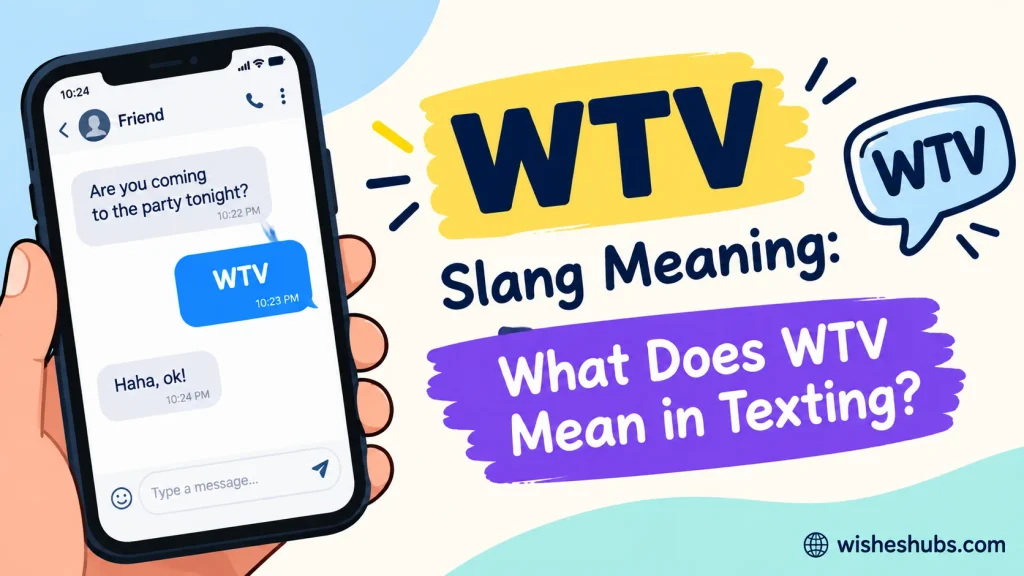
Have you ever received “WTV” in a message and wondered what it means? WTV Slang Meaning usually depends on context, tone, and everyday English usage in digital conversations.
This guide explains WTV, its common meanings, and how people use it across texts, social media, and casual chats. You’ll also learn how context, grammar, and conversational tone can change its meaning in different situations.
Beyond casual texting, understanding slang supports clearer business communication, meetings, scheduling, and online interactions. We’ll also distinguish informal language from formal writing, while exploring consistency, calendars, project management, broadcasting, and online booking contexts.
Quick Answer: What Does WTV Mean in Text?
WTV usually means “whatever” in texting, messaging, and social media conversations. It can express indifference, flexibility, casual acceptance, or dismissal, depending on the context.
For example:
“Pizza or burgers?”
“WTV works for me.”
Here, WTV means “whatever” and shows that the person has no strong preference.
But consider this:
“I already told you what happened.”
“WTV.”
In this situation, WTV may sound more like “whatever, I don’t care” and could signal frustration or a desire to end the conversation.
So, don’t judge the meaning from the abbreviation alone. Context is the real clue.
What Does WTV Stand For?
WTV stands for “whatever.”
It’s a shortened form commonly used in informal digital communication. Instead of typing the complete word, someone may use WTV to make a message quicker and more casual.
For example:
- Whatever → WTV
- “Whatever you want” → “WTV you want”
- “Whatever works” → “WTV works”
- “Whatever, it’s fine” → “WTV, it’s fine”
WTV belongs to the same broad world of texting abbreviations as IDK, IDC, BTW, TBH, and IMO. These shortcuts make casual conversations faster without requiring full sentences.
The abbreviation works particularly well when both people already understand common texting language. It may look unusual in formal writing, though.
Why Do People Use WTV?
People generally use WTV because it is:
- Shorter than “whatever”
- Easy to type on a phone
- Familiar in casual online conversations
- Useful for quick replies
- Appropriate for many informal chats
- Flexible enough to express several shades of meaning
Still, shorter doesn’t always mean clearer. A single “WTV” can leave more room for interpretation than the full word “whatever.”
WTV Meaning in Texting
The most common WTV meaning in texting is simply “whatever.” However, that definition covers several different intentions.
WTV Can Mean “Any Option Is Fine”
Someone might use WTV when they genuinely don’t care which option you choose.
For example:
“Do you want to watch a comedy or an action movie?”
“WTV you want is fine.”
Here, WTV sounds neutral. The sender isn’t necessarily annoyed. They’re simply letting the other person decide.
Another example:
“Where should we eat?”
“WTV works for me.”
The person is saying that any choice is acceptable.
WTV Can Show Indifference
Sometimes WTV means the person has little interest in the subject.
For example:
“Should we go Friday or Saturday?”
“WTV.”
This could mean “Whatever. I don’t really care which day.”
That doesn’t automatically make the response rude. Some people naturally use short replies when they don’t have a preference.
WTV Can Sound Dismissive
Tone changes when WTV appears during an argument or tense conversation.
For example:
“You didn’t listen to anything I said.”
“WTV.”
Here, WTV can communicate something closer to “Whatever. I’m done discussing this.”
A one-word response can feel much sharper than a longer sentence. That’s especially true when the conversation already carries emotional tension.
WTV Can Be Playful
Friends sometimes use WTV jokingly.
For example:
“You always steal my fries.”
“WTV 😂”
The laughing emoji changes the feel. Instead of sounding cold, the response may come across as playful or teasing.
That’s why interpreting WTV requires more than expanding the abbreviation.
WTV Meaning Depends on the Context
The same abbreviation can carry different emotional signals in different conversations.
| Context | Likely Meaning | Possible Tone |
| Choosing a restaurant | Any option is fine | Neutral |
| Making weekend plans | Either choice works | Casual |
| During an argument | Whatever / I’m done | Dismissive |
| Friendly teasing | Whatever | Playful |
| Someone asks for a preference | I don’t mind | Indifferent |
| A tense conversation | I don’t care | Annoyed |
Why Context Matters
Imagine someone asks:
“Tea or coffee?”
You reply:
“WTV.”
That probably means you don’t mind either choice.
Now imagine someone explains why they feel hurt and receives:
“WTV.”
The same abbreviation can feel much colder.
Words don’t exist in a vacuum. The conversation around them supplies the emotional context.
Pay attention to:
- The message immediately before WTV
- Punctuation
- Emojis
- The sender’s usual texting style
- Whether you’re arguing
- Your relationship with the sender
- Whether the person continues talking afterward
WTV Meaning in a Text From a Guy
If a guy sends WTV, the basic slang definition doesn’t suddenly change. It still generally means “whatever.”
What changes is the intended tone.
For example:
“What do you wanna do tonight?”
“WTV you wanna do.”
This likely means he’s leaving the decision to you.
Another example:
“Are you still mad?”
“WTV.”
That response could sound more dismissive, especially if you’ve been arguing.
Don’t Overread the Gender
There isn’t a standard texting rule where WTV has one meaning when a guy uses it and another when a girl uses it.
Instead, look at the actual conversation.
A guy might use WTV to mean:
- “You decide.”
- “I don’t mind.”
- “Whatever works.”
- “I’m not interested in arguing.”
- “I’m joking around.”
The surrounding context matters far more than the sender’s gender.
WTV Meaning in a Text From a Girl
WTV meaning in a text from a girl is generally the same: “whatever.”
For example:
“Which dress should I wear?”
“WTV one you like.”
Here, the sender may simply be saying that the other person should choose.
In a different conversation:
“I can’t believe you did that.”
“WTV.”
The response could sound dismissive or frustrated.
The Key Point
Don’t assign a hidden meaning to WTV simply because a girl sent it.
Instead, consider:
- What was discussed before the message?
- Was the conversation friendly or tense?
- Did the sender add an emoji?
- Did they continue the conversation?
- Do they normally use short abbreviations?
Those clues provide much more useful information.
Is WTV Rude?
WTV isn’t inherently rude.
Its tone depends heavily on how someone uses it.
When WTV Sounds Neutral
“What do you want for dinner?”
“WTV is fine.”
The sender is probably saying that they don’t have a preference.
When WTV Sounds Rude
“Can you please explain why you’re upset?”
“WTV.”
Here, the short response may feel dismissive because the sender appears unwilling to engage.
When WTV Sounds Playful
“You’re such a drama queen.”
“WTV 😂”
The emoji and friendly context can make the response lighthearted.
A Simple Rule
WTV becomes more likely to sound rude when it shuts down a meaningful conversation.
The abbreviation itself isn’t the problem. The conversational intent matters.
How to Tell What Someone Means by WTV
If you’re unsure about a WTV message, don’t immediately assume the worst.
Look at the Previous Message
The easiest clue usually sits right before WTV.
“Movie or bowling?”
“WTV.”
That’s probably a lack of preference.
But:
“Why did you ignore me?”
“WTV.”
That carries a very different feel.
Check the Punctuation
Compare these:
- “WTV 😂”
- “WTV lol”
- “WTV, it’s fine.”
- “WTV.”
The last version may feel more final because the period gives the short reply a firm ending.
Punctuation doesn’t guarantee tone. It simply provides another clue.
Look at Emojis
Emojis can soften or reshape an abbreviated reply.
For example:
- “WTV 😂” → likely playful
- “WTV 😭” → possibly joking or overwhelmed
- “WTV 🙄” → may suggest annoyance
- “WTV ❤️” → potentially affectionate or lighthearted
The emoji doesn’t create a universal definition. It simply adds emotional context.
Consider Your Relationship
A close friend can send “WTV” without causing offense because you already understand each other’s communication style.
A new acquaintance sending the same message may feel more abrupt.
Familiarity changes interpretation.
Examples of WTV in Text Messages
Realistic examples make the slang much easier to understand.
Casual Conversation
“What should we eat?”
“WTV you want.”
Meaning: Whatever you want is fine.
Making Plans
“Friday or Saturday?”
“WTV works.”
Meaning: Either day is acceptable.
Showing Indifference
“Do you want the blue one or black one?”
“WTV.”
Meaning: The sender doesn’t have a preference.
During an Argument
“You’re not even listening.”
“WTV.”
Meaning: Whatever / I don’t want to continue this discussion.
Friendly Banter
“You always lose at this game 😂.”
“WTV 😂.”
Meaning: Whatever, said playfully.
Quick Reference Table
| Message | Likely Meaning |
| “WTV works.” | Any option is fine. |
| “WTV you choose.” | You decide. |
| “WTV 😂” | Whatever, in a playful way. |
| “WTV 🙄” | Whatever, possibly annoyed. |
| “WTV.” | Whatever, potentially dismissive. |
| “WTV you want.” | Your choice. |
Read More: HBU Meaning in Chats: What Does HBU Mean in Texting?
WTV vs. Whatever
WTV and “whatever” usually carry the same basic meaning.
The biggest difference is style.
| Expression | Meaning | Style |
| WTV | Whatever | Very casual, abbreviated |
| Whatever | Whatever | Casual and more explicit |
| Any is fine | No preference | Clear and neutral |
| You decide | Letting someone choose | Direct |
WTV feels more like a texting shortcut. The full word can work in casual speech, text messages, and some less formal writing.
For example:
“WTV, you pick.”
This sounds like a quick chat response.
Meanwhile:
“Whatever you prefer is fine.”
That sounds clearer and more polished.
WTV vs. IDC vs. IDK
These abbreviations can overlap in casual conversations. However, they don’t mean exactly the same thing.
| Slang | Full Meaning | Main Idea |
| WTV | Whatever | No preference or indifference |
| IDC | I don’t care | Lack of concern |
| IDK | I don’t know | Uncertainty or lack of knowledge |
WTV vs. IDC
WTV can mean that any choice is acceptable.
“Pizza or tacos?”
“WTV.”
IDC sounds more direct:
“Pizza or tacos?”
“IDC.”
The second response can feel stronger because it explicitly says “I don’t care.”
WTV vs. IDK
These two are even easier to separate.
IDK means the person doesn’t know.
“What time does the store close?”
“IDK.”
WTV expresses indifference or flexibility.
“What time should we go?”
“WTV works.”
One communicates uncertainty. The other usually communicates lack of preference.
How to Respond When Someone Says WTV
Your response should match the apparent tone.
If They’re Being Casual
You can simply make the decision:
“Cool, let’s get pizza.”
Or:
“Alright, I’ll pick the movie.”
If They Seem Annoyed
Avoid immediately escalating the situation.
You might say:
“You seem frustrated. We can talk about it later.”
Or:
“No worries. Let’s leave it for now.”
If You Need a Clear Choice
Sometimes WTV doesn’t give you enough information.
Try:
“Either one works, or do you have a preference?”
Or:
“I can choose. Just checking if you wanted something specific.”
This keeps the conversation moving without turning a tiny abbreviation into a major issue.
Can WTV Mean Something Else?
In ordinary texting and social media conversations, “whatever” is the standard interpretation of WTV.
However, abbreviations can have specialized meanings in particular communities, workplaces, games, or technical settings. That’s why context remains important when WTV appears outside normal casual conversation.
For everyday texting, though, WTV = whatever is the meaning most readers will encounter.
It’s better to rely on the surrounding conversation than to force an obscure definition onto an ordinary message.
Is WTV Used on Social Media?
Yes. WTV can appear across many casual digital platforms, especially where users commonly shorten words.
You may see it in:
- Instagram DMs
- Snapchat messages
- TikTok comments
- Facebook Messenger
- Discord chats
- Group messages
- SMS texting
- Online gaming chats
For example, someone might comment:
“WTV 😂”
The meaning is usually obvious from the post or conversation surrounding it.
Social media encourages compact language because users often want to respond quickly. Short abbreviations such as WTV fit naturally into that environment.
Common Mistakes When Using WTV
Although WTV looks simple, a few misunderstandings happen often.
Assuming WTV Always Means Anger
It doesn’t.
Someone might simply have no preference.
Treating WTV and IDC as Exact Synonyms
They can overlap, but WTV often sounds less direct than IDC.
“Whatever” can leave room for flexibility. “I don’t care” is more explicit.
Using WTV in Formal Communication
WTV belongs primarily in casual communication.
Avoid it in:
- Job applications
- Academic assignments
- Professional emails
- Business proposals
- Formal reports
- Official correspondence
Instead, use a clearer phrase such as “either option is acceptable” or “I don’t have a preference.”
Assuming Gender Changes the Definition
WTV doesn’t have a special standard meaning based on whether a guy or girl sends it.
Context wins.
Ignoring the Conversation Around It
A single abbreviation rarely tells the whole story.
Read the surrounding messages before deciding whether the sender sounds casual, annoyed, playful, or indifferent.
Is WTV Appropriate in Formal Writing?
Generally, no.
WTV is designed for informal digital communication. Formal writing benefits from complete words and precise language.
Instead of:
“WTV option works.”
Use:
“Either option works for me.”
Instead of:
“WTV you prefer.”
Use:
“Whatever you prefer is fine.”
And instead of:
“WTV.”
Use something more precise, such as:
“I don’t have a preference.”
This distinction matters because professional writing depends on clarity and tone. A texting abbreviation can make a formal message look overly casual.
FAQs About WTV Slang Meaning
What does WTV mean in texting?
WTV usually means “whatever.” Depending on context, it can express no preference, indifference, casual acceptance, or dismissal.
What does WTV stand for?
WTV stands for “whatever.” It’s an informal abbreviation commonly used in texts and online chats.
Is WTV slang for whatever?
Yes. WTV is commonly used as a texting abbreviation for “whatever.”
Is WTV rude?
Not necessarily. WTV can sound completely neutral when someone has no preference. During an argument, however, a short “WTV” can sound dismissive or annoyed.
What does WTV mean from a guy?
It generally means “whatever” when a guy uses it. The specific tone depends on the conversation rather than the sender’s gender.
What does WTV mean from a girl?
It generally means “whatever” when a girl uses it. Look at the surrounding messages to understand whether she means indifference, flexibility, humor, or dismissal.
Does WTV mean “I don’t care”?
Sometimes, but not always. WTV can mean “I don’t have a preference” rather than literally saying that the subject doesn’t matter.
What’s the difference between WTV and IDC?
WTV means “whatever,” while IDC means “I don’t care.” WTV can sound more flexible, whereas IDC directly communicates a lack of concern.
How should I respond to WTV?
If the person seems casual, you can simply make the choice yourself. If the response seems annoyed, avoid escalating the conversation and consider asking whether something is bothering them.
Can WTV be used in formal writing?
WTV is generally too informal for professional or academic writing. Use complete phrases such as “whatever,” “either option is fine,” or “I don’t have a preference.”
Conclusion:
Understanding WTV Slang Meaning makes everyday texting easier by helping you recognize its casual tone, intended context, and common usage across messages, social media, and online conversations.
Whether you’re chatting with friends or navigating digital communication, knowing WTV helps you interpret messages naturally. Always consider the context, relationship, and tone before responding, especially when switching between informal chats and formal communication.

Emily Harris shares simple, heartfelt wishes, quotes, and messages to help you celebrate every special moment beautifully.

1 thought on “WTV Slang Meaning: What Does WTV Mean in Texting?”