
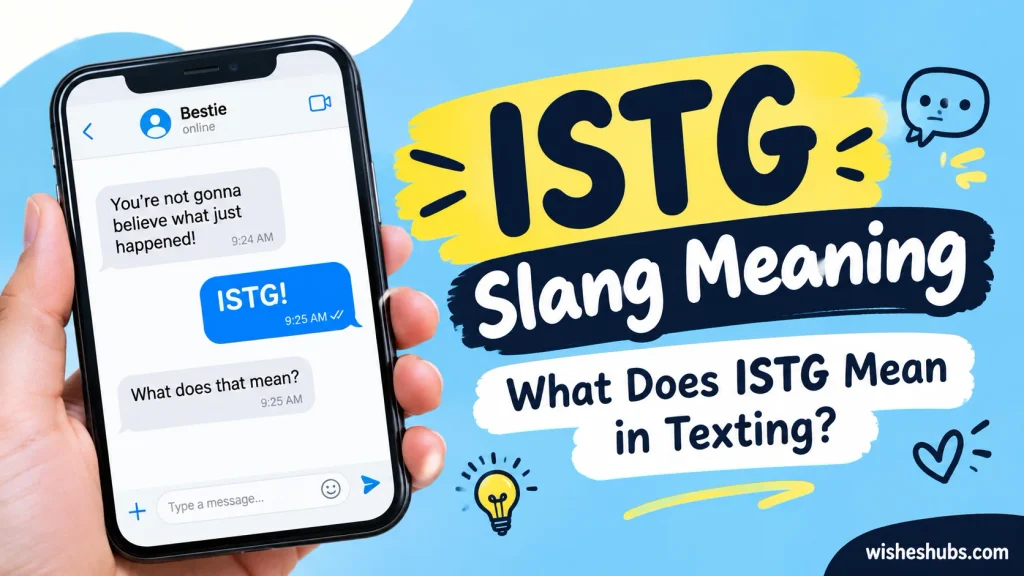
Ever received a text that starts with “ISTG” and wondered what those four letters actually mean? This popular texting abbreviation can make a message sound serious, frustrated, surprised, or even playful. ISTG slang meaning is usually “I Swear to God,” a phrase people use to add strong emphasis to what they say.
You’ll often see ISTG in text messages, group chats, comments, direct messages, gaming conversations, and social media posts. Someone might write “ISTG I didn’t do it” while defending themselves, or “ISTG this is hilarious” when reacting strongly to something funny. The abbreviation stays the same, yet its emotional meaning can shift with the situation.
That flexibility makes ISTG especially common in informal digital conversations. Unlike abbreviations that have one narrow purpose, ISTG can express sincerity, annoyance, disbelief, excitement, frustration, or exaggeration. Your relationship with the sender also matters. A friend may use it jokingly, while someone in an argument may use it very seriously.
Understanding what ISTG means in texting isn’t just about memorizing four letters. You also need to recognize its tone, context, and appropriate use. This guide breaks down the full meaning of ISTG, explains how people use it, compares it with similar slang, and gives realistic examples you can recognize instantly.
Quick Answer
ISTG means “I Swear to God.” It is an informal texting abbreviation used to strongly emphasize a statement, promise, reaction, or feeling.
For example:
“ISTG, I didn’t take your headphones.”
This means:
“I swear to God, I didn’t take your headphones.”
Depending on the context, ISTG can communicate:
- Sincerity: “ISTG, I’m telling the truth.”
- Frustration: “ISTG, this keeps happening.”
- A promise: “ISTG, I’ll finish it tonight.”
- Disbelief: “ISTG, he actually said that.”
- Excitement: “ISTG, that was amazing!”
- Humor: “ISTG, you always do this 😂”
The abbreviation doesn’t automatically mean the sender is angry. Context determines the tone.
What Does ISTG Stand For?
ISTG stands for “I Swear to God.”
The abbreviation takes the first letters of the four words:
| Letter | Word |
| I | I |
| S | Swear |
| T | To |
| G | God |
The expression “I swear to God” predates texting by a long way. People traditionally use it as an oath or emphatic statement when they want to stress that they’re telling the truth or making a serious promise.
Digital communication simply shortened the expression.
Instead of typing:
“I swear to God, I didn’t see your message.”
Someone can quickly type:
“ISTG, I didn’t see your message.”
That shorter version works particularly well in fast-moving conversations. Texting culture relies heavily on abbreviations because people often want to communicate emotion without typing an entire phrase.
Why Is ISTG So Popular in Texting?
The appeal is simple: four letters can carry considerable emotional weight.
When someone writes “I didn’t do it,” the statement sounds relatively neutral. Add “ISTG” to the beginning and the message becomes much more emphatic:
- “I didn’t do it.” → Simple statement
- “ISTG, I didn’t do it.” → Strong denial
- “ISTG I didn’t do it!” → Even stronger emotional emphasis
That difference makes ISTG useful when ordinary words don’t seem strong enough.
ISTG Slang Meaning in Different Contexts
The ISTG slang meaning changes slightly depending on why someone uses it. Reading the surrounding conversation usually reveals the intended tone.
ISTG Meaning: Showing You’re Serious
One of the most common uses involves emphasizing sincerity.
Suppose someone doesn’t believe your explanation. You might respond:
“ISTG, that’s exactly what happened.”
Here, ISTG tells the other person that you’re insisting on the truth of your statement.
It functions almost like putting verbal emphasis in bold. The speaker isn’t merely making a claim. They’re stressing that they genuinely mean it.
ISTG Meaning: Expressing Frustration
ISTG frequently appears when someone feels annoyed.
For example:
“ISTG, this computer crashes every time I open this file.”
The speaker isn’t necessarily making an oath. Instead, ISTG intensifies their frustration.
You’ll often see this usage after something repeatedly goes wrong:
“ISTG, my alarm never works when I need it.”
The phrase adds emotional force to an ordinary complaint.
ISTG Meaning: Making a Promise
ISTG can also introduce a promise or strong assurance.
For example:
“ISTG, I’ll send you the photos tonight.”
The speaker wants the promise to sound serious.
However, ISTG doesn’t guarantee that the person will actually follow through. It simply strengthens the speaker’s wording.
ISTG Meaning: Showing Disbelief
Sometimes ISTG appears when someone can’t believe what they’ve just seen or heard.
“ISTG, she actually wore that to the party.”
Depending on context, this could communicate surprise, amusement, disbelief, or criticism.
The words surrounding ISTG provide the missing clues.
ISTG Meaning: Showing Excitement
The abbreviation isn’t limited to negative emotions.
Consider:
“ISTG, that concert was incredible!”
Here, ISTG emphasizes excitement rather than anger.
That’s an important point because newcomers sometimes assume ISTG always signals frustration. It doesn’t.
ISTG as a Playful Expression
Friends can also use ISTG dramatically for comedic effect.
“ISTG, you always steal my fries.”
If the conversation includes laughing emojis or playful language, the statement may have little genuine anger behind it.
Think of ISTG as an emotional amplifier. The surrounding message determines which emotion gets amplified.
Is ISTG Angry or Serious?
ISTG can sound angry, serious, humorous, or frustrated.
There isn’t one fixed emotional tone.
Compare these messages:
“ISTG, stop doing that.”
This can sound irritated or confrontational.
Now consider:
“ISTG, that puppy is adorable.”
That sounds enthusiastic rather than angry.
And:
“ISTG 😂 you never remember your password.”
That likely sounds playful.
What Determines the Tone?
Several clues can affect how ISTG comes across:
- The words surrounding ISTG
- Punctuation
- Capitalization
- Emojis
- The relationship between the speakers
- The topic being discussed
- The previous messages
For example, an exclamation mark can increase emotional intensity:
“ISTG!”
A laughing emoji can soften it:
“ISTG 😂”
A complaint can make it sound frustrated:
“ISTG, this app is driving me crazy.”
So, don’t interpret ISTG in isolation.
ISTG Texting Examples
Realistic examples make the abbreviation much easier to understand.
| Text | Likely Meaning | Tone |
| “ISTG, I didn’t touch it.” | Strong denial | Serious |
| “ISTG, you’re making me laugh.” | Strong reaction | Playful |
| “ISTG this traffic is awful.” | Strong frustration | Annoyed |
| “ISTG, I’ll be there at 8.” | Strong assurance | Serious |
| “ISTG, that was the best movie.” | Strong opinion | Excited |
| “ISTG 😂 you did that again.” | Dramatic reaction | Playful |
| “I can’t believe he said that, ISTG.” | Strong disbelief | Surprised |
| “ISTG I’m exhausted.” | Strong emotional emphasis | Frustrated |
The abbreviation works in several positions, although placing it at the beginning of a sentence is particularly common.
ISTG in a Real Text Conversation
Example: Defending Yourself
Alex: Did you delete my presentation?
Jordan: No, ISTG I didn’t touch it.
Alex: Really?
Jordan: Yeah. Check the recycle folder.
Here, ISTG strengthens Jordan’s denial. The conversation gives it a serious and defensive tone.
Example: Frustration
Mia: The printer stopped working again.
Sam: ISTG, that printer breaks every week.
In this case, ISTG expresses annoyance about a recurring problem.
Example: Surprise
Chris: He bought the entire team lunch.
Taylor: ISTG, that’s so generous.
Here, ISTG emphasizes genuine surprise or admiration.
Example: Friendly Banter
Emma: You ate the last cookie.
Noah: ISTG, it wasn’t me 😂
The laughing emoji changes the feel. The exchange sounds playful rather than hostile.
How to Use ISTG in a Text
Using ISTG is straightforward when you’re having an informal conversation.
Common ISTG Sentence Patterns
You might see these structures frequently:
- “ISTG, [statement].”
- “ISTG I’m not lying.”
- “ISTG, this always happens.”
- “ISTG, I forgot again.”
- “I can’t believe it, ISTG.”
- “ISTG, you’re hilarious.”
The abbreviation generally works best when you want to add emotional emphasis.
For example:
“ISTG, I’ve told you three times.”
The speaker isn’t simply sharing information. They’re emphasizing that they’ve already explained something repeatedly.
Should You Capitalize ISTG?
The standard abbreviation appears as ISTG, with all four letters capitalized.
However, texting is flexible. You may also encounter:
- istg
- Istg
- ISTG
These versions generally carry the same meaning.
Lowercase “istg” often feels more casual because people commonly type informal messages without capitalization.
Also Read This: FYA Meaning in Text: What Does FYA Mean in a Text?
Is ISTG a Bad Word?
ISTG isn’t a traditional swear word or profanity by itself.
However, it contains the phrase “I Swear to God,” which invokes God as part of an oath. Because of that religious reference, some people may consider the expression inappropriate or disrespectful.
That reaction varies considerably among individuals.
In casual conversations, many people use ISTG simply as an emphatic expression. They may not intend a literal religious oath. Still, the phrase can carry more weight for people who take religious language seriously.
Where ISTG May Not Fit
It’s generally better to avoid casual slang such as ISTG in:
- Formal business emails
- Job applications
- Academic assignments
- Professional reports
- Official correspondence
- Formal presentations
A phrase such as “I can assure you” may communicate the same general idea in a professional setting without the informal or religious wording.
Is ISTG Offensive?
ISTG isn’t automatically offensive.
Its acceptability depends on the audience and context.
For one person, “ISTG” may feel like ordinary internet slang. Another person might dislike the phrase because they consider swearing to God inappropriate.
This difference matters when you’re communicating with people you don’t know well.
For instance:
“ISTG, I’m telling the truth.”
A close friend may see this as completely normal.
In a formal conversation, however, the same wording can sound overly casual or emotionally charged.
When you’re unsure, neutral language is usually safer.
ISTG vs. Similar Texting Abbreviations
Several texting abbreviations overlap with ISTG. However, they aren’t identical.
ISTG vs. FR
FR means “For Real.”
Both expressions can emphasize sincerity.
Compare:
“FR, that movie was amazing.”
and:
“ISTG, that movie was amazing.”
FR generally means “seriously” or “I’m being genuine.”
ISTG carries stronger oath-like emphasis.
ISTG vs. ONG
ONG commonly means “On God.”
It can also emphasize sincerity, truthfulness, or strong agreement.
For example:
“ONG, that’s exactly what happened.”
and:
“ISTG, that’s exactly what happened.”
The meanings overlap, although the expressions aren’t interchangeable in every situation. Both can carry a strong emphasis on the speaker’s sincerity.
ISTG vs. TBH
TBH means “To Be Honest.”
TBH usually introduces a candid statement or personal opinion:
“TBH, I didn’t like the movie.”
ISTG has a different function:
“ISTG, I didn’t spoil the movie.”
TBH signals honesty or openness. ISTG intensifies a statement or assertion.
ISTG vs. I Swear
“I swear” is simply the full phrase shortened by ordinary speech.
For example:
“I swear, I didn’t do it.”
has essentially the same core meaning as:
“ISTG, I didn’t do it.”
The major difference is the communication style. ISTG feels more like internet shorthand, while “I swear” works naturally in both spoken and written language.
ISTG on Social Media
ISTG appears across many forms of online communication because its meaning works well in short, emotional posts.
ISTG on TikTok
On TikTok, people may use ISTG in comments, captions, replies, and direct messages.
A comment might say:
“ISTG this is the funniest video I’ve seen today.”
The abbreviation adds emphasis to the reaction.
ISTG on Instagram
Instagram users can use ISTG in:
- Comments
- Direct messages
- Story replies
- Captions
- Group conversations
Its informal nature makes it more suitable for casual interactions than formal posts.
ISTG on Snapchat
Snapchat’s quick conversational style also lends itself to abbreviations such as ISTG.
For example:
“ISTG you always disappear right when I need you 😂”
The context makes the playful intent clear.
ISTG in Gaming Chats
Gaming conversations often move quickly. Short abbreviations can communicate strong reactions without slowing the conversation.
For example:
“ISTG that player was hiding behind the wall.”
Here, ISTG emphasizes the player’s frustration or disbelief.
When Should You Use ISTG?
ISTG works best when the conversation is already informal.
Good Situations to Use ISTG
You can generally use it with:
- Close friends
- Family members who understand texting slang
- Casual group chats
- Social media friends
- Informal gaming communities
- Online conversations
The key is familiarity.
When to Avoid ISTG
Consider more neutral wording when speaking with:
- Employers
- Teachers
- Clients
- Customers
- Professional contacts
- People unfamiliar with internet slang
You don’t need to eliminate slang from your vocabulary. Just match the language to the setting.
Common Mistakes With ISTG
Understanding the abbreviation also means knowing what not to assume.
Assuming ISTG Always Means Anger
This is probably the most common mistake.
ISTG can express excitement, amusement, sincerity, disbelief, or frustration. Look at the entire message before interpreting the emotion.
Using ISTG in Every Serious Statement
ISTG adds emphasis. Using it constantly can make ordinary statements sound unnecessarily dramatic.
Compare:
“ISTG, I’ll be there.”
with:
“I’ll be there.”
The first carries more emotional weight.
Using ISTG in Formal Writing
Texting slang doesn’t automatically belong in professional communication. A formal audience may interpret ISTG as overly casual.
Ignoring Religious Sensitivity
Although many people use ISTG casually, the phrase references God. Some audiences may find that wording uncomfortable.
That’s worth considering when you don’t know the recipient well.
What Does ISTG Mean From a Girl?
ISTG has no special gender-specific meaning.
If a girl texts you “ISTG,” the abbreviation still generally means “I Swear to God.”
The intended emotion depends on the conversation.
For example:
“ISTG you’re impossible 😂”
could be playful teasing.
Meanwhile:
“ISTG, I’m telling you the truth.”
sounds more serious.
The sender’s gender doesn’t change the basic definition.
What Does ISTG Mean From a Guy?
The same rule applies when a guy uses ISTG.
ISTG doesn’t have a special meaning when a guy sends it.
Look at the surrounding words instead.
“ISTG bro, that was insane.”
could express excitement.
“ISTG, don’t do that again.”
could communicate frustration or a warning.
The context supplies the emotional meaning.
How to Respond When Someone Says ISTG
Your response should match the tone of the original message.
If They’re Being Serious
If someone says:
“ISTG, I didn’t do it.”
You might respond:
“Okay, I believe you.”
If They’re Frustrated
If someone writes:
“ISTG, this app keeps crashing.”
A natural response could be:
“Yeah, that’s seriously annoying.”
If They’re Joking
If the person writes:
“ISTG you always steal my snacks 😂”
You can keep the same playful energy:
“Only because you have the good ones 😂”
If You Don’t Understand the Context
When the meaning isn’t obvious, look at the messages immediately before and after ISTG.
Texting abbreviations rarely exist in isolation. Context is the decoder ring.
ISTG Capitalization and Punctuation
Digital conversations don’t follow strict formatting rules. That’s why you’ll see ISTG written in several ways.
| Version | Meaning |
| ISTG | Standard uppercase abbreviation |
| istg | Casual lowercase version |
| Istg | Mixed capitalization |
| ISTG! | Stronger emotional emphasis |
| ISTG 😂 | Often playful or humorous |
| ISTG… | Can suggest frustration, disbelief, or exasperation |
Punctuation and emojis don’t change the basic definition. They can, however, influence how the message feels.
Key Facts About ISTG Slang Meaning
- ISTG means “I Swear to God.”
- It is primarily used in informal digital communication.
- The abbreviation can emphasize truthfulness or sincerity.
- It can also express frustration, disbelief, excitement, or humor.
- ISTG doesn’t automatically indicate anger.
- Context determines the emotional tone.
- Lowercase “istg” generally has the same meaning.
- ISTG has no special meaning based on the sender’s gender.
- The expression references God, which may make it unsuitable for some audiences.
- Similar abbreviations include FR and ONG, although their meanings aren’t identical.
FAQs:
Can ISTG be used in a friendly conversation?
Yes. Friends often use ISTG casually to add emphasis or humor. The tone depends on the surrounding message, emojis, and relationship between the people chatting.
Can ISTG express excitement instead of frustration?
Absolutely. ISTG can emphasize excitement, surprise, or admiration. For example, “ISTG, that song is incredible!” shows enthusiasm rather than annoyance.
Why do people type ISTG instead of “I Swear to God”?
People use ISTG because it’s quicker and fits naturally into fast-paced texting. Like many internet abbreviations, it saves typing while keeping the original expression recognizable.
Can ISTG appear at the end of a sentence?
Yes. Although ISTG often appears at the beginning, people can place it at the end for emphasis. For example, “That was unbelievable, ISTG.”
Does lowercase “istg” have a different meaning?
No. “istg” and “ISTG” generally mean the same thing. Lowercase spelling simply gives the message a more casual texting style.
Can ISTG be used as a joke?
Yes. Friends frequently use ISTG for dramatic or humorous emphasis. An accompanying emoji, such as 😂, can make the playful intention clearer.
Does punctuation change the meaning of ISTG?
Punctuation can change the tone without changing the definition. “ISTG!” can feel intense, while “ISTG…” may suggest frustration, disbelief, or exasperation.
Is ISTG common in online gaming?
Yes. Gamers may use ISTG during fast conversations to emphasize frustration, surprise, excitement, or disbelief about something happening during a match.
Can ISTG mean different things in different conversations?
Its core meaning remains “I Swear to God,” but its emotional purpose can change. Context determines whether it expresses sincerity, frustration, excitement, humor, or disbelief.
Should you use ISTG with someone you don’t know well?
It’s better to consider the setting and recipient first. Since ISTG is informal and contains religious wording, a neutral expression may work better with unfamiliar people or in formal conversations.
Conclusion:
Understanding ISTG Slang Meaning makes texting conversations much easier to follow. The abbreviation means “I Swear to God” and can add emphasis to statements about honesty, frustration, promises, surprise, or excitement.
Its tone depends heavily on context, punctuation, and the relationship between the people chatting. Use ISTG naturally in casual conversations, while choosing more neutral wording for professional or formal situations.

Anna Brown is a passionate writer at WishesHubs, sharing heartfelt wishes, quotes, and messages for every special moment.







1 thought on “ISTG Slang Meaning: What Does ISTG Mean in Texting?”