
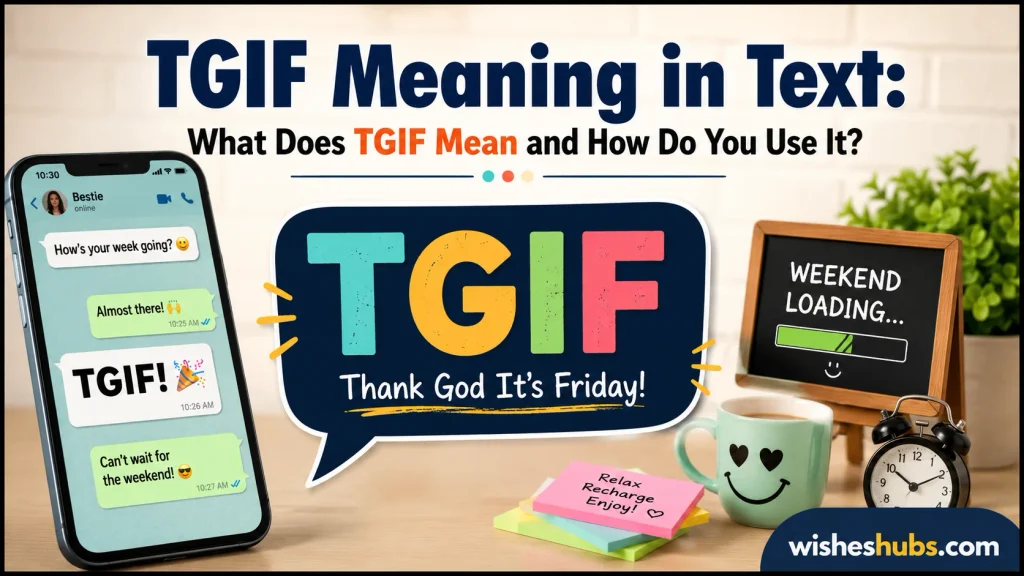
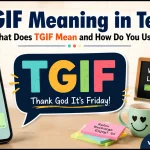
TGIF Meaning in Text is a common question for people who see this abbreviation in chats, social media, or messages. It usually expresses excitement for Friday and the weekend. Understanding this text slang can make online conversations easier and clearer.
When someone types TGIF, they are usually showing relief, happiness, or excitement that the work or school week is ending. The abbreviation stands for Thank God It’s Friday and is widely used in casual communication. You may see it in text messages, social media posts, emails, and online conversations when people welcome the weekend.
The TGIF meaning can sometimes depend on the conversation and the person using it. In most cases, it has a positive and casual tone. People use it to celebrate the end of a busy week, talk about weekend plans, or share their excitement with friends, coworkers, and followers online. Knowing its meaning helps you understand internet slang and everyday digital communication.
If you have recently seen TGIF in a text and wondered what it means, you are not alone. This abbreviation has become a familiar part of modern texting language. In this guide, you will learn the meaning, usage, examples, tone, and context of TGIF, so you can understand when people use it and how you can use it naturally.
Quick Answer: What Does TGIF Mean in Text?
TGIF means Thank God It’s Friday. It is an informal expression people use to show relief, excitement, happiness, or anticipation when Friday arrives.
For example:
- TGIF! I can’t wait to relax tonight.
- TGIF 😭 This week was exhausting.
- TGIF! Are we still going out later?
- Finally, TGIF.
The basic meaning stays the same. However, the emotion can range from cheerful excitement to exhausted relief.
The abbreviation is mainly suited to casual communication. You might send it to a friend, coworker, family member, or group chat. It generally doesn’t belong in a formal business letter or highly professional document.
What Does TGIF Stand For?
TGIF stands for Thank God It’s Friday.
Here’s the breakdown:
| Letter | Word |
| T | Thank |
| G | God |
| I | It’s |
| F | Friday |
The expression refers to the common feeling that Friday marks the end of the traditional work or school week.
There’s also a less religious variation: Thank Goodness It’s Friday. People sometimes use this version when they want to express the same relief without referring to God.
TGIF vs. Thank Goodness It’s Friday
Both versions communicate essentially the same idea.
Thank God It’s Friday is the traditional expansion of TGIF. Thank Goodness It’s Friday provides a secular alternative.
In everyday texting, most people don’t stop to think about the full phrase. TGIF functions as a familiar expression on its own.
What Does TGIF Mean Emotionally?
The literal expansion tells only part of the story.
When someone writes TGIF, they’re usually expressing a feeling connected to reaching Friday. That feeling could be excitement, relief, exhaustion, or even humor.
Consider these examples:
| Text | Likely emotion |
| TGIF! 🎉 | Excitement |
| TGIF! | Happiness or relief |
| TGIF 😭 | Exhaustion mixed with relief |
| TGIF… | Weariness |
| TGIF 😂 | Humorous relief |
| Finally. TGIF. | Strong relief |
The surrounding words matter.
For example, TGIF! Let’s celebrate sounds energetic. Meanwhile, TGIF. I need eight hours of sleep sounds tired but relieved.
That subtle difference makes texting interesting. The acronym doesn’t change. The context does.
Why Do People Say TGIF on Friday?
Friday holds a special place in the traditional Monday-to-Friday schedule. For many workers and students, it signals that the regular weekday routine is coming to an end.
That’s where TGIF comes in.
After five days of meetings, assignments, deadlines, commutes, classes, and early alarms, Friday can feel like reaching the finish line.
You might see someone send:
TGIF! We made it.
They aren’t simply announcing that it’s Friday. They’re celebrating the transition from the workweek to the weekend.
The phrase also works because it’s incredibly compact. Instead of writing I’m so relieved that the workweek is finally over, someone can simply type TGIF.
Four letters do the heavy lifting.
How Is TGIF Used in Text Messages?
TGIF meaning in text becomes clearer when you look at the different ways people place the abbreviation in messages.
TGIF as a Standalone Message
Sometimes the entire message is just:
TGIF!
That’s enough when the context is obvious.
The sender assumes you understand the shared feeling. They might have just finished work or noticed that Friday has arrived.
TGIF at the Beginning of a Message
This format often introduces a conversation about weekend plans.
TGIF! What are you doing tonight?
TGIF! Are you free this weekend?
TGIF! I need a break.
Here, TGIF sets the mood before the main point.
TGIF With an Emoji
Emojis can make the emotional meaning even clearer.
- TGIF 🎉 — celebration
- TGIF 🙌 — excitement or relief
- TGIF 😭 — exhausted relief
- TGIF 😂 — humorous frustration
- TGIF 😎 — relaxed weekend mood
The emoji doesn’t create the meaning. Instead, it adds emotional color.
TGIF With Punctuation
Punctuation can also change the feel.
TGIF! sounds upbeat.
TGIF… may sound tired or sarcastic.
TGIF?! can suggest disbelief that Friday finally arrived.
Tiny details can change the personality of a short message.
TGIF Meaning in Different Conversations
The TGIF meaning in text stays consistent across conversations. Its tone can shift depending on who sends it and why.
TGIF With Friends
Friends commonly use TGIF to celebrate the weekend.
TGIF! Pizza and a movie tonight?
This sounds casual and upbeat. The sender isn’t making a formal announcement. They’re opening the door to weekend conversation.
TGIF With Coworkers
Coworkers may use TGIF after a particularly busy week.
TGIF! That deadline nearly finished me.
This kind of message is informal. It works best among colleagues who already communicate casually.
TGIF With Family
Family members can use TGIF when they look forward to spending time together.
TGIF! Can’t wait for our family dinner tonight.
The expression adds a cheerful tone without requiring a long explanation.
TGIF in Group Chats
Group chats often turn TGIF into a conversation starter.
TGIF! Who’s doing something tonight?
One short message can quickly lead to plans.
TGIF on Social Media
People frequently use TGIF in captions and posts about Friday activities.
Examples include:
- TGIF! Weekend mode activated.
- TGIF 🎉
- TGIF. Time for some much-needed rest.
- TGIF! Ready for the weekend.
Is TGIF Always Positive?
Not necessarily.
Although TGIF usually expresses positive feelings, people also use it to communicate fatigue, frustration, or sarcasm.
Imagine someone has spent the entire week dealing with difficult deadlines. On Friday evening, they send:
TGIF 😭
The message isn’t pure excitement. It’s closer to Thank goodness this week is finally over.
Likewise:
TGIF… I need coffee.
The three dots make the message feel more drained than celebratory.
The Same Acronym Can Carry Different Moods
Think of TGIF as a blank canvas. The words around it paint the emotion.
- TGIF! Beach tomorrow! → excited
- TGIF 😭 I’m completely exhausted. → relieved but tired
- TGIF 😂 What a week. → humorous
- TGIF… → weary
- TGIF! Let’s go! → energetic
That’s why interpreting slang requires more than expanding the acronym.
How to Reply When Someone Texts TGIF
If someone sends you TGIF, your response depends on the relationship and the mood.
Friendly TGIF Replies
For an ordinary conversation, keep things simple:
- Absolutely!
- I know, right?
- Finally!
- We made it!
- Couldn’t agree more.
- Happy Friday!
Excited Replies to TGIF
If they’re clearly celebrating:
- TGIF! What’s the plan?
- Yes! Weekend starts now.
- Let’s make the most of it!
- Finally! I’m ready for the weekend.
Funny Replies to TGIF
A little humor can make the exchange more natural:
- We survived another week.
- My weekend battery is loading.
- Friday showed up right on time.
- Monday feels very far away.
- The inbox can wait.
Casual Workplace Replies
When responding to a coworker, you can stay friendly without sounding too informal:
- Definitely. Have a great weekend!
- Agreed! Hope you have a relaxing weekend.
- Absolutely. Enjoy your weekend!
- We made it. Have a good one!
TGIF Text Examples in Real-Life Situations
Seeing actual examples makes the TGIF meaning in texting much easier to understand.
| Situation | Example text | What it communicates |
| Busy workweek | TGIF! That was a long week. | Relief |
| Weekend plans | TGIF! What are we doing tonight? | Excitement |
| Feeling exhausted | TGIF 😭 I need a nap. | Tired relief |
| Going out | TGIF! Drinks after work? | Social excitement |
| Staying home | TGIF. I’m not leaving the couch. | Relaxation |
| Coworker chat | TGIF! Great job this week, everyone. | Friendly workplace mood |
| Social media | TGIF 🎉 Weekend officially begins. | Celebration |
| Humor | TGIF. My brain clocked out hours ago. | Playful exhaustion |
Also Read This: TMU Meaning in Texting: What Does TMU Mean in a Text?
Practical Case Study: A Busy Employee
Imagine someone has spent the week handling meetings and deadlines. On Friday afternoon, they text a coworker:
TGIF! I’m ready to shut the laptop.
The sender isn’t merely identifying the day. They’re communicating relief after a demanding week.
Now imagine the same person texts:
TGIF! Dinner tonight?
The emotional focus changes. This version emphasizes anticipation for weekend plans.
The acronym remains identical. Context does the rest.
TGIF Meaning on Social Media
Social media gives TGIF another useful role: the quick Friday caption.
A person doesn’t need to explain why they’re happy. The audience already understands the cultural association with Friday and the weekend.
Common uses include:
Friday Food Posts
TGIF! Pizza night is officially here. 🍕
Travel Posts
TGIF! Time to hit the road.
Night-Out Posts
TGIF! Who’s ready for tonight?
Relaxation Posts
TGIF. Nothing but coffee and a quiet evening.
Weekend Celebrations
TGIF 🎉 Let the weekend begin!
The abbreviation works particularly well when the image already communicates the context.
TGIF vs. Other Friday Expressions
TGIF isn’t the only way to celebrate Friday.
| Expression | Meaning | Typical tone |
| TGIF | Thank God It’s Friday | Casual and expressive |
| Happy Friday | A friendly Friday greeting | Warm and positive |
| Finally Friday | Relief that Friday arrived | Casual |
| Friday vibes | A Friday-related mood | Playful |
| Weekend is here | The weekend has arrived | Straightforward |
| Have a great weekend | A weekend wish | Friendly and polite |
When Should You Use TGIF?
Use TGIF when you want to sound relaxed and conversational.
Use Happy Friday when you want something slightly more neutral.
Use Have a great weekend when you’re wrapping up a conversation and want a friendly sign-off.
For formal communication, a complete phrase usually works better than slang.
Is TGIF Appropriate for Work Texts?
Yes, TGIF can work in casual workplace conversations.
If coworkers regularly use informal language in Slack, Teams, text messages, or group chats, TGIF usually won’t seem unusual.
For example:
TGIF, everyone! Hope you have a great weekend.
That sounds friendly and harmless in a relaxed team environment.
However, context matters.
A formal email to a client probably isn’t the place for TGIF. A professional message such as Have a great weekend sounds more polished.
A Simple Rule
Casual audience → TGIF can work.
Formal audience → Use a complete phrase.
The distinction isn’t about grammar. It’s about register, which means the level of formality appropriate for a particular situation.
Does TGIF Mean Something Else?
In ordinary texting, TGIF almost always means Thank God It’s Friday.
However, abbreviations can have different meanings in specialized industries, organizations, or technical settings. Context therefore matters when the conversation doesn’t involve Friday or the weekend.
For everyday texting, though, there’s usually little mystery.
If someone writes:
TGIF!
on Friday afternoon, they’re almost certainly expressing happiness or relief that Friday has arrived.
That makes the everyday meaning far more important than obscure alternative interpretations.
Where Did TGIF Come From?
The phrase Thank God It’s Friday predates modern texting by decades.
That history matters because TGIF isn’t a product of texting culture. Texting simply gave the abbreviation a faster and more convenient home.
People already used the spoken expression to celebrate Friday. Once abbreviations became common in informal communication, TGIF naturally fit the pattern.
TGIF and TGI Fridays
The restaurant chain TGI Fridays is closely associated with the phrase.
Its name deliberately uses the same familiar wording, which helped reinforce the expression in popular culture. However, the restaurant didn’t invent the phrase itself.
That distinction is worth remembering. The expression existed before the restaurant brand.
TGIF in Popular Culture
TGIF became more than an everyday expression because popular culture adopted it in several ways.
TGI Fridays
The restaurant brand turned the phrase into a recognizable commercial name. Its branding helped make the expression familiar to generations of customers.
ABC’s TGIF Programming Block
ABC also used TGIF as the name of a Friday-night television programming block.
The lineup became particularly associated with family-oriented sitcoms during the 1990s. ABC even played with the abbreviation by using the phrase Thank Goodness It’s Funny for promotional purposes.
This cultural history explains why TGIF can feel familiar even to people who rarely use abbreviations in text.
Common Mistakes People Make With TGIF
Although TGIF is simple, people can still misunderstand how it works.
Mistake: Treating TGIF as a Formal Expression
TGIF is casual slang. It fits texts, social media, and relaxed conversations much better than formal documents.
Mistake: Assuming TGIF Always Means Excitement
Sometimes it communicates exhaustion.
TGIF 😭
can mean, essentially, I’m exhausted and so glad this week is over.
Mistake: Ignoring the Context
If someone writes TGIF! Are you ready?, they may be talking about weekend plans.
If they write TGIF… I can’t keep my eyes open, they’re expressing fatigue.
Mistake: Assuming TGIF Signals Romantic Interest
TGIF doesn’t inherently communicate flirting or attraction.
If someone you like sends TGIF!, the acronym alone doesn’t prove romantic interest. Look at the broader conversation, their wording, and the plans they’re suggesting.
TGIF Meaning in Text: More Examples
Here are natural examples you might actually encounter:
- TGIF!
- TGIF! We made it.
- TGIF! Any plans tonight?
- TGIF 😎
- TGIF! I’m ready for the weekend.
- Finally Friday. TGIF!
- TGIF 😭 This week was brutal.
- TGIF 😂 I barely survived Monday.
- TGIF! Dinner after work?
- TGIF. I’m staying home tonight.
- TGIF! Hope everyone has a great weekend.
- TGIF… I need a serious nap.
Notice how the basic meaning remains stable while the emotional tone changes.
That’s the key to understanding slang. Don’t interpret the abbreviation in isolation. Read the whole message.
What Does TGIF Mean From a Girl or Guy?
If a girl or guy sends you TGIF, the acronym itself doesn’t have a special romantic meaning.
It usually means exactly what it means from anyone else:
Thank God It’s Friday.
The surrounding conversation matters much more.
For example:
TGIF! Want to grab dinner tonight?
could indicate an invitation to spend time together. Yet the romantic meaning comes from the invitation and relationship context, not from TGIF itself.
Likewise:
TGIF! Have a great weekend!
may simply be a friendly farewell.
Avoid reading too much into four letters.
What Is Another Way to Say TGIF?
If you want to express the same general idea without using TGIF, several alternatives work naturally.
Casual Alternatives
- Finally Friday!
- Happy Friday!
- The weekend is here!
- We made it to Friday!
- Friday is finally here!
- Weekend mode starts now!
- Cheers to the weekend!
More Neutral Alternatives
- Have a great weekend!
- Enjoy your weekend!
- Glad it’s Friday.
- Hope you have a relaxing weekend.
Each option has a slightly different flavor. Finally Friday emphasizes relief. Happy Friday sounds cheerful. Have a great weekend works in much more professional settings.
FAQs:
What does TGIF mean in text?
TGIF means Thank God It’s Friday. People use this abbreviation in text messages, chats, and social media to show happiness or relief that the work or school week has ended. It usually has a positive, casual, and friendly tone.
Is TGIF a slang word?
Yes, TGIF is commonly considered informal internet slang or an abbreviation. It is mainly used in casual conversations rather than formal writing. Friends, coworkers, and social media users may use TGIF to express excitement about Friday or the upcoming weekend.
What does TGIF stand for?
TGIF stands for Thank God It’s Friday. The phrase expresses relief, happiness, or excitement about reaching Friday after a busy week. Its short form, TGIF, became popular because it is quick and easy to use in digital communication.
When do people use TGIF?
People usually use TGIF on Friday, especially when they are happy that the week is ending. It can appear in texts, captions, comments, and workplace chats. Someone might use it when discussing weekend plans or simply celebrating the arrival of Friday.
Is TGIF positive or negative?
TGIF usually has a positive meaning. It often shows that someone feels happy, relieved, or excited because Friday has arrived. However, the exact tone can depend on the conversation. Most of the time, it is used in a cheerful and relaxed way.
Can I use TGIF in a text message?
Yes, you can use TGIF in a casual text message. It works well when talking with friends, family, or coworkers you know well. For example, you can send TGIF when you want to express excitement about the weekend or relief after a long week.
Is TGIF appropriate for professional communication?
TGIF can be appropriate in informal workplace communication, especially when chatting with friendly coworkers. However, it is better to avoid it in formal emails, official documents, or serious business communication. Always consider your relationship with the reader and the overall tone of the message.
What is an example of TGIF in a text?
A simple example is: TGIF! I’m ready to relax this weekend. Another example is: TGIF! This week felt so long. These examples show how the abbreviation can express relief and excitement in everyday digital conversations.
Does TGIF always mean Thank God It’s Friday?
In everyday texting, TGIF almost always means Thank God It’s Friday. This is the most recognized meaning of the abbreviation. However, abbreviations can sometimes have different meanings in specific contexts, so understanding the conversation and surrounding words is always helpful.
What does TGIF mean on social media?
On social media, TGIF usually means Thank God It’s Friday and expresses excitement about the weekend. People often use it in captions, comments, memes, and posts to share their mood, weekend plans, or happiness about finishing another busy week.
Conclusion:
The TGIF Meaning in Text is simple: it stands for Thank God It’s Friday. People commonly use this abbreviation to express relief, happiness, and excitement when Friday arrives after a long or busy week.
Understanding TGIF can make texting and online conversations easier to follow. It is a casual expression commonly found in messages, social media, workplace chats, and weekend-related conversations. While it is friendly and positive, remember that it is best suited to informal communication rather than formal writing.
Now that you know the meaning, tone, usage, and examples of TGIF, you can easily recognize it when you see it online. Using common texting abbreviations and internet slang correctly can help you communicate naturally and understand what others mean in everyday digital conversations.

“Explore Mark Hill at Wisheshubs.com – your go-to place for best wishes, greetings, and celebrations. Easy, fun, and ready to share!”
1 thought on “TGIF Meaning in Text: What Does TGIF Mean and How Do You Use It?”